Enough: Stop Destroying America’s Historic Inheritance



The United States enters its 250th year with a historical inheritance far younger than those of the world's older civilizations. Two and a half centuries may seem substantial in a nation's life, yet it is remarkably short compared with the histories of Rome, Greece, China, Britain, France, or the civilizations of the Middle East. The buildings, monuments, battlefields, cemeteries, churches, courthouses, statues, bridges, and public spaces that survive from the American past carry significance extending beyond architecture or aesthetics.
They form part of the physical record of the nation.
That record is easily misunderstood. A monument is seldom only an object. As historian Thomas Cauvin argues in A Public History of Monuments, monuments occupy public space while transmitting certain understandings of history, political authority, and collective identity.[1] Their meanings are open to dispute, especially when the values of the generation that erected them no longer correspond with those of the generation that inherits them.
Disagreement, however, does not settle the question of destruction.
Historical interpretation can change. A building can acquire new purposes. A monument can be reinterpreted, supplemented, moved, or placed within a different historical setting. Physical destruction belongs to another category because it removes choices from those who come later.
This distinction should form the starting point for any serious discussion of historic preservation.
Societies have sought to alter the past by altering the objects through which the past remained visible.
The Romans understood the relationship between political authority and public memory remarkably well. What modern historians commonly call damnatio memoriae included sanctions against the memory of disgraced emperors and prominent public figures. Names were cut from inscriptions. Portraits were removed, attacked, stored, destroyed, or recarved into the likenesses of successors.
The term itself requires care. Oxford historian Adrastos Omissi has shown that damnatio memoriae is a modern expression imposed upon a much more varied collection of Roman memory sanctions. His study, Damnatio Memoriae or Creatio Memoriae?, also makes an important point: efforts to erase memory could themselves create new forms of memory.[2] A mutilated portrait or chiseled inscription continued to testify to the person who had been condemned and to the political power that attempted the erasure. The scar became part of the historical record.
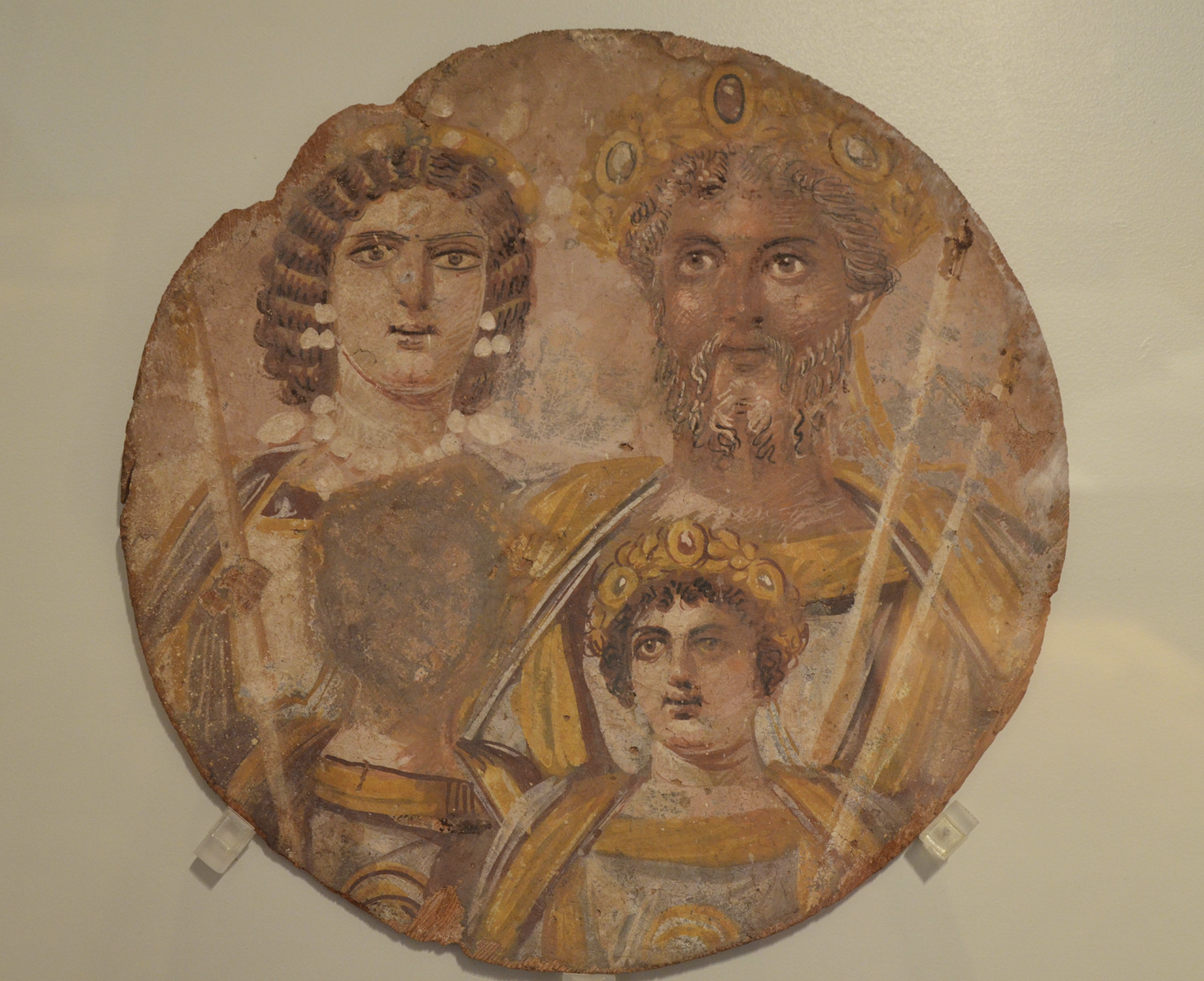
The Severan Tondo, c. AD 200. The face of Geta was deliberately erased after his murder by his brother Caracalla. The damaged portrait survives as evidence of the attempt to alter his public memory.
The Roman experience is useful for precisely this reason. Political communities have long understood that control over public memory can be exercised through control over the physical environment. Yet physical objects often survive changes in interpretation and acquire meanings their makers could never have anticipated.
The English Reformation brought destruction on a much greater architectural scale. Following Henry VIII's dissolution of the monasteries, hundreds of religious institutions were closed and their property transferred. Some buildings survived because they acquired new functions. Others were dismantled for stone, timber, roofing, and lead.
At Bury St Edmunds Abbey, demolition followed the surrender of the monastery in 1539. English Heritage's history of the abbey records that demolition crews systematically dismantled the church and central buildings and that the destruction itself demonstrated royal power.[3] The site subsequently became a quarry for local construction.
The ruins are protected today.
That reversal should introduce some humility into modern judgments about inherited places. A structure considered politically inconvenient, economically obsolete, or culturally expendable by one generation may become an irreplaceable part of the inheritance of another.
The French Revolution provides an equally revealing example. In January 1793, the Commune of Paris ordered statues of kings on the Cathedral of Notre-Dame destroyed. The figures were attacked as representations of French monarchy. They were, in fact, biblical kings. The Metropolitan Museum of Art describes the episode as government-sanctioned iconoclasm rather than spontaneous disorder.[4]
The mistake matters. Those responsible believed they understood what the objects represented. Their political interpretation supplied sufficient justification for destruction. Historical knowledge came later.
Destruction of inherited places has also accompanied attempts to construct an entirely new political landscape.
Mussolini's transformation of Rome offers an ominous example. The Fascist government wanted the modern capital to reveal ancient imperial Rome while providing broad avenues suitable for ceremony and political spectacle. The Alessandrino Quarter, a densely inhabited district that had developed over several centuries, stood in the way.
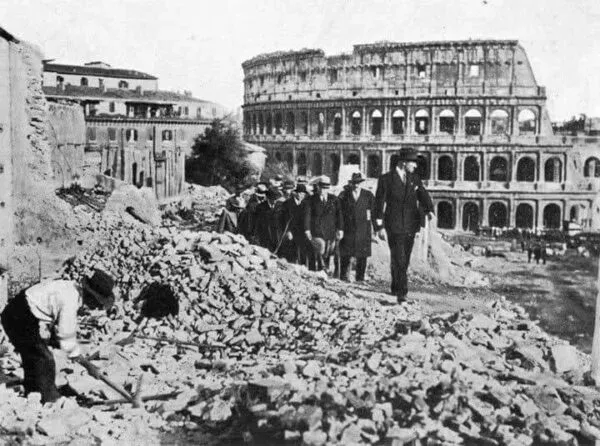
Demolition in central Rome during the creation of the Via dell'Impero, now the Via dei Fori Imperiali, in the early 1930s. Fascist redevelopment removed an older urban landscape to create a monumental route through imperial Rome.
The neighborhood was demolished for the creation of the Via dell'Impero, now the Via dei Fori Imperiali. Archaeological research records that the demolition erased an entire neighborhood, including five churches, and displaced approximately 4,000 inhabitants. Rome's own archaeological authority describes the quarter as having been swept away together with centuries of history, art, and urban life.[5]
The policy was selective rather than indiscriminately hostile to history. Ancient Rome was valued intensely. Medieval, Renaissance, and working-class Rome carried less importance because those layers did not serve the political narrative Fascism wanted the city to convey.
This is an important feature of historical destruction. Governments do not always destroy because they reject the past. They may destroy one past in order to elevate another.
The Soviet Union provides a different example. Moscow's Cathedral of Christ the Saviour was demolished under Stalin in 1931. The site was intended for the enormous Palace of Soviets. That structure was never completed. After the Soviet Union collapsed, the cathedral was reconstructed. The Library of Congress records the destruction of the original cathedral in its photographic history of post-Soviet Russia.[6]
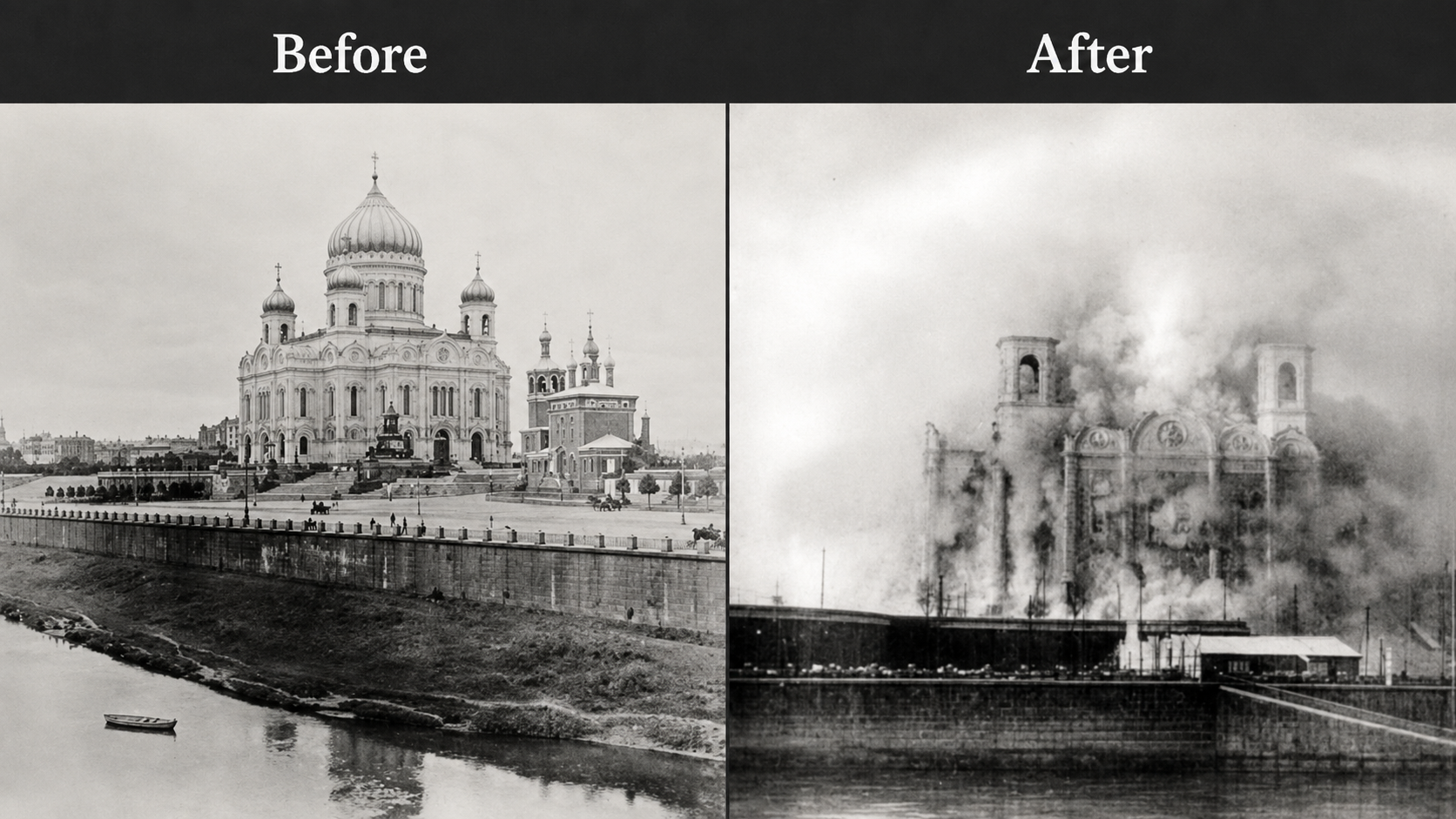
The demolition of Moscow's Cathedral of Christ the Saviour in 1931. Stalin's government intended the site for the Palace of Soviets, which was never completed. The cathedral was eventually reconstructed after the collapse of the Soviet Union. The cathedral as it looked in the early 20th century (left); Its demolition in December 1931 (right)
The reconstructed cathedral recovered the appearance and function of the building.
It could not recover the original building.
Nazi Germany likewise understood architecture as an expression of political authority. Richard J. Evans, in The Third Reich in Power, describes Hitler and Albert Speer's ambitions for the reconstruction of Berlin. Existing houses and apartment buildings were bulldozed as preparations began for monumental boulevards and buildings intended for the projected new capital. Evans emphasizes the immense scale of the plans rather than presenting monumental classicism itself as uniquely Nazi.[7]
Official Berlin historical material confirms that planning for the National Socialist reconstruction of the capital began under Speer in 1937 and envisaged a fundamental transformation of the city center.[8]
Mao's Cultural Revolution provides another example. During its early stages in 1966 and 1967, Red Guards attacked what were known as the "Four Olds." A Library of Congress country study records the destruction of temples, statues, and ancestral tablets during this campaign.[9]
The revolutionary objective was directed toward the future. Yet portions of China's inherited cultural record became vulnerable because they were judged through the political requirements of the present.
These cases are not morally or politically equivalent. Historical comparison becomes useless when differences of circumstance are erased.
The recurring feature is narrower. Political power has recognized that the built environment influences how people understand the society they inhabit and the history from which it emerged.
Modern scholarship has described the broader problem as one of urban memory. Sebla Arın Ensarioğlu's study of urbicide and cultural sustainability argues that the selective destruction of urban layers can narrow a city's historical narrative and weaken the continuity through which communities understand place.[10] Cities accumulate history rather than acquiring it at a single moment. Their character emerges from layers. Removing those layers selectively can produce a cleaner political narrative at the expense of a more complicated historical one.
The Buddhas of Bamiyan provide perhaps the clearest modern demonstration of the finality involved.
For roughly fifteen centuries, two monumental standing Buddhas occupied niches in the cliffs of Afghanistan's Bamiyan Valley. They survived changes of dynasty, religion, government, and political order.
Once it is gone, it is gone.
In March 2001, the Taliban destroyed them.
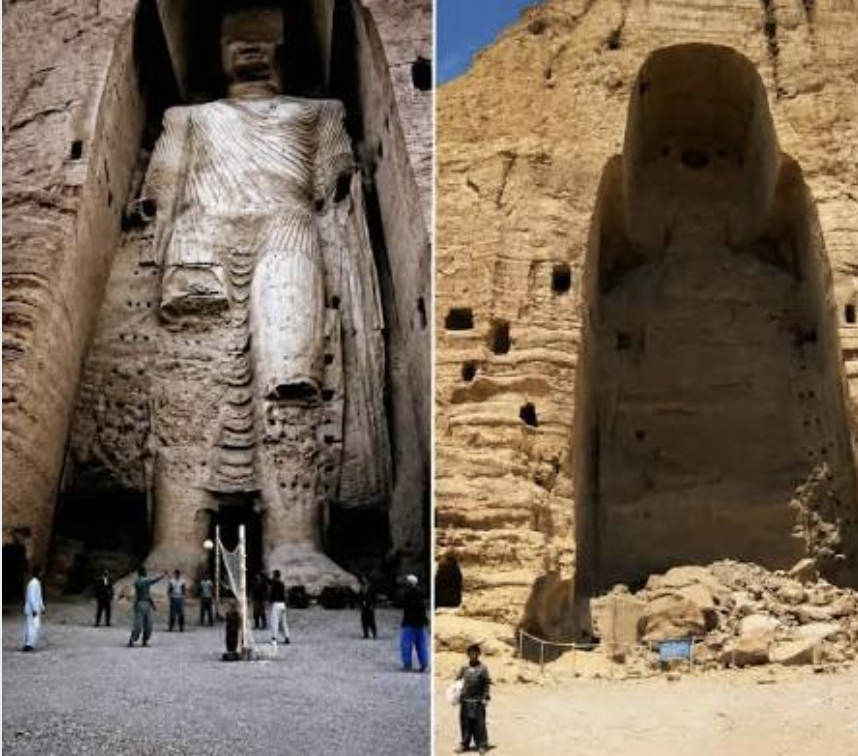
The larger Buddha of Bamiyan before and after its destruction by the Taliban in March 2001. The monumental sculptures had stood in Afghanistan's Bamiyan Valley for approximately fifteen centuries.
UNESCO's documentation of the Bamiyan Valley records the use of explosives and the resulting damage to the niches, murals, and archaeological remains.[11] UNESCO described the loss as irreversible.
The world possesses photographs. Archaeologists possess measurements, drawings, fragments, and records. The enormous niches remain.
The Buddhas do not.
The distinction between documentation and survival deserves more attention than it generally receives. A digital reconstruction may be exact. A replica may reproduce dimensions, colors, and outward appearance. Neither possesses the material continuity of an object that endured through the lives of successive generations.
Research on museums and architectural destruction in conflict reaches a similar conclusion. Reyhan Sabri, Danah AlGhareeb, and Noora Alkhaja describe the destruction of museums and their collections as producing losses in cultural identity and memory that reconstruction can never completely reverse.[12]
This is the point at which preservation becomes something more than architectural preference.
It becomes stewardship.
The United States has already learned this lesson through its own destruction.
The original Pennsylvania Station in New York was demolished between 1963 and 1966. Its loss became one of the most consequential events in the history of American preservation.
What one generation destroys, another can only regret.
The National Park Service's history of the National Historic Preservation Act records that Penn Station's destruction became a catalyst for New York City's Landmarks Law. More broadly, the urban renewal period resulted in the loss of entire blocks, neighborhoods, and historic districts throughout American cities.
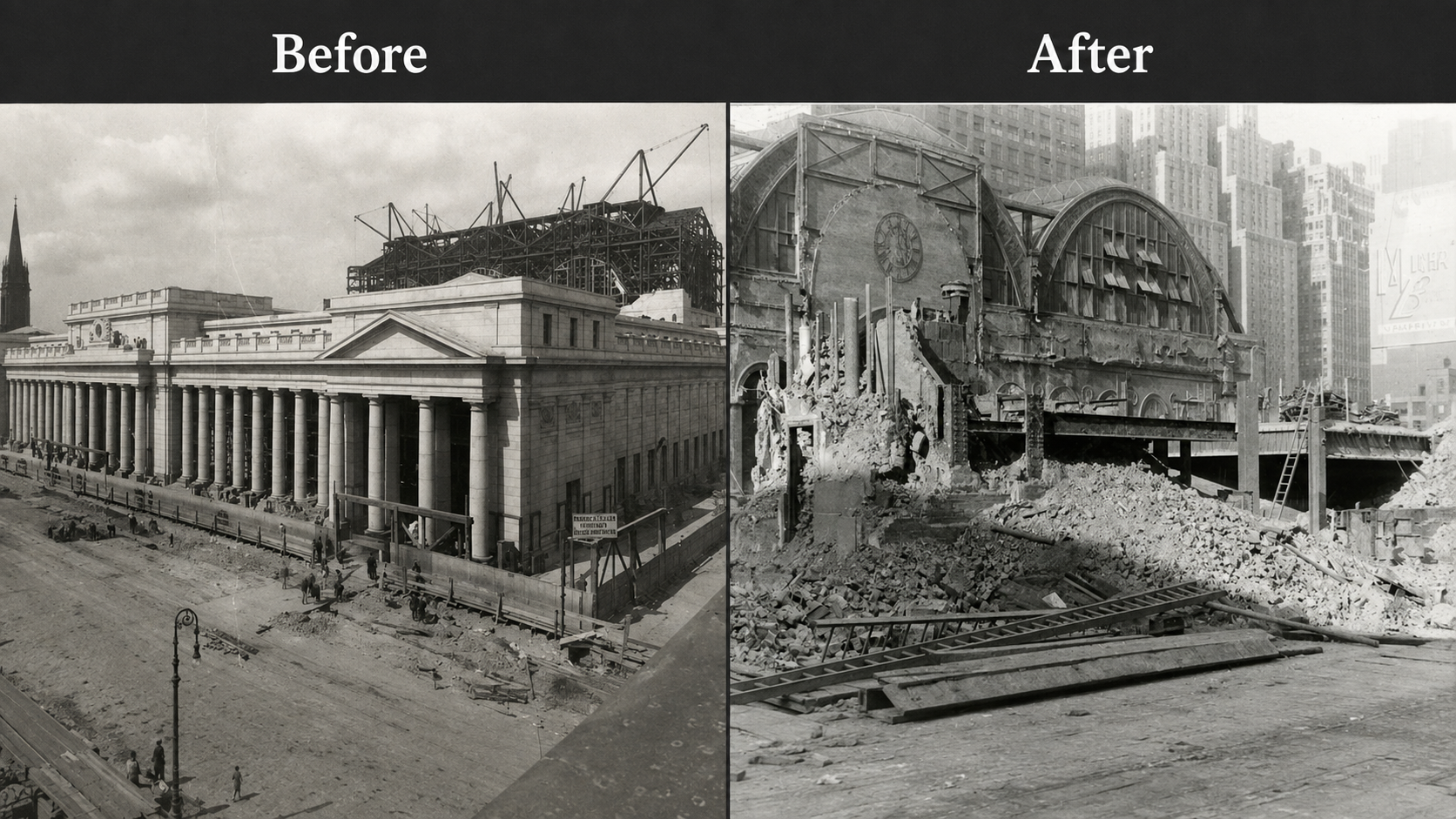
The demolition of the original Pennsylvania Station in New York, begun in 1963. Public reaction to its loss became an important catalyst for the modern American historic-preservation movement.
The national response was the National Historic Preservation Act of 1966.
The language of that law is worth remembering. Congress declared that the nation's historical and cultural foundations should be preserved as a living part of community life and that preservation of this "irreplaceable heritage" was in the public interest for future generations.[13]
Jess R. Phelps, reviewing the Act fifty years later, concluded that it fundamentally transformed historic preservation at the federal level while preservation practice itself became increasingly inclusive.[14]
That evolution matters. Preservation need not mean preserving only the history earlier generations chose to honor. The answer to an incomplete historical landscape is often to make it more complete.
This is especially evident when Native American understandings of place are considered. Michael Spears, Kurt Dongoske, Octavius Seowtewa, Maren Hopkins, and T. J. Ferguson describe Zuni historical sites as "memory pieces" through which culture, history, ancestry, and continuing relationships with place are maintained.[15] Their work broadens preservation beyond the conventional Western idea of an old building preserved because of architectural significance. Places can carry historical continuity because communities remain connected to them.
The concept of stewardship consequently extends beyond ownership.
Sam W. Gieryn's analysis of federal historic preservation law is useful here. In Federal Historic Preservation's "Place" in Property Theory, he examines the principle that historic structures can possess public value beyond the immediate economic choices of their present owners.[16]
That principle reaches the heart of the preservation question. Those living at a moment inherit historic places, but they are not necessarily the final people for whom those places will possess meaning. That principle is no longer merely historical. It is being tested in Washington today.
The question is no longer confined to buildings lost in an earlier age.
In October 2025, demolition began on the White House East Wing to make way for a new ballroom. The East Wing itself had evolved considerably over time. Its modern form was largely the product of twentieth-century additions and alterations, and the White House has never been a static building. Presidents from Thomas Jefferson to Harry Truman altered the Executive Mansion in response to changing practical, political, and ceremonial requirements. That history should caution against treating every architectural change as an act of historical destruction. The White House has survived in part because it has adapted.[17]
Yet adaptation and removal are different questions.
Before the East Wing was demolished, the White House Historical Association undertook comprehensive digital scanning and photography intended to preserve a historical record of the building and the Jacqueline Kennedy Garden. Historic artifacts were removed and preserved. The effort was responsible and important. It also illustrates the limitation discussed throughout this essay. Documentation can preserve information about a place. It cannot preserve the place itself.[18]
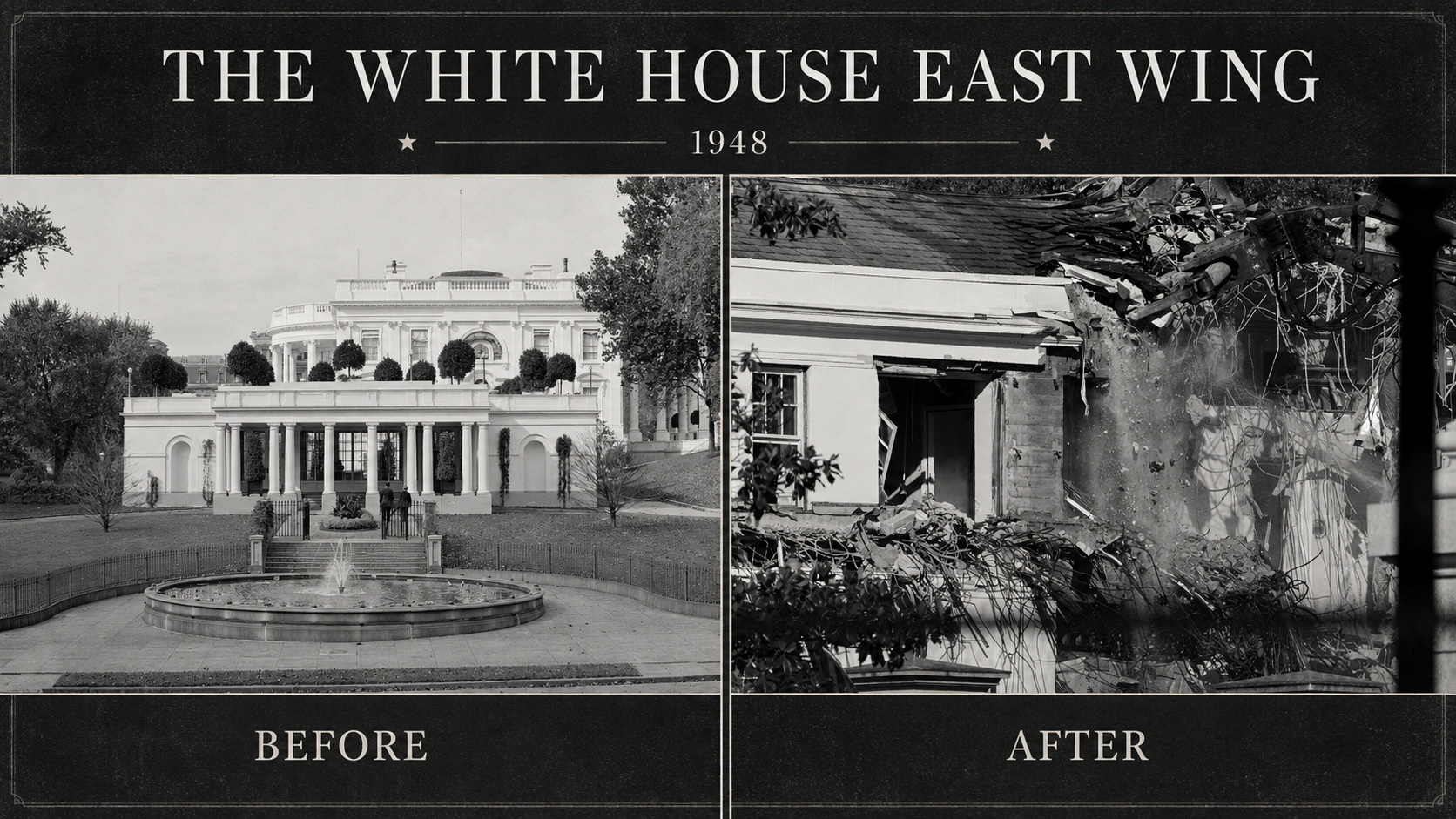
The White House East Wing before and during its demolition in 2025. The building was photographed and digitally documented before removal, preserving a record of its form and history. Documentation, however, is not preservation: the record remains, while the structure itself does not.
The East Wing raises a question extending beyond the merits of any certain ballroom. What obligation does one administration, institution, owner, or generation have toward structures that have acquired historical significance beyond their immediate function? The relevant issue is not whether buildings can ever change. Clearly they must. It is whether irreversible alteration of a nationally important place should require a correspondingly high standard of historical review, public justification, and institutional stewardship.
Only a short distance away, another nationally significant building presents a different problem: there is still time to decide.
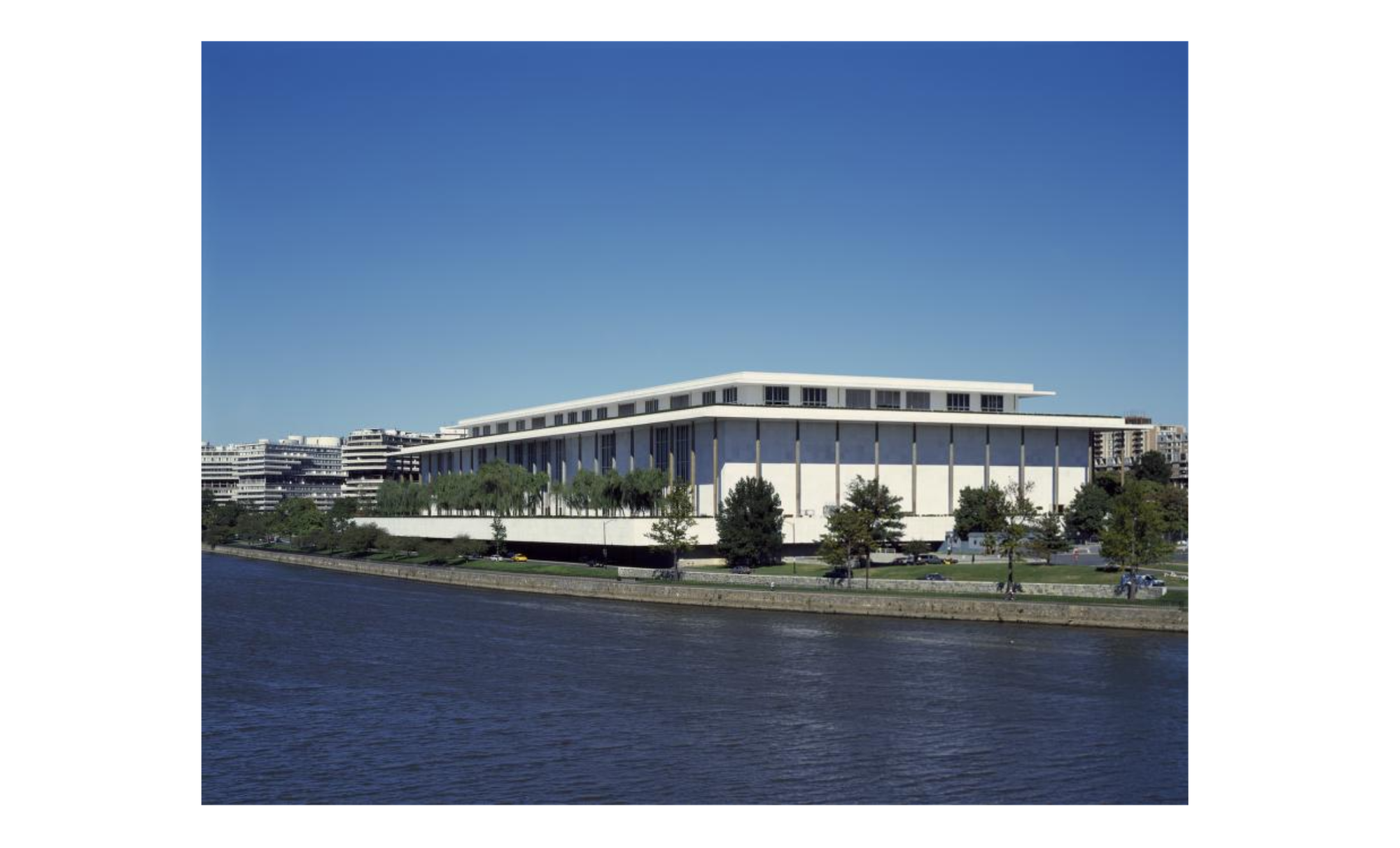
The John F. Kennedy Center for the Performing Arts, Washington, D.C. Established by Congress as the National Cultural Center in 1958 and designated a living memorial to President John F. Kennedy in 1964, the building opened in 1971. Photograph: Carol M. Highsmith, Library of Congress, Prints and Photographs Division.
The John F. Kennedy Center for the Performing Arts was established by Congress as the national cultural center and subsequently designated as a living memorial to President Kennedy. In August 2026, Justice Department lawyers stated in a federal court filing that the building could eventually face demolition if critical repairs were not undertaken. That statement should not be confused with an approved demolition plan. No such decision has been made. Earlier representations by the administration indicated that the existing structure would be renovated rather than subjected to wholesale demolition. Yet the fact that demolition has entered the official discussion makes the preservation question immediate rather than theoretical.[19]
What, then, should be done with the Kennedy Center?
That question should be answered before the building deteriorates to the point at which circumstances answer it for us.
Demolition settles what history can no longer answer.
The Kennedy Center need not remain unchanged. Few important buildings do. Its systems can be repaired. Its interiors can be modernized. Its uses may evolve. Its architecture can be criticized, and future generations may judge its aesthetic merits differently from those who commissioned and built it.
But demolition would settle all of those questions permanently.
The lesson of Penn Station was that a society can recognize the historical significance of a building only after the machinery has arrived. The lesson of the East Wing is that even careful documentation cannot substitute for the physical object once it has disappeared. The Kennedy Center offers an opportunity to approach the problem in a different order: to determine what should be preserved before deciding what can be removed.
That is what stewardship requires. The harder question arises when the object itself has become politically contested.
The strongest case for preservation should acknowledge why monuments become contested.
Recent scholarship on what Sybille Frank and Mirjana Ristić call urban fallism treats the removal or transformation of monuments as a form of political engagement. Monuments may embody histories of exclusion, colonialism, racial hierarchy, or political repression. For communities that associate them with those histories, continued placement in a position of civic honor may itself carry political meaning.[20]
That argument deserves serious consideration.
But it does not resolve the question of destruction.
A democratic society can decide that a person should no longer occupy a place of civic honor without deciding that the historical artifact associated with that person must cease to exist. Removal from a courthouse lawn, destruction with a hammer, relocation to a museum, placement in a historical park, and retention with expanded interpretation are different acts with different consequences.
Christine Yeats makes this distinction well in Should They Stay or Should They Go? Contested Statues. Her argument does not provide a universal answer for every contested monument. It instead emphasizes historical context and warns that removal from public view should not result in erasure of the history embodied by the object.[21]
New scholarship on monument removal continues to demonstrate why these disputes become so intense. Elīna Troščenko's 2026 study of Latvia's Victory Monument shows how monuments can accumulate layers of political meaning until they become focal points for broader arguments over historical injustice, sovereignty, identity, and the future.[22]
That is precisely why destruction should require caution.
Political intensity is evidence that the object carries historical meaning. It is not necessarily evidence that the object has ceased to possess historical value.
The presumption should be preservation.
This does not mean that every monument must remain forever in its original position. It does not require communities to continue honoring people whom they no longer believe deserve public honor. Nor does it prevent cities from changing. Buildings become unsafe. Infrastructure must be built. Communities require housing, transportation, schools, and development.
Historic preservation has always had to operate within these realities.
But historically significant buildings, monuments, archaeological sites, and cultural objects occupy a different category because the consequences of their destruction extend beyond the immediate decision.
Viktoriya Sukovata's study of monument demolition describes periods in which societies undergo radical changes in their relationship with the past and seek to give those changes material expression through the destruction of memorial objects.[23] The phenomenon recurs throughout history because monuments are capable of carrying memory across political generations.
This makes restraint important in a democracy.
Context can be added. Plaques can be rewritten. New monuments can be commissioned. A statue can be relocated. Museums can preserve objects while explaining why they became controversial. Historic buildings can be adapted to contemporary purposes. Public spaces can accommodate competing accounts of the past rather than a single official account.
Destruction closes those possibilities.
Once a historic building is gone, something more than brick, stone, timber, or ornament disappears with it. Its craftsmanship is lost. Its beauty is lost. The accumulated memory of the place, the people who passed through it, and the events it witnessed is broken. A reconstruction may reproduce the dimensions and appearance of a structure, but it cannot recreate its age, its material continuity, or its place within the lived history of a community.
The destruction of historic buildings and monuments is about more than architecture. These places are often among the most visible expressions of a larger inheritance: the institutions, customs, achievements, failures, values, and memories through which a people understands itself. When that inheritance is treated as disposable, the loss cannot be measured solely in stone, bronze, timber, or marble.
A nation that ceases to value its inheritance eventually ceases to understand why that inheritance was worth preserving.
A society reveals something about itself by what it chooses to preserve. It also reveals something by what it is willing to destroy.
The danger is not that every demolished building signals the collapse of a civilization. Cities must change, buildings sometimes fail, and public spaces cannot remain frozen indefinitely. The danger arises when destruction becomes habitual—when preservation is treated as an obstacle, historical continuity as sentimentality, and the inherited physical record as something the present generation is entitled to erase whenever it becomes inconvenient.
At some point, the United States must ask how much of its physical inheritance it is prepared to lose. Two hundred and fifty years may be a short span beside the histories of older civilizations, but it is our history nonetheless. Its relative youth should make what survives more precious, not less. Buildings and monuments that have endured for generations should not be treated as expendable merely because present needs, tastes, or judgments have changed.
Americans should reject the assumption that this inheritance is disposable. The physical inheritance of the United States does not belong exclusively to one administration, one political movement, one property owner, or even one generation. We hold it for a time. Others will inherit what we leave behind.
The question is whether we intend to leave them an inheritance, or merely photographs of one.
Americans living in 2026 cannot know what Americans living in 2126 will want to understand about the nineteenth or twentieth centuries. Future historians will ask questions we have not considered. Future communities will interpret places differently. Objects considered embarrassing or unfashionable today may become indispensable evidence for understanding how earlier Americans thought, governed, worshipped, worked, fought, discriminated, created, failed, and changed.
The question is larger than whether the present generation likes one monument over another monument.
It concerns whether we regard ourselves as owners of the past or stewards of what has reached us from it.
The historical record—from Rome and Reformation England to revolutionary France, Fascist Italy, the Soviet Union, Nazi Germany, Maoist China, Bamiyan, and America's own era of urban renewal—shows how frequently societies have underestimated the future value of what they were destroying.
We can argue about history. We should.
We can revise its interpretation, recover neglected voices, challenge inherited assumptions, and reconsider whom the nation chooses to honor.
None of that requires us to destroy the evidence.
A mature society should be capable of preserving an object without endorsing everything it represents. Indeed, the willingness to preserve difficult history may be one measure of historical confidence. It permits future generations to encounter the evidence themselves rather than merely inherit our description of what once stood there.
Preservation is an act of restraint exercised on behalf of people who cannot yet participate in the decision.
What we inherit belongs to the past.
What we choose to leave standing belongs, in part, to the future.
1. Thomas Cauvin, "A Public History of Monuments," Studies on National Movements 10, no. 1 (2022): 7–43. Cauvin examines monuments as forms of public history operating within political and social space.
University of Luxembourg research record and open-access article.
2. Adrastos Omissi, "Damnatio Memoriae or Creatio Memoriae? Memory Sanctions as Creative Processes in the Fourth Century AD," The Cambridge Classical Journal 62 (2016): 170–199. See also Rosemarie Trentinella, "Roman Portrait Sculpture: Republican through Constantinian," Metropolitan Museum of Art. Omissi cautions against treating Roman memory sanctions as simple erasure and shows their capacity to generate new historical memory.
Cambridge University Press open-access paper; Metropolitan Museum of Art discussion of Roman portrait destruction and reuse.
3. English Heritage, "History of Bury St Edmunds Abbey." The abbey was surrendered in November 1539; demolition crews subsequently dismantled the church and central buildings.
English Heritage: Bury St Edmunds Abbey.
4. Wendy A. Stein and Charles T. Little, "The Face in Medieval Sculpture," Metropolitan Museum of Art, 2006. The authors discuss the January 1793 decree ordering destruction of the royal figures on Notre-Dame and the wider phenomenon of government-sanctioned iconoclasm during the French Revolution.
The Metropolitan Museum of Art.
5. See "Practicing Urban Archaeology in a Modern City: The Alessandrino Quarter of Rome," Journal of Field Archaeology, and the Sovrintendenza Capitolina's account of the destruction of the Quartiere Alessandrino. The redevelopment erased the neighborhood and several churches and displaced thousands of inhabitants.
Rome's archaeological authority: destruction of the Alessandrino Quarter.
6. Library of Congress, Russian Photographs, 1992–2002: Reflections. The original Cathedral of Christ the Saviour was demolished under Stalin in 1931 and later reconstructed following the Soviet period.
Library of Congress exhibition.
7. Richard J. Evans, The Third Reich in Power, 1933–1939 (New York: Penguin, 2005/2006), discussion of Nazi architecture and the reconstruction of Berlin. Evans records evictions and the bulldozing of houses and apartment blocks for the projected boulevards and emphasizes the extraordinary scale of Nazi monumental planning.
8. Landeszentrale für politische Bildung Berlin, Metropole Berlin—Traum und Realität 1920–2020. The publication records the beginning of plans in 1937 under Albert Speer for the extensive National Socialist transformation of central Berlin.
Official Berlin publication on metropolitan development.
9. Library of Congress, China: A Country Study. The study records the destruction of temples, statues, and ancestral tablets during the early Cultural Revolution as part of the campaign against the "Four Olds."
10. Sebla Arın Ensarioğlu, "A Threat to Cultural Sustainability: Urbicide," Space and Culture (2025). Ensarioğlu argues that selective destruction of layers of the built environment can erode urban memory and cultural continuity.
SAGE Journals article.
11. UNESCO World Heritage Centre, documentation concerning the Cultural Landscape and Archaeological Remains of the Bamiyan Valley. UNESCO records the destruction of the monumental Buddhas in March 2001 and describes the loss as irreversible.
UNESCO Bamiyan documentation.
12. Reyhan Sabri, Danah AlGhareeb, and Noora Alkhaja, "Museums and Museumification in Post-Conflict Contexts: Revisiting the Shaping of Architectural Reconstruction Strategies," The Historic Environment: Policy & Practice 14, no. 2 (2023): 236–258. The authors examine the irreversible cultural and memory losses associated with the destruction of museums and heritage in conflict.
Taylor & Francis article.
13. National Historic Preservation Act of 1966, now codified principally in Title 54 of the United States Code. Congress explicitly identified historic heritage as a public interest to be maintained for future generations.
National Park Service compilation of federal historic preservation law.
14. Jess R. Phelps, "The National Historic Preservation Act at Fifty: Surveying the Forest Service Experience," Environmental Law 47, no. 2 (2017): 471–518.
Lewis & Clark Law School article record.
15. Michael C. Spears, Kurt E. Dongoske, Octavius Seowtewa, Maren P. Hopkins, and T. J. Ferguson, "Zuni Perspectives on Historic Preservation," Human Organization 83, no. 1 (2024): 31–42. The authors describe Zuni historical places as "memory pieces" connected to continuing cultural practice, ancestry, and stewardship.
Taylor & Francis open-access article.
16. Sam W. Gieryn, "Federal Historic Preservation's 'Place' in Property Theory," Pace Environmental Law Review 39 (2022): 56. Gieryn examines the public benefit attributed to historic structures and the relationship between preservation and obligations extending beyond unrestricted property use.
Pace University Digital Commons.
17. White House Historical Association, “East Wing Fact Sheet” and Stewart McLaurin, “An Ever-Changing White House.” The East Wing developed through several stages, including Thomas Jefferson’s early nineteenth-century colonnade, Theodore Roosevelt’s 1902 East Wing, and Franklin D. Roosevelt’s 1942 expansion. The Association records that demolition of the East Wing for the new ballroom began on October 20, 2025. Its broader history of the White House documents the repeated alteration and adaptation of the Executive Mansion under successive presidents.
White House Historical Association: East Wing Fact Sheet; White House Historical Association: An Ever-Changing White House.
18. White House Historical Association, “White House Historical Association Statement on October 22, 2025.” Following announcement of the ballroom project, the Association supported comprehensive digital scanning and photography of the East Wing and Jacqueline Kennedy Garden to create a historical record. It also reported that historic artifacts from the East Wing had been preserved and stored.
White House Historical Association statement, October 22, 2025.
19. John F. Kennedy Center for the Performing Arts, 2025 Fiscal Year Budget Justification to Congress; Mike Scarcella, “Trump Administration Defends Kennedy Center Renaming Plan, Warns of Demolition Risk,” Reuters, August 25, 2026. The National Cultural Center was established by Congress in 1958 and designated a living memorial to President John F. Kennedy in 1964; construction began in 1966 and the building opened in 1971. In an August 2026 federal court filing, administration lawyers stated that the building could eventually require demolition if major repairs were not undertaken. Earlier court filings concerning the planned renovation cited the administration’s position that the existing structure would be retained rather than subjected to wholesale demolition.
Kennedy Center: 2025 Fiscal Year Budget Justification to Congress; Reuters, August 25, 2026.
20. Sybille Frank and Mirjana Ristić, "Urban Fallism: Monuments, Iconoclasm and Activism," City 24, nos. 3–4 (2020): 552–564. The authors examine monument contestation and removal as political action in public space and present an important counterpoint to arguments based solely upon preservation.
Taylor & Francis open-access article.
21. Christine Yeats, "Should They Stay or Should They Go? Contested Statues," Public History Review 28 (2021). Yeats argues for historically informed consideration of contested monuments and warns against allowing removal to erase the histories they embody.
University of Technology Sydney, Public History Review.
22. Elīna Troščenko, "Monumental Events: Imaginaries, Materialities, and Temporalities in Latvia's Monument Removal," Critique of Anthropology 46, no. 1 (2026): 89–104. The article examines how monuments become concentrated sites of contemporary political conflict and how their destruction participates in the reordering of public space.
SAGE Journals article.
23. Viktoriya Sukovata, "Demolition of Monuments as a Phenomenon of Culture in Global and Local Contexts: Iconoclasm, 'New Barbarity', or a Utopia of Memory?" Studies on National Movements 10, no. 1 (2022). Sukovata examines monument destruction as an attempt to alter cultural memory during periods of political and social transformation.
Open-access article, Ghent University Open Journals.