Author's Perspective: An Institutional Governance Essay
This essay examines the American constitutional system through the lens of institutional governance and organizational leadership. Its focus is the relationship among authority, responsibility, accountability, and purpose within one of the longest-enduring governance systems in modern history.
Institutions are created to
Author's Note: The reflections presented here form part of an extended reading of Groundwork of the Metaphysics of Morals by Immanuel Kant. Written in the late eighteenth century, the Groundwork remains a text of unusual severity, returning insistently to questions that admit of no easy resolution: what it
Chapter Six
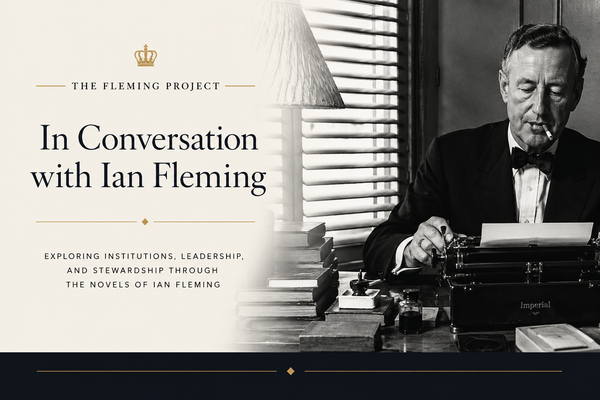
The first crack in Hugo Drax’s remarkable public image appears at a bridge table. By the opening chapters of Moonraker, Drax is among the most admired men in Britain: enormously wealthy, celebrated as a patriot, and closely identified with the rocket project that bears the novel’s
Chapter Six
The first crack in Hugo Drax’s remarkable public image appears at a bridge table. By the opening chapters of Moonraker, Drax is among the most admired men in Britain: enormously wealthy, celebrated as a patriot, and closely identified with the rocket project that bears the novel’s
Author's Perspective: An Institutional Governance Essay
This essay examines the American constitutional system through the lens of institutional governance and organizational leadership. Its focus is the relationship among authority, responsibility, accountability, and purpose within one of the longest-enduring governance systems in modern history.
Institutions are created to
Author's Note: The reflections presented here form part of an extended reading of Groundwork of the Metaphysics of Morals by Immanuel Kant. Written in the late eighteenth century, the Groundwork remains a text of unusual severity, returning insistently to questions that admit of no easy resolution: what it
Author’s Note: This article forms part of an ongoing reading of Immanuel Kant’s Groundwork of the Metaphysics of Morals, considered in relation to questions of institutional life, leadership, and governance. These reflections inform a broader body of work at the intersection of philosophical foundations and practical institutional responsibility.
In April 2026, I led a three-part seminar series titled “Leading Change in Complex, Resource-Constrained Health Systems: The Reality of the DRC.” Hosted by the Higher Institute of Nursing Sciences (ISSI), the series brought together healthcare professionals working in conditions that resist easy description, and perhaps easy resolution.
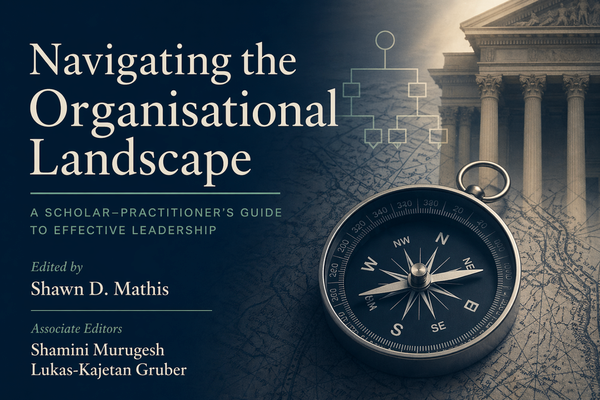
Navigating the Organisational Landscape brings together scholar–practitioner reflections on leadership, responsibility, and institutional life. The volume reflects the practical and intellectual concerns that shape much of the work gathered at That Remains: how leaders exercise judgment, how organizations endure complexity, and how authority is tested within institutions.
Access the
Some books begin as proposals. Others begin as conversations. Navigating the Organisational Landscape: A Scholar-Practitioner’s Guide to Effective Leadership began as a promise made on a summer afternoon outside the Sheldonian Theatre in Oxford, after a world had changed and a cohort had endured it together.
The book
Exploring the Role of Adversity Quotient and Resilience in Leadership
Business practitioners routinely encounter challenges in the course of leading and managing an enterprise. Resilience has long been a subject of interest in my exploration of leadership and adversity, likewise. Both are often defined, rather simplistically, as the capacity to