
Book Review: The Society of the Spectacle, by Guy Debord

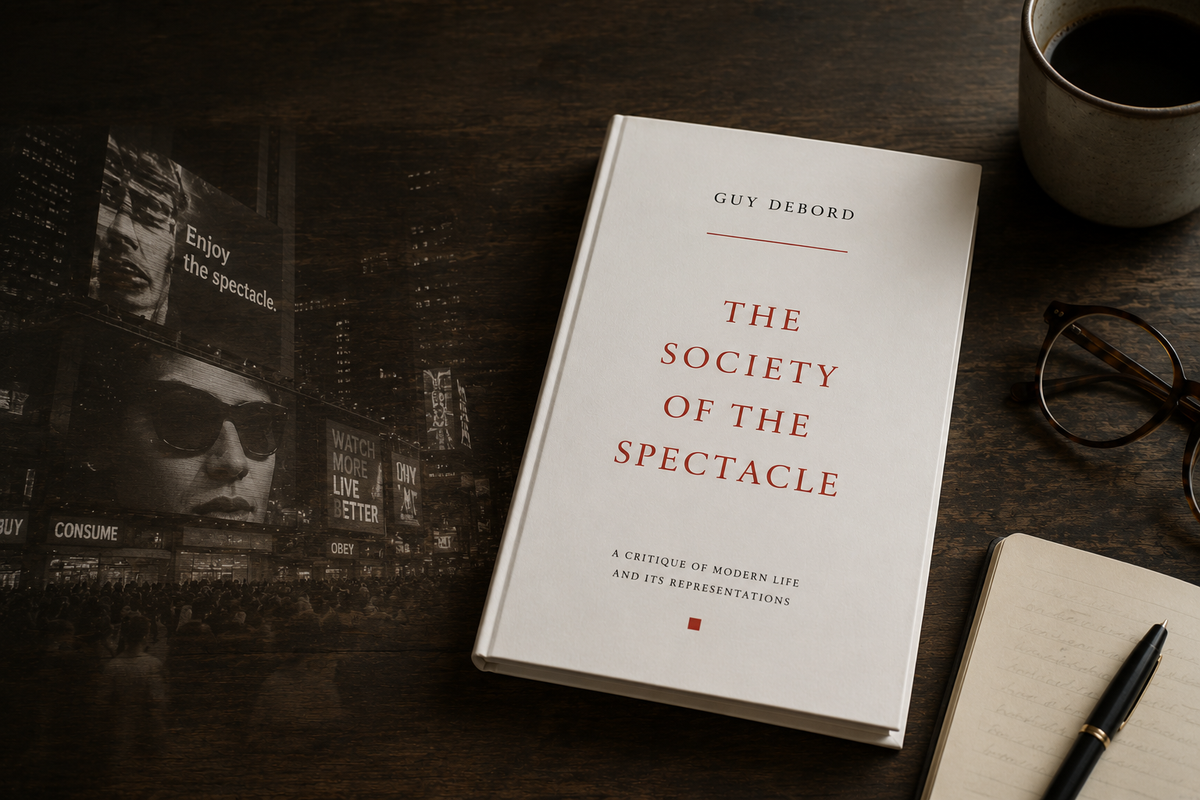
I had not known of Guy Debord until last Saturday. While wandering through a weekend market in Nashville, I noticed a copy of The Society of the Spectacle lying among a collection of socially oriented books. The title alone was sufficient to arrest my attention. I bought it with no real knowledge of either the author or the work.
Since then, I have found it remarkably difficult to put down.
This is not because the book is an easy read. Quite the opposite. Debord writes in compressed aphorisms, assumes considerable familiarity with Marxian thought, and develops his argument with little concession to the casual reader. There are passages that demand repeated reading before their significance becomes apparent. Yet beneath the density lies an intellect of extraordinary precision. One senses throughout a thinker who has stripped away everything he regarded as inessential, leaving behind arguments that are rigorous, provocative, and relentlessly pursued.
The greatest challenge in reading The Society of the Spectacle was not Debord's prose. What emerged as the difficulty was the meaning he attached to the word spectacle itself. The ordinary understanding of the term is so ingrained that it is initially difficult to orient one's thinking towards Debord's conception. Only once it becomes clear that the spectacle is not a collection of images but a form of mediated social existence does the intellectual architecture of the book begin to reveal itself. What had appeared opaque becomes remarkably coherent, and individual aphorisms assume their proper place within a larger philosophical argument.
Few works of twentieth-century social theory have acquired a reputation comparable to The Society of the Spectacle. Published in 1967 on the eve of the political upheavals that would define the following year, it has become one of the canonical texts through which the cultural and political condition of late modernity is interpreted. Debord was a central figure in the Situationist International, a revolutionary artistic and intellectual movement whose critique of capitalism, consumer culture, and everyday life provided the wider context in which the book emerged. References to the spectacle now appear routinely in discussions of consumer capitalism, mass media, digital platforms, and social networking. Yet the book's prominence has been accompanied by an unusual paradox. It is frequently cited; yet, comparatively rarely read; and when it is read, it is understood primarily as a critique of images or media rather than as a more fundamental inquiry into the nature of mediated social life.
This misunderstanding is understandable. Debord's style is deliberately aphoristic, his arguments are compressed, and his debt to Marx is explicit throughout. These features have encouraged commentators to situate The Society of the Spectacle principally within the tradition of Western Marxism. Such readings are neither inaccurate nor unimportant. They do, however, risk obscuring the conceptual ambition of the work. Debord's concern is not simply with media or visual culture. His subject is mediation itself and the conditions under which representation acquires an authority independent of the realities it was originally intended to express. To recognize these intellectual origins is not to accept Debord's conclusions but to understand the framework within which he develops them.
Debord develops these arguments from within the Marxian tradition, but the questions he raises are by no means confined to it. The relationship between representation and reality, the nature of mediation, and the conditions under which institutions become detached from the purposes they were created to serve are questions that extend well beyond Marxism and have occupied thinkers across philosophy, political theory, sociology, and theology. It is this broader philosophical inquiry, rather than Debord's political commitments, that gives The Society of the Spectacle its enduring significance.
The distinction is introduced in what remains the book’s defining proposition: “The spectacle is not a collection of images, but a social relation among people, mediated by images” (Thesis 4). The importance of this statement lies less in its reference to images than in its conception of mediation. The spectacle is not a technological phenomenon, nor is it reducible to advertising, television, or public relations. Rather, it describes a condition in which individuals increasingly encounter one another, and indeed their own social existence, through representations that gradually displace direct experience.
This process of mediation occupies the center of Debord's analysis. Modern society, he argues, is characterized by an increasing separation between lived reality and its representation.
Economic exchange becomes increasingly abstract; political participation gives way to political representation; culture becomes an object of consumption rather than creation. Social life does not disappear. Instead, it is experienced indirectly through institutions, commodities, narratives, and images that mediate human relationships. The spectacle is, then, neither illusion nor deception in any simple sense. It is a historically produced form of social organization.
It is for this reason that Debord repeatedly returns to the concept of separation. Individuals become separated from their labor, from one another, from historical consciousness, and ultimately from their own capacity to shape the social institutions they collectively sustain. Society presents itself as an objective system operating according to its own internal logic, while human agency appears progressively diminished. Although this diagnosis emerges from a Marxian account of capitalist development, its philosophical significance extends beyond the historical circumstances to which Debord addressed himself.
The enduring value of The Society of the Spectacle lies precisely here. Much contemporary discussion has sought to establish the book's relevance by identifying technological developments that Debord supposedly anticipated. Social media, digital advertising, online influencers, and algorithmic recommendation systems are frequently presented as empirical confirmation of his thesis. Such observations are not mistaken. They are, however, comparatively superficial. More historically attentive interpretations place the book's concern with spectacle within its wider account of history, revolution, and the transformation of social relations. The conceptual problem identified by Debord is not exhausted by the emergence of new technologies. Rather, these developments illustrate a more fundamental question concerning the relationship between reality and its representation in complex societies.
This is perhaps the discipline that books of this kind demand. They ask the reader to suspend immediate judgment long enough to enter another person's intellectual world.
The objective is not agreement, nor even disagreement, but understanding.
Criticism acquires value only after one has first grasped the argument as its author intended. To read otherwise is merely to compare one's own assumptions with a caricature of someone else's thought.
Whether one ultimately accepts Debord's conclusions is a secondary question. The more important achievement is the encounter itself: the opportunity to engage with a mind pursuing first principles with uncommon consistency. Books such as The Society of the Spectacle remind us that the purpose of reading is not simply to accumulate conclusions. Indeed, the purpose is to enlarge our capacity for thought.
There is perhaps a broader lesson here. Contemporary discourse has an understandable preoccupation with the new: the latest technologies, the latest political controversies, the latest theories. Yet works such as The Society of the Spectacle remind us that many of the more profound, even troubling, questions confronting modern society have been asked before, often with greater philosophical patience than contemporary debate permits.
Older books are not simply historical artifacts; they are windows into enduring traditions of human inquiry. They expose us to ways of thinking that challenge, refine, and sometimes transform our own. Whether we finally agree with their conclusions matters less than whether we have first taken the trouble to understand them.
Some books leave us with answers. Others leave us with better questions. The Society of the Spectacle belongs firmly in the latter category. It is not a book to be read quickly or even comfortably. It demands patience, careful thought, and a willingness to suspend one's own assumptions long enough to inhabit another mind. That, perhaps, is its greatest reward. For beyond its critique of modern society lies something more enduring: a reminder that the serious reading of difficult books remains one of the surest means by which we deepen our understanding not only of the world, but of the possibilities of human thought itself.