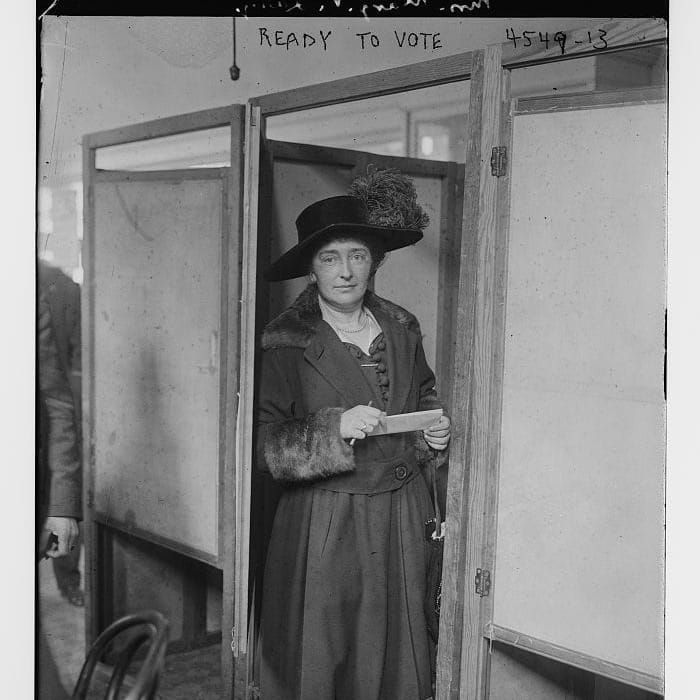
Margaret V. Lally at the door of a voting booth during the first election in which women could vote in New York City, March 5, 1918. Bain News Service. Library of Congress.
The Voting Booth Is Where the Party Machine Should Stop
As the November elections approach, I would ask every American citizen to take seriously the responsibility that comes with the ballot. Study the people whose names appear before you. Listen to what they say. Look at what they have done. Consider their character, their judgment, their respect for the limits of public office, and what they propose to do with the authority they are asking us to entrust to them. Then vote according to your own considered judgment and values.
A ballot is not an oath of allegiance to a party. It is an act of judgment by a citizen.
We are electing men and women who will exercise public authority in our name, and a party designation should never relieve us of the responsibility to know who they are.
The first duty of the voter is not to a party, but to the republic the party seeks permission to govern.
Political parties have an important place in representative government, but they are instruments of representative government; they must never become its masters. No political party is larger than the republic it seeks to govern. Parties should win elections because they have persuaded citizens, offered candidates worthy of public trust, and earned the support of the people. When party machinery, concentrated money, or political influence begins to substitute for the judgment of citizens, representation itself begins to weaken.
Those we elect should remember the same thing. Whether serving in local government, state government, Congress, or the presidency, public officials hold authority in trust. They are elected to govern for the people, not merely for a party, a donor, a faction, or the political machinery that helped place them in office.
Our constitutional system depends upon divided authority, restraint in the exercise of power, and institutions strong enough to survive the political interests of the moment. Constitutional safeguards are meaningful because power must remain divided, bounded, and accountable.
I do not write this as an indictment of the Republican Party or the Democratic Party. I write because our system of institutional governance is under strain, and we should not assume that it will correct itself. Public trust in the federal government remains near historic lows, and political confidence follows partisan lines. That should concern us regardless of party.
We are close enough to the edge that complacency is no longer responsible. Mud-slinging, contempt, and hatred will not repair weakened institutions or restore confidence in representative government. They make the work of governing together more difficult. Yet we are not powerless. Each citizen still possesses something no party, donor, campaign, or political machine can exercise for us: an individual voice and the judgment that gives that voice meaning.
We are not too late to correct course, but institutional repair cannot substitute for citizens willing to exercise judgment. Know the candidates. Know their records. Know what they propose to do. Apply the same scrutiny to the candidate you are inclined to support that you apply to the candidate you oppose. We cannot demand independence, judgment, and integrity from those we elect if we are unwilling to exercise those qualities ourselves.
The republic does not require us to agree. It requires us to remain citizens when we disagree.
That is the work before us. In November, each of us has a part in it.
There is perhaps no better way to close than with Ray Charles singing America the Beautiful—a reminder of the country we share, even when we disagree about how it should be governed.
Share this article
The link has been copied!
Your link has expired. Please request a new one.
Your link has expired. Please request a new one.
Your link has expired. Please request a new one.
Great! You've successfully signed up.
Great! You've successfully signed up.
Welcome back! You've successfully signed in.
Success! You now have access to additional content.