A seed among the stones: belonging at Reuben College, Oxford


When I arrived at Oxford to begin the MSc Global Healthcare Leadership, I anticipated a world of thought shaped by rigour, breadth, and the weight of long tradition. What I did not foresee, though I came to treasure it, was the presence of something more intimate and human: the role of college life in giving shape and grounding to the experience. For me, that place was Reuben College.
New among the ancient, Reuben carried a freshness that was not at odds with Oxford, but rather in quiet conversation with it. Amid a demanding programme and a global professional life, it offered not simply affiliation, but space: a space to think, to reflect, and to connect.
Reuben’s ethos is one of convergence. Its intellectual centre draws together themes of artificial intelligence, environmental change, ethics, and the life sciences. Yet beyond subject matter, it holds a particular disposition: one that leans forward without rushing, that invites complexity and embraces uncertainty. For those working at the intersections of systems and people, health, and policy, such a posture is not only helpful, but essential.
While my formal learning took place at Saïd Business School and the Nuffield Department of Primary Care Health Sciences, it was Reuben that framed the experience. The conversations I encountered there, whether in passing or around a shared table, stretched my imagination and gave context to the questions I was already carrying.
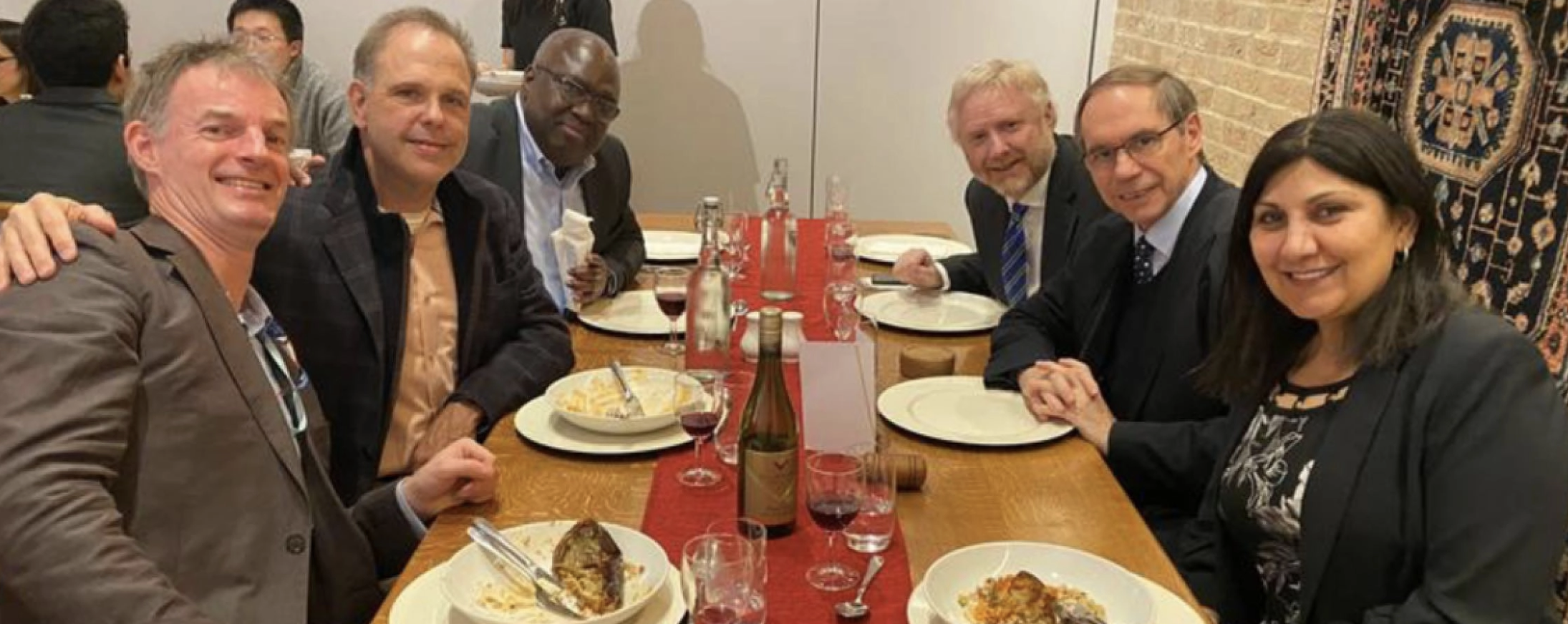
In the early days of the programme, three fellow cohort members and I, each affiliated with Reuben, attended a formal college dinner. We were part-time students, present in Oxford only a few weeks each year, and the customs of college life still felt unfamiliar. That evening, however, remains etched in my memory.
Professor Lionel Tarassenko, President of the College, greeted us at the door. He spoke with warmth and attentiveness, inviting us to join his table. The conversation that followed, with Lionel and several fellows, was unhurried, thoughtful, and wholly unexpected. It was not a performance of hospitality, but something more natural: an embodiment of what Reuben was becoming.
In that moment, and many others that followed, Lionel came to represent the College itself: intellectually serious, personally gracious, and unafraid to begin something new.
Dr Peter Drobac was another presence who shaped the experience. As both a faculty lead on the programme and a member of Reuben, Peter bridged the world of learning and community with ease. He brought coherence to the whole, helping those of us who lived professionally in systems and strategy remember the human ground beneath it all.
The College’s student support team, too, met us with consistency and care. Though our time in Oxford was measured in brief intervals, we were never treated as visitors. We were received as part of the whole.
One of the more unexpected joys came near the end of the programme, when I attended a Reuben College reception at the Museum of Natural History. There, amid fellow Reubenites, including my college advisor, three MSc Global Healthcare Leadership cohort companions, Lionel Tarassenko, president of Reuben and a dynamo of intellectual and imaginative energy, and the ever-engaging Peter Drobac, the evening acquired a peculiar resonance.
Fossils kept silent watch as conversation ranged widely: technology and innovation, humanitarian endeavours, and the evolving landscape of education in Africa. As is so often the case at Oxford, the topics shifted and intertwined, each thread adding to the tapestry of the night. The atmosphere was suffused with the playful gravity that marks new beginnings in ancient settings, a gentle homage to heritage and the restless spirit of inquiry. The night lingers in the mind, a quietly luminous episode in the unfolding chronicle of Reuben College.
There are figures who seem to carry with them the soul of a place, and for me, Professor Lionel Tarassenko is such a figure. In those early encounters, when Reuben was still beginning to find its form within the ancient body of Oxford, his presence was steady, considered, and uncommonly generous. He gave shape to what the College was becoming.
It is often thus with newly founded Oxford institutions. In their earliest years, they lean upon the character of those who steward their birth. The spirit of the College begins in a person, but it does not remain there. Over time, and quietly, it moves from voice to room, from gesture to ritual, until the College begins to speak for itself. To consider Reuben is to think of something new set amidst the old. It is a college of modern lines and clear purpose, planted with quiet confidence among the ancient quadrangles and towers. There is something deeply Oxford about it, and yet also something not yet fully named. Even centuries hence, Reuben will still be known as one of the youngest colleges, but age here is no deficiency. Youth, in this setting, carries a kind of prophecy.
Reuben stands as a seed of the future, growing quietly among the stone walls and inherited traditions of Oxford. It is not merely a building, nor a cohort, nor an idea. It is a gesture towards the continuing story of the University. It is a thinking place, a creative mind housed within a body of memory. It is Oxford in its newest form, conceived in the present, rooted in tradition, and oriented towards what lies ahead.
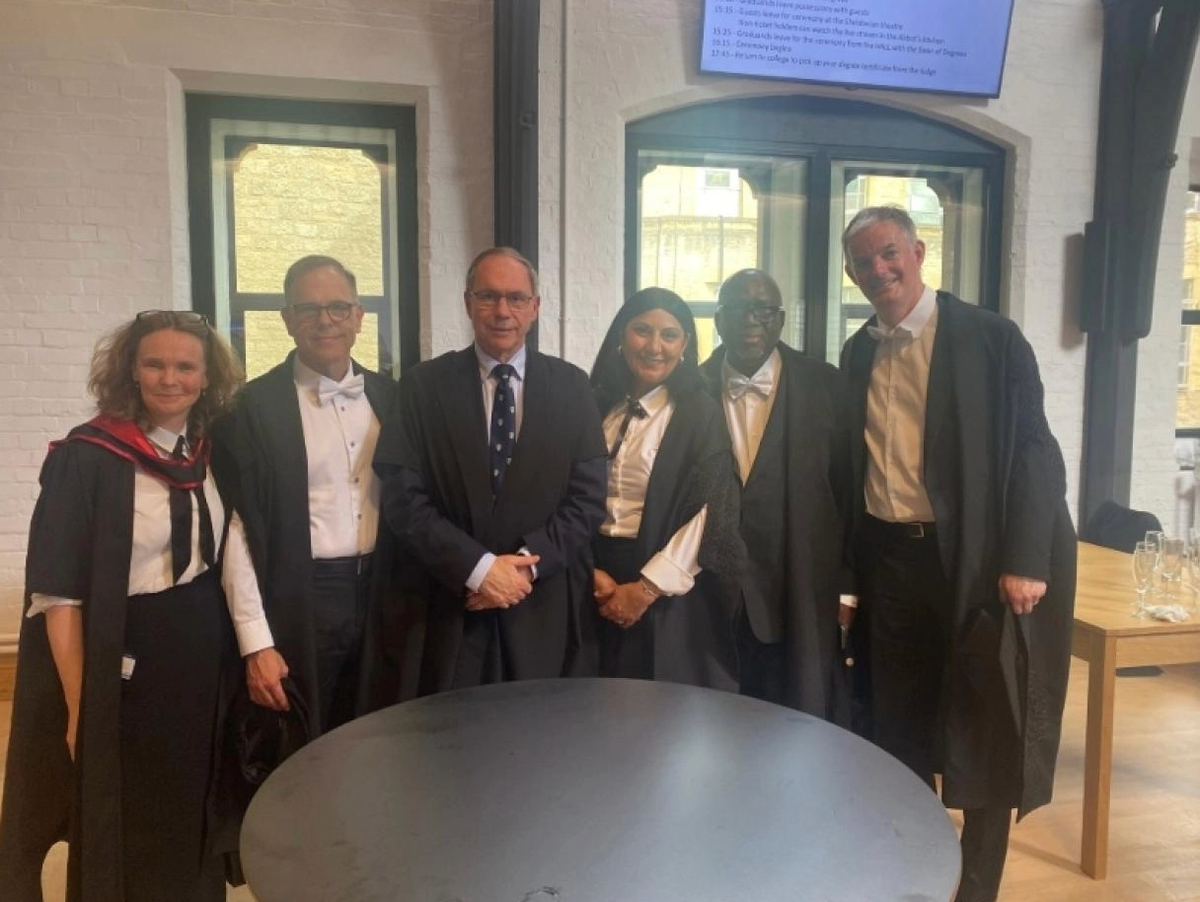
Graduation morning held a quiet significance. Before the formal procession began, we gathered at Reuben for coffee and conversation. We were no longer students, not quite yet alumni, but we belonged. We shared laughter, recollection, and a gentle recognition of the journey we had walked together.
In that moment, Reuben no longer felt new. It felt rooted, not in age, but in meaning. Looking back now, I see that Reuben became, for me, more than a point of affiliation. It became the setting where reflection could occur. It offered the frame around the intensity of learning and the space in which memory could settle. It was the part of Oxford that gave shape to the whole.
Reuben stands within the University’s global spirit and interdisciplinary strength yet brings to it a fresh energy marked by innovation and imaginative reach. It is Oxford at its most agile, shaping possibility with a clarity of purpose and a willingness to inhabit new forms. Among the traditions it honours, Reuben offers something new. It is not a departure from Oxford’s identity, but a distinctive expression of its continuing evolution.
I remain grateful for its place in my own story, and I carry that gratitude forward, not only as one who studied there, but as one who now walks with it into the years ahead.
Find out more about the MSc Global Healthcare Leadership.