Ian Fleming on Evil and Institutional Judgment


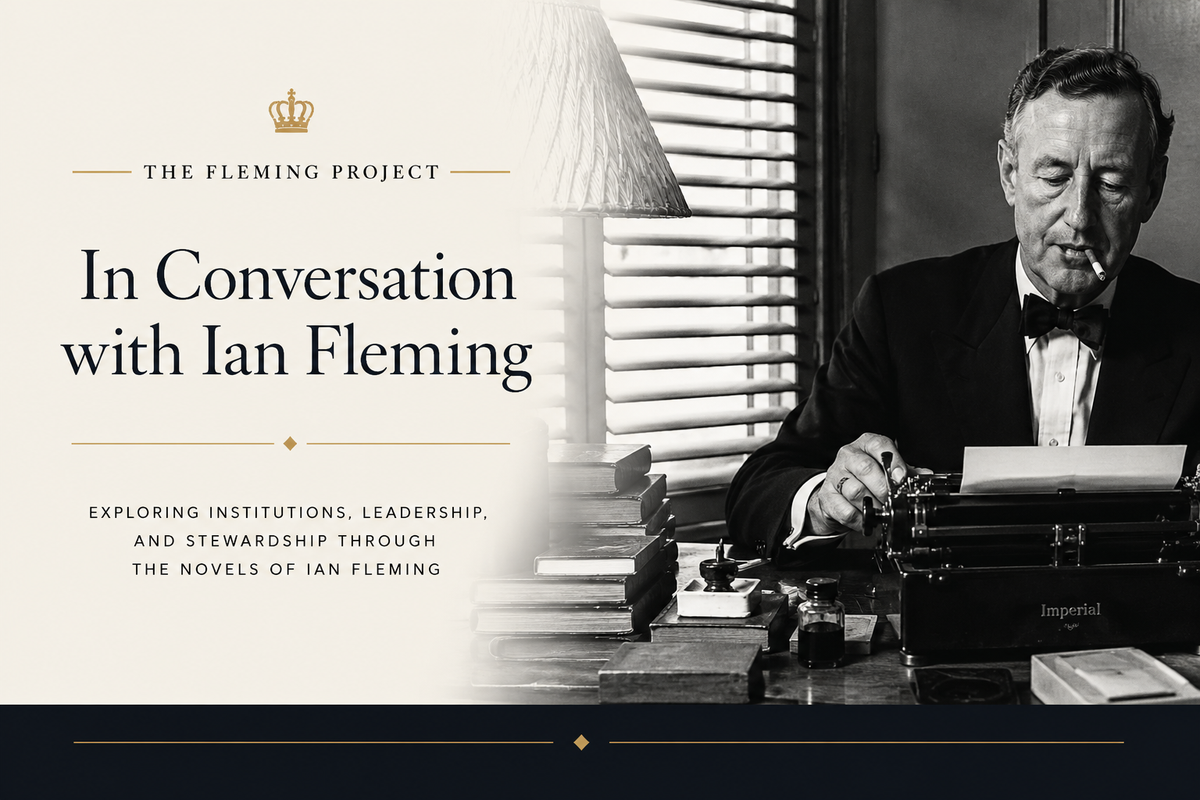
Among Ian Fleming’s fourteen James Bond books, only once does he appear to suspend the narrative long enough to ask directly what evil is. The conversation between James Bond and René Mathis near the end of Casino Royale is unlike anything else in the Bond canon.[1] Le Chiffre is dead. Bond has survived torture. The immediate operation appears to be over. Rather than ending the novel with triumph, Fleming pauses to ask a philosophical question.
Most readers understand it as Bond's personal crisis. It is certainly that. Yet I believe Fleming is doing something far more significant. Throughout The Fleming Project, I have argued that Fleming possessed an unusually sophisticated understanding of institutions. Read in that light, this conversation extends beyond Bond's conscience. It asks a larger question.
What must an institution understand about evil if it is to govern well?
The remarkable feature of this chapter is that Fleming does not leave the question behind. The principles articulated here reappear, in narrative form, throughout the series. Casino Royale provides the philosophical framework. Many of the books that follow can then be read as illustrations. Fleming never offers a single definition of evil. Instead, he teaches readers to recognize its changing disguises.
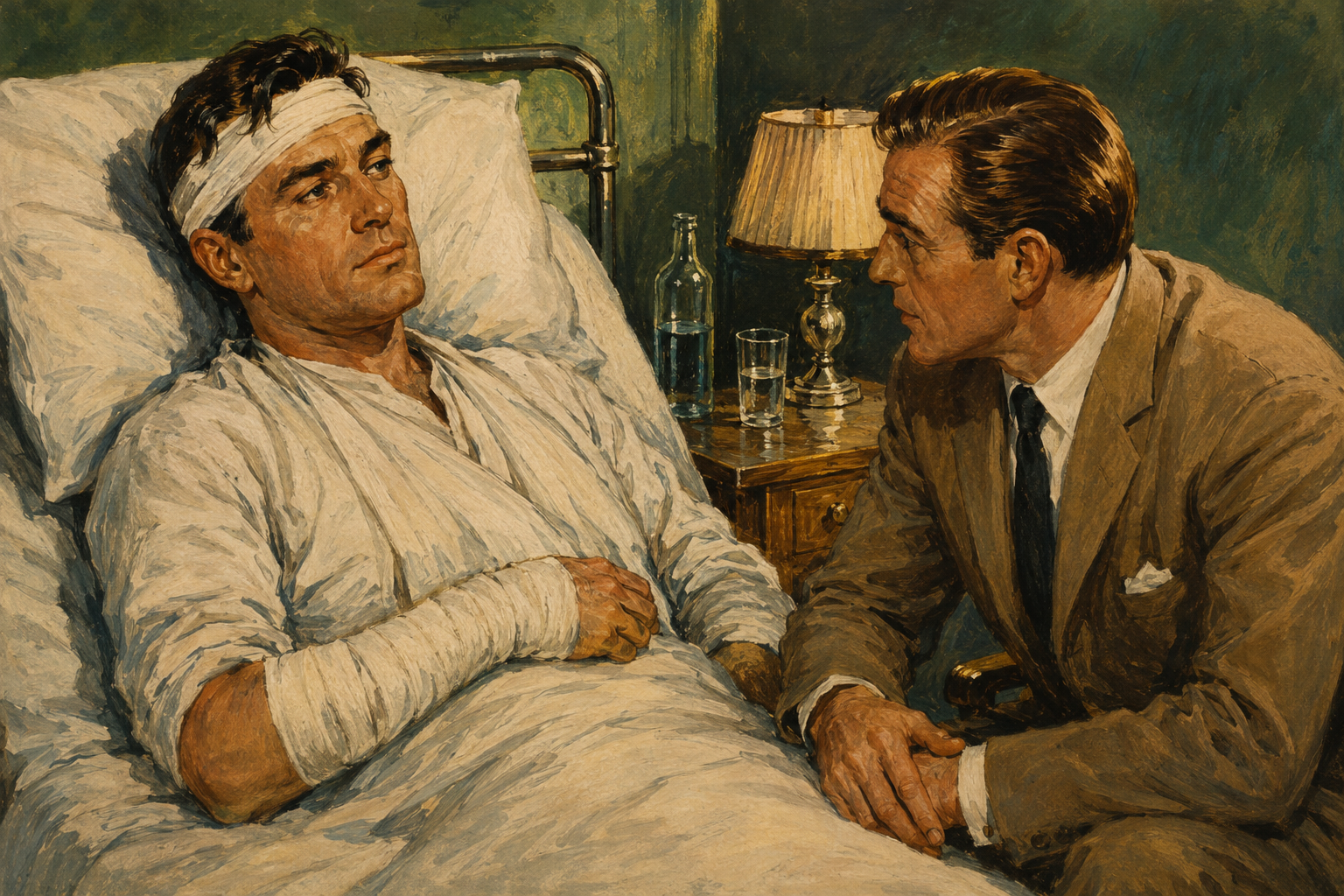
James Bond and René Mathis after the events of Casino Royale. Contemporary illustration inspired by the visual style of the 1950s PAN Books editions.
Bond begins with a confession that experience has unsettled the moral certainty of youth.
"You see," he said, still looking down at his bandages, "when one's young, it seems very easy to distinguish between right and wrong, but as one gets older it becomes more difficult. At school it's easy to pick out one's own villains and heroes and one grows up wanting to be a hero and kill the villains. ... History is moving pretty quickly these days and the heroes and villains keep on changing parts."[2]
Bond never questions the reality of evil. Le Chiffre remains unquestionably evil. What has changed is Bond's confidence that evil always arrives wearing familiar political labels. Governments change. Alliances shift. Yesterday's patriot becomes tomorrow's traitor. Institutions that define evil solely through ideology may eventually lose the ability to recognize it when evil acquires respectability.
Fleming next explores this danger memorably in Moonraker. Sir Hugo Drax is not an obvious criminal lurking in the shadows. He is Britain's celebrated industrial hero, admired by the public, honored by the government, and entrusted with the nation's most important defense project. His gift of the Moonraker rocket to the British government makes him a national benefactor as well as a national hero. As M recounts Drax's rise to national prominence:
"And then there were months of delay and everyone got impatient. Questions in the House. The Opposition nearly forced a vote of Confidence. And then the announcement by the Prime Minister that the design had been approved by the Woomera Range experts of the Ministry of Supply, and that the Queen had been graciously pleased to accept the gift on behalf of the people of Britain and had conferred a knighthood on the donor."[3]
Evil has learned to wear patriotism. Decorated. Knighted. Admired. Drax is everything an institution wishes to trust. What emerges from Fleming's portrayal is unsettling. Institutions seldom fail because evil announces itself. More often, they fail because they mistake reputation for character.
Yet the conversation in Casino Royale is not finished. The question becomes even more personal when Bond turns his attention inward.
"All right," he said. "Take our friend Le Chiffre. It's simple enough to say he was an evil man, at least it's simple enough for me because he did evil things to me. If he was here now, I wouldn't hesitate to kill him, but out of personal revenge and not, I'm afraid, for some high moral reason or for the sake of my country."[4]
This may be one of the most honest sentences Bond ever speaks. Before Bond can exercise judgment on behalf of the institution, he must govern himself. He recognizes that the greater danger is the possibility that justice has quietly become revenge. Read in institutional terms, the passage suggests that moral self-government is the first qualification for judgment exercised on behalf of others.
He recognizes that identical actions may arise from radically different motives. Justice and revenge can produce the same outward behavior while differing entirely in moral character. Institutions devote immense effort to regulating conduct. Fleming’s distinction invites a larger institutional question: can conduct be governed adequately without some understanding of motive? Rules may authorize force. They cannot purify the heart of the one who exercises it.
That insight becomes institutional in From Russia, with Love. Before Bond appears, Fleming invites readers inside SMERSH, the Soviet intelligence organization responsible for planning Bond's death. The organization speaks almost entirely in the language of administration:
"The direction of SMERSH is carried out from the 2nd floor. The most important room on the 2nd floor is a very large light room painted in the pale olive green that is the common denominator of government offices all over the world."[5]
Nothing in the description appears extraordinary. The setting could belong to almost any modern bureaucracy. Everything about the organization appears orderly, disciplined, and professional. The machinery is impressive. The purpose is evil. The distinction matters because administrative excellence and moral excellence are not the same achievement.
But the conversation between Bond and Mathis still has one more surprise. Bond observes:
"There's a Good Book about goodness and how to be good and so forth, but there's no Evil Book about evil and how to be bad. The Devil has no prophets to write his Ten Commandments and no team of authors to write his biography. ... He has no book from which we can learn the nature of evil in all its forms, with parables about evil people, proverbs about evil people, folk-lore about evil people. All we have is the living example of the people who are least good, or our own intuition."[6]
This passage is, I believe, where Fleming's argument about evil comes most clearly into view.
Institutions rightly concern themselves with policies, procedures, professional standards, and technical competence. None of these, however, teaches leaders how evil will present itself in the next generation. Evil continually changes its appearance. It adapts itself to new technologies, new political movements, new organizational forms, and new ambitions. Judgment cannot be reduced to procedure because evil cannot be reduced to precedent.
Fleming repeatedly illustrates that truth throughout the series.
In Dr. No, technical brilliance becomes detached from moral restraint. Dr. No treats intellect as a claim to rule. He rejects the ordinary limitations of human judgment in favor of an elite vision of disciplined genius:
"Mania, my dear Mister Bond, is as priceless as genius. Dissipation of energy, fragmentation of vision, loss of momentum, the lack of follow-through—these are the vices of the herd.... I do not possess these vices. I am, as you correctly say, a maniac—a maniac, Mister Bond, with a mania for power."[7]
Yet Fleming does not leave that philosophy as mere rhetoric. Dr. No explains how knowledge became an instrument of domination:
"I hid myself in the academic world of libraries and laboratories and campuses.... I had to learn what this day is capable of.... From secure base, armoured against the casual slings and arrows of the world, I could proceed to the achievement of power—the power to do unto others what had been done unto me, the power of life and death, the power to decide, to judge, the power of absolute independence from outside authority."[8]
Expertise serves good government. Wisdom governs it. Fleming does not allow us to mistake genius for wisdom.
In Goldfinger, Fleming extends this concern from expertise to administration. Wealth remains Goldfinger's governing obsession, but what distinguishes him is his ability to organize people, institutions, and specialized knowledge in its service. Before Goldfinger's plan to rob Fort Knox begins, Fleming devotes an entire chapter to planning meetings, logistics, transportation, personnel, and security. Goldfinger speaks less like a criminal than an executive directing a complex operation. He tells his associates,
"I want you to anticipate, to treat this whole project as an operation in which any inefficiency or insecurity will of course have to be dealt with."[9]
Administrative excellence is never presented as a moral achievement. The machinery is efficient. Its purpose is theft. Fleming's concern is not that administration is inherently corrupt. It is that administrative excellence can serve ends that are profoundly immoral. After the meeting, the operation dissolves into "an unending blizzard of paperwork," emphasizing that evil depends not only upon dramatic acts but upon ordinary administration.[10]
By Thunderball, evil has become corporate in its organization. SMERSH serves a state and its ideology. SPECTRE serves only itself. Behind the respectable façade of a charitable foundation lies what Blofeld openly describes as a "private enterprise for private profit."[11] Its executive committee resembles a corporate board more than a military staff. Once the meeting begins, it becomes "as solidly overt as any meeting of principals in the Boulevard Haussmann," invoking the respectable world of Parisian finance and corporate business.[12]
Revenues are reported, profits distributed, succession planned, operations coordinated, and failures punished before the organization proceeds to its next item of business. Even the theft of two nuclear weapons is discussed as a matter of administration. Reporting on the organization's finances, Blofeld notes that its income "has been distributed in accordance with our charter," reducing mass criminality to routine corporate accounting.[13] What Fleming observed—or at least imagined—feels profoundly modern. An institution becomes dangerous whenever it loses sight of moral purpose while becoming exceptionally good at organization.
By Thunderball, Fleming has explored evil across the principal forms of modern institutional life. Evil has worn patriotism, bureaucracy, technical expertise, administration, and finally the structure of the modern corporation. Its appearance changes. Its character does not. Institutions therefore require more than competence or efficiency. They require leaders capable of moral judgment.
Yet Fleming does not end the conversation there. Institutions exist for a purpose beyond their own preservation, and moral judgment ultimately serves something greater than organizational success. In the novels that follow, Fleming leaves the committee room, the executive office, and the planning conference behind. He turns instead to the people those institutions exist to protect. The question of evil becomes intensely personal.
[1] Ian Fleming, Casino Royale (London: Penguin Books, 1955), 133–39. This section provides the philosophical foundation for the argument developed in this chapter. Quotations from the later Bond novels are included as narrative illustrations of the principles developed here.
[2] Fleming, Casino Royale, 133–35.
[3] Ian Fleming, Moonraker (London: Penguin Books, 1955), 20.
[4] Fleming, Casino Royale, 135–36.
[5] Ian Fleming, From Russia, with Love (London: Penguin Books, 1957), 29.
[6] Fleming, Casino Royale, 136-137.
[7] Ian Fleming, Dr. No (London: Penguin Books, 1958), 161–62.
[8] Fleming, Dr. No, 165–66.
[9] Ian Fleming, Goldfinger (London: Penguin Books, 1959), 212.
[10] Fleming, Goldfinger, 221.
[11] Ian Fleming, Thunderball (London: Penguin Books, 1961), 50.
[12] Fleming, Thunderball, 43.
[13] Fleming, Thunderball, 52.