The Boat That Became Venice


Before dawn, Venice belongs briefly to the people who work on the water.
The delivery boats come first. Engines grumble under bridges. Men throw boxes onto wet fondamenta. Somewhere a vaporetto pushes a pale wake against stone steps green with weed. And then, improbably, a gondola appears.
It makes almost no sound.
The black hull slips forward and the gondolier stands high at the stern, one hand resting on the oar. There is something faintly impossible about the boat when seen among engines, plastic crates, motor launches, and mobile phones. It seems too slender to carry anyone, too long for the canals, too ornate for ordinary use, and too archaic to have survived.
Yet it survives because it works.
That may be the first thing we have forgotten about the gondola.
Before the postcards and the striped shirts, before Byron and Thomas Mann, before honeymooners, barcarolles, and film stars, there was a boat. A Venetian needed to get from one place to another, and there was water in the way.
The first gondola I have been able to locate in the written record appears in 1094. There is no romance attached to it. No moon. No serenade. No beautiful woman behind a curtain.
It occurs in a ducal privilege concerning Loreo, far down the Venetian lagoon system. Among the obligations being discussed is the furnishing of a gondola. The surviving text needs further archival work, but the word is there.
Almost nine hundred years later, a few strokes of black ink suggesting a curved boat are enough to signify Venice anywhere on earth.
What happened in between?
That question has taken me into places I did not expect to go.
In 1494 Pietro Casola came to Venice on his way to Jerusalem. He noticed the gondolas immediately. Almost every citizen of means, he wrote, kept one. Even the cheaper boats cost around fifteen ducats. Maintaining one could be more expensive than keeping a horse.
The horse matters.
On dry land, power had hooves. Princes arrived on horseback. Goods moved by cart. Wealth showed itself in carriages, harness, liveries.
Venice required another arrangement.
Here the carriage floated.
A palace did not open onto a road but onto water. The front door might be a flight of stone steps descending into the canal. The family vehicle waited below, knocking softly against its mooring post. A servant stepped aboard. A curtain moved. The gondolier pushed away.
The city had made the boat part of the house.
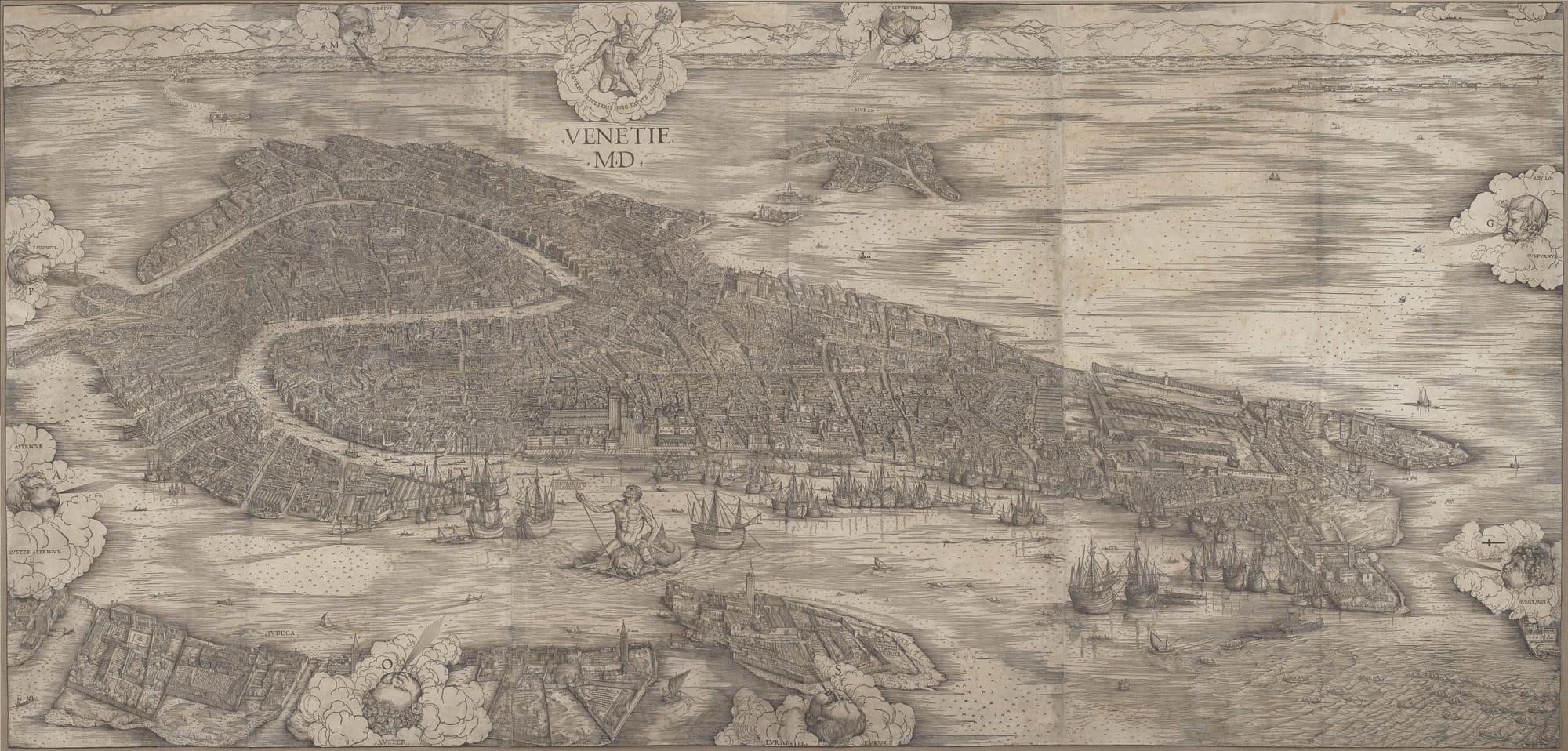
Jacopo de’ Barbari’s monumental View of Venice, 1500. Water is not around the city; it is within its system of movement.
And not only the house. Gondolas crossed the Grand Canal as ferries. They could be hired. They waited at stations. They carried rich and poor, citizens and strangers. By 1344 the boatmen of the Santa Sofia traghetto already possessed a mariegola, evidence of an organized fraternity with rules, privileges, and memory.
The gondolier whom we now imagine singing to tourists was once embedded in a much rougher economy of labor, household service, and inherited occupation.
Some of the earliest images make this startlingly visible.
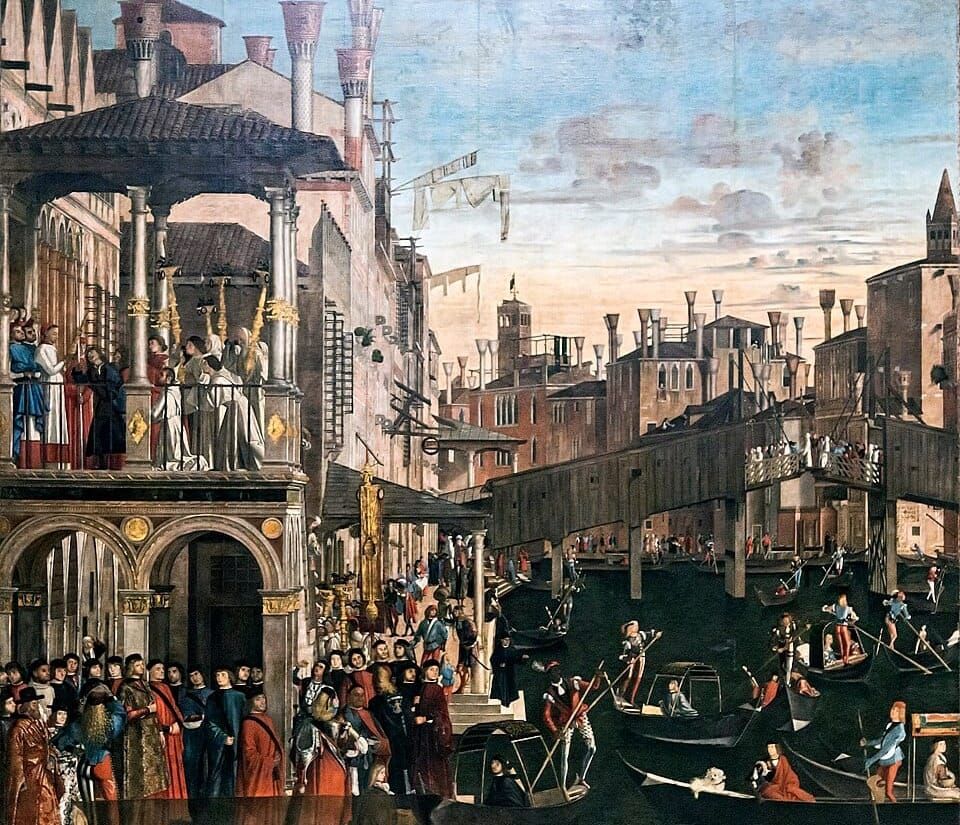
Look closely at Carpaccio’s Venice and forget, for a moment, that you are looking at a Renaissance masterpiece. Look at the traffic.
Boats push through the water. Men lean into their oars. Passengers wait. Gondolas cluster beneath bridges.
A reported passage in Marin Sanudo speaks of negri saraceni and other household servants who knew how to row. Suddenly the familiar Venetian scene opens onto another history: slavery, migration, domestic service, race, empire. The gondolier was not always the figure we think we know.
Nor did the gondola always look as we expect.
For generations wealthy Venetians decorated their boats extravagantly. Silk. Tassels. Carved wood. Gilding. Fine cloth. Ivory. Ebony. Ornamented metalwork. The gondola could announce a family before its passenger had stepped ashore.
The Venetian government tried to stop them.
Again and again.
There are laws against silk felzi in 1562. More prohibitions follow in 1609. Then 1624. 1626. 1628. 1632. 1633. 1634. 1637. 1638. 1642. 1644.
Reading them one after another is almost comic. You can feel the magistrates losing patience across the centuries.
No silk.
No tassels.
No gilding.
No elaborate carving.
No expensive inlay.
Keep the ironwork plain.
Even the pointed metal studs on the boat were regulated and ordered blunted.
And somewhere inside this long quarrel between Venetian vanity and Venetian law, the black gondola begins to emerge.
I had always heard that story presented neatly: the government decreed that gondolas must be black, and therefore they became black.
The archive is not so courteous.
There is no single theatrical moment in which colored Venice suddenly turns black. There is instead pressure, repetition, evasion, enforcement. Fashion collides with regulation. Regulation returns. By the eighteenth century travelers simply notice that the gondolas are black, as though they had always been so.
History often happens that way. By the time anyone remarks upon the transformation, the argument that produced it has been forgotten.
But usefulness alone cannot explain what the gondola became.
Somewhere along the way the boat acquired an interior life.
The felze—the small covered cabin—made it a room moving through the city. Curtains could be drawn. Conversation disappeared behind them. Faces vanished. A person might cross Venice unseen.
The possibilities were obvious.
Love affairs. Gambling. Political conversation. Assignations. Intrigue.
William Beckford called gondoliers managers of intrigue. Piozzi thought the boat wonderfully suited to refined gallantry. The gondolier knew where his passenger had been and with whom, but his profession required discretion.
Venice had invented a room without an address.
At night the room acquired a soundtrack.
Visitors came expecting gondoliers to sing. Goethe arranged an experiment. He sat in a gondola under the moon while voices called and answered across the water. Piozzi investigated the famous claim that gondoliers sang Tasso and Ariosto. Burney listened for the music. Beckford heard songs carried from boat to boat.
Whether every gondolier sang epic poetry matters less than what followed.
Europe began to dream the sound.
The barcarolle escaped from Venice. Composers who had never needed an actual gondola could summon one with rhythm: the gentle rocking of water, a minor key, a melody returning upon itself. Venice had become portable.
Painters discovered the same thing.
For Canaletto, gondolas fill the Grand Canal because they belong there. They are traffic.
For Guardi they begin to flicker.
For Turner they dissolve into light.
For Whistler the boat enters darkness, silence, tonal mist.
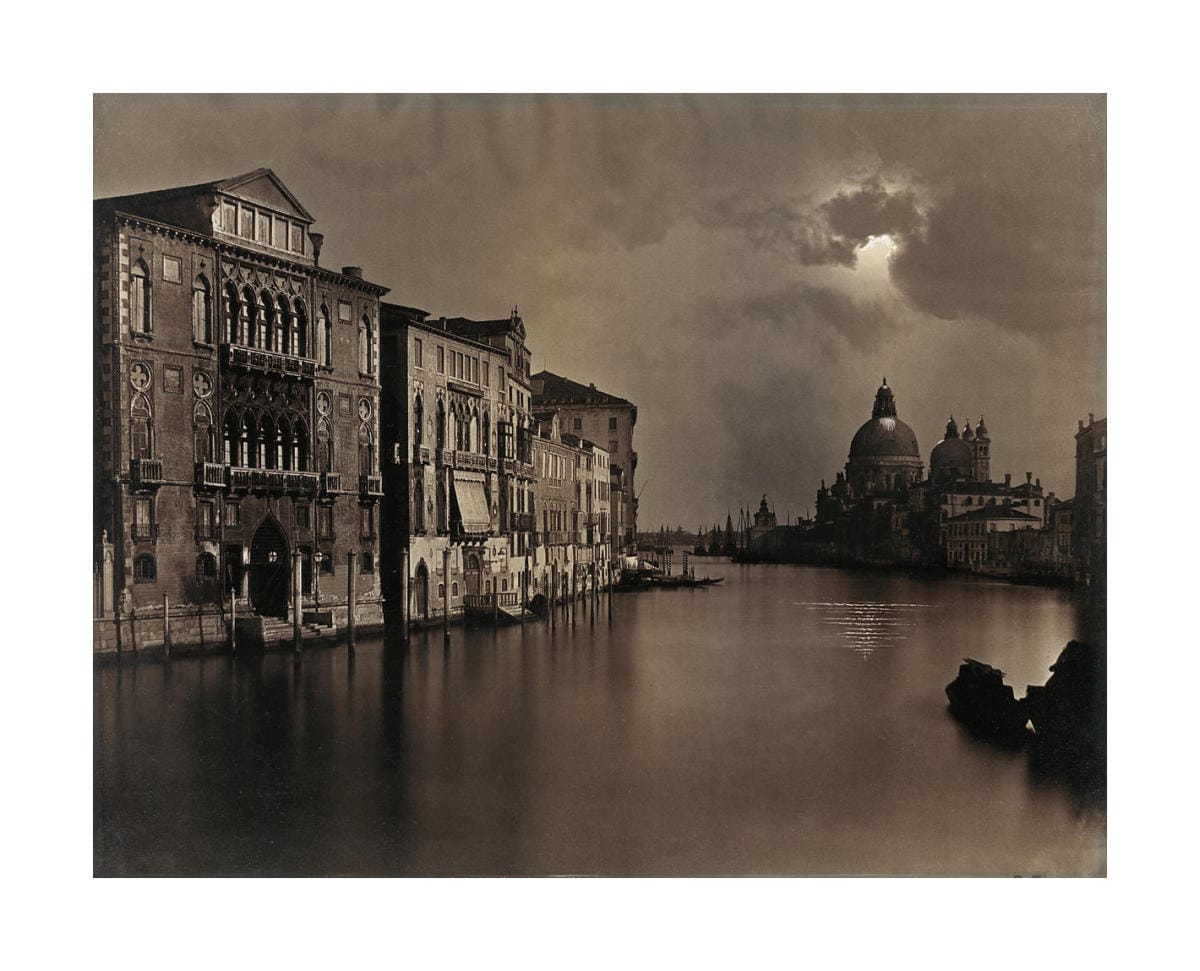
Carlo Naya, Night View of the Grand Canal, Venice, c. 1875. Albumen silver print. The Metropolitan Museum of Art, New York. Naya’s “moonlight” was created in the darkroom from a photograph made during the day—a remarkably literal example of Venice being transformed into the image visitors expected to find. Public domain.
For Sargent something stranger happens. He paints repeatedly from a gondola. The boat itself sometimes disappears, but its presence remains in the angle of vision: low against the water, walls rising suddenly, reflections broken by the moving hull.
The gondola has ceased to be merely something the artist looks at.
It has become the place from which he looks.
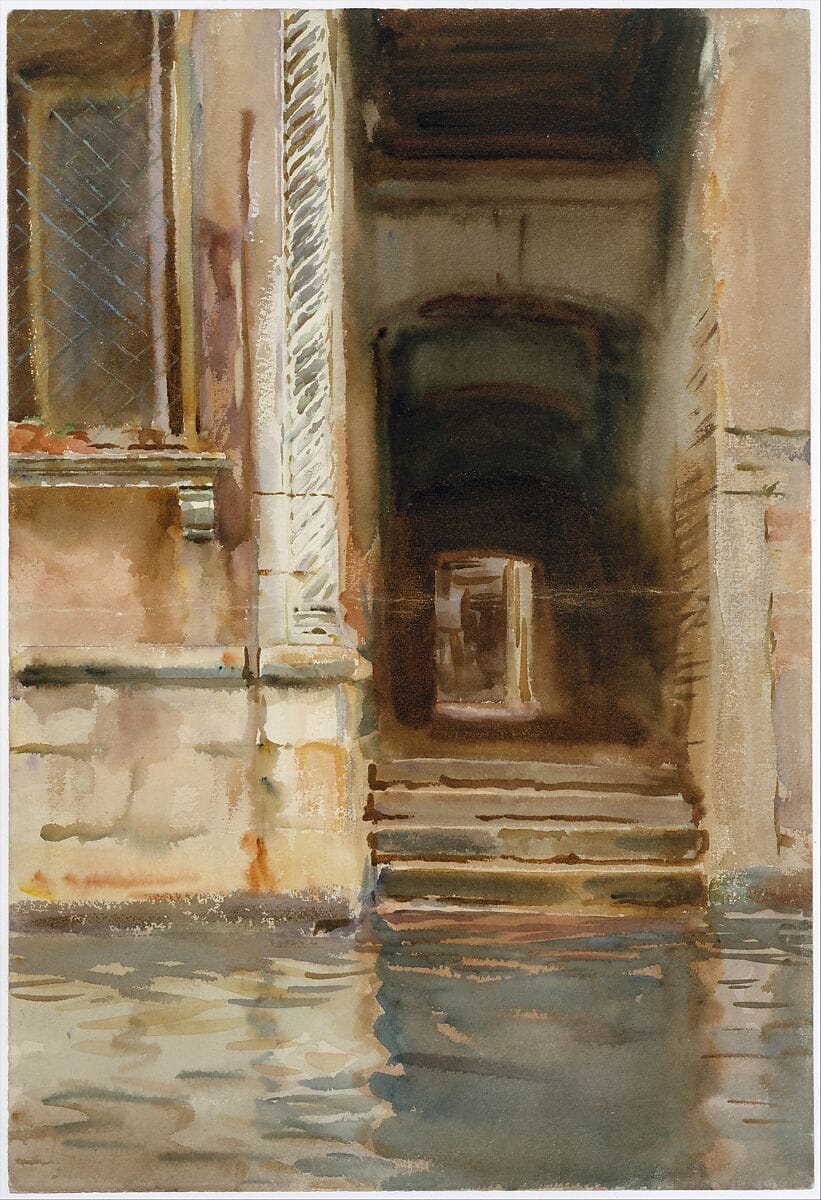
John Singer Sargent, Venetian Passageway, c. 1905. The gondola is absent, but its viewpoint remains.
And then the poets and novelists climb aboard.
The blackness begins to trouble them.
Goethe sees cradle and coffin. Andersen thinks of a hearse. Browning puts lovers inside the boat. Henry James makes the gondolier the foreign visitor’s companion and shadow.
Then Thomas Mann sends Gustav von Aschenbach across the lagoon.
By now the gondola has carried so much accumulated meaning that Mann scarcely needs to invent anything. The black boat is already erotic and secretive, beautiful and funereal. The strange gondolier is already part servant, part guide, part ferryman. Venice itself seems to be transporting Aschenbach toward his fate.
The ordinary boat has become Charon’s vessel.
And then, almost cruelly, the twentieth century simplifies everything.
The gondola becomes a logo.
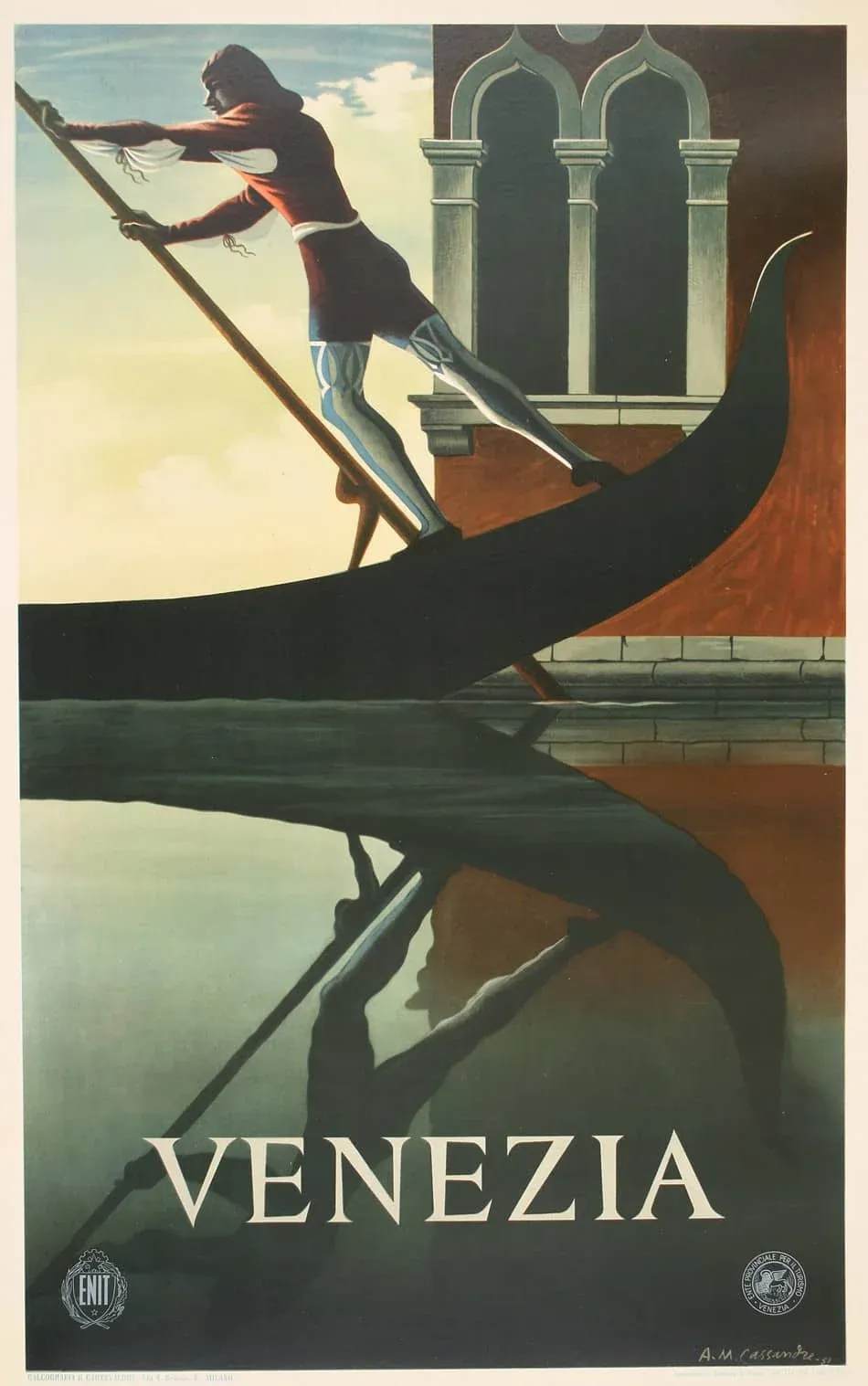
A. M. Cassandre, Venezia, 1951. Tourism poster for ENIT (Ente Nazionale per l’Incremento delle Industrie Turistiche). Museo Nazionale Collezione Salce, Treviso. By mid-century, the gondolier had become sufficient shorthand for Venice: the working boat had become a graphic symbol.
Postcards place it beneath the Salute. Tourist posters reduce it to black curves. Cassandre turns the rowing gondolier into a magnificent modern graphic figure. Another designer takes only the ferro at the bow and fills it with Venice. Film Festival posters bend the gondola into strips of cinema.
You no longer need the boat.
A fragment will do.
A prow.
An oar.
A silhouette.
Venice.
That should have been the end of the story.
Motorboats came. Vaporetti came. Railways delivered millions of people to the lagoon. The gondola lost the city it had once transported.
But it did not disappear.
There are still traghetti crossing the Grand Canal. There are still workshops where hulls are built by hand, still remèri shaping oars and forcole to the bodies and habits of individual rowers. The municipality regulates licenses, clothing, fares, and capacity. In the 1990s Venice formally established an institution devoted to conserving the gondola and protecting the gondolier profession.
In 2010 Giorgia Boscolo qualified as Venice’s first female gondolier, entering an occupation that had guarded its male identity for centuries.
The old object continues to change.
That is what I had not understood when I began.
I thought I was researching the history of a boat.
But the gondola refuses to remain a boat.
Follow it backward, and it becomes labor, race, class, law, craftsmanship, and war. Follow it through the eighteenth century, and it becomes music, secrecy, and desire. Follow it into the nineteenth, and it becomes painting, poetry, death, and the foreign imagination of Venice. Follow it into the twentieth, and it becomes advertising, cinema, and tourism. Follow it into the present, and it becomes something else again: heritage deliberately kept alive.
And beneath every one of those meanings is still that improbable hull.
Long. Black. Asymmetrical.
A man or woman stands at the stern. The oar settles into the carved forcola. A small movement of the wrist alters the direction of the boat.
Stone slides past.
Water opens.
Then closes again behind it.
Nearly a thousand years of Venice, and hardly a wake.