Why Does Drax Cheat? The Obligation to Ask Why



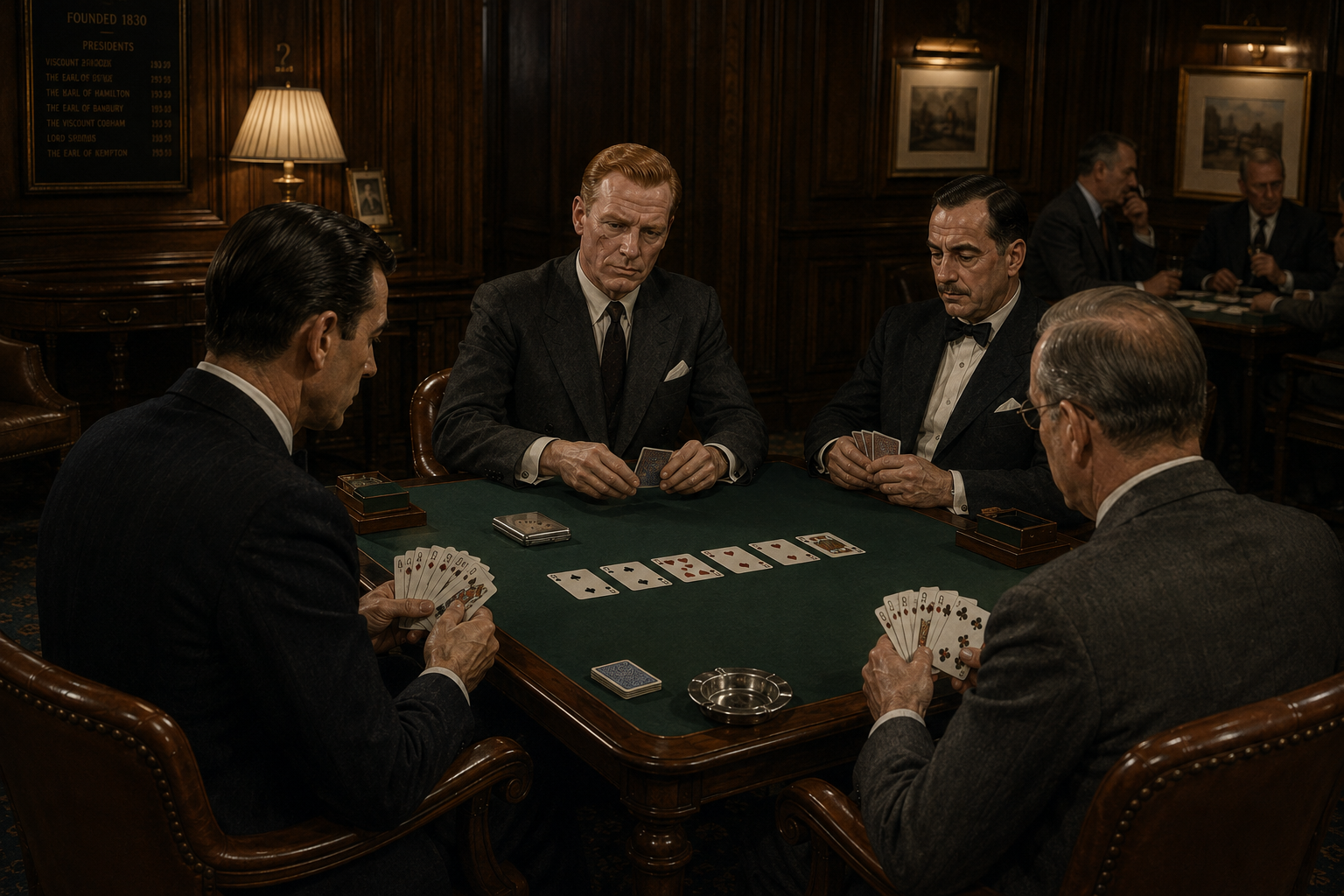
The first crack in Hugo Drax’s remarkable public image appears at a bridge table. By the opening chapters of Moonraker, Drax is among the most admired men in Britain: enormously wealthy, celebrated as a patriot, and closely identified with the rocket project that bears the novel’s name. He has become, in Bond’s words, a “national hero.” Yet Lord Basildon, chairman of Blades and an old friend of M, has become suspicious that Drax is cheating at cards. He brings the matter privately to M.
Blades is Fleming’s fictional private card club in St James’s, but he gives it the weight and pedigree of an old London institution. Its supposed history reaches back to the 1770s; membership is restricted to two hundred men, and admission depends upon both gentlemanly standing and considerable wealth. Fleming calls it “the most exclusive club in London.”
M reduces the problem to a startlingly simple statement: “Sir Hugo Drax cheats at cards.” Bond’s first response is telling. It “just didn’t fit in with my picture of Drax.” M replies: “That’s the point. Why does he do it?”[1]
At this stage neither M nor Bond suspects the conspiracy that will later emerge. M has been asked to help with a discreet problem involving a prominent member of Blades, and he asks Bond, the Service’s best card player and a man trained in the methods of card-sharping, to determine whether Drax is cheating and how he is doing it.[2] What begins the inquiry is simply the discrepancy between the man Britain believes Drax to be and something he does that makes no apparent sense.
That small question sets much of the novel in motion.
There is something worth noticing here about institutional judgment. M does not confuse an irregularity with proof. He does not accuse Drax of something for which he has no evidence. A fact that does not sit comfortably beside the others reaches him, and he decides that it deserves examination.
Institutions reveal themselves in such moments. A number cannot quite be reconciled. A payment has no satisfactory explanation. A decision seems inconsistent with the stated purpose of the organization. A board takes an action that raises questions about whose interests are actually being served. None of these things proves wrongdoing. Sometimes there is a perfectly reasonable explanation.
The obligation is to find out.
M cannot make Drax’s reputation answer the question for him. That reputation is formidable. Drax is successful, admired, regarded as intensely patriotic, and attached to a project of immense national importance. Almost everything the country believes about him argues against suspicion. Fleming understands how powerful that kind of reputation can become. Success develops its own authority. People cease asking questions because so many other people have already decided what they think of the man.
M agrees that the question should be asked.
Bond answers one question that evening at Blades. He discovers how Drax cheats. Drax uses the polished surface of his silver cigarette case as a “shiner,” allowing him to catch a reflection of the cards as they are dealt. Bond turns the tables on him and wins heavily.[3]
Yet knowing how Drax cheats does not answer the more interesting question. The following morning Bond is still thinking about him. Why should a millionaire, a national hero, and a man occupying so extraordinary a position in British life need to cheat at cards? Fleming is careful here. Bond begins forming judgments about Drax’s character, but he also questions his own conclusions. The cheating is not evidence of treason. It is an inconsistency that has made Drax newly interesting.[4]
That distinction matters. An anomaly need not prove the larger problem. Sometimes its importance lies simply in telling a responsible person where closer attention may be warranted.
I have long had a habit of visiting places associated with consequential people and institutions. I have stood in the Roman Forum, visited J. Pierpont Morgan’s library in New York, where bankers gathered during the Panic of 1907, visited Rockefeller’s Kykuit above the Hudson, walked through Greystone, the Doheny estate in Beverly Hills, stood in Palazzo Bembo on Venice’s Grand Canal, visited Medici palaces and villas in and around Florence, and gone to Blenheim Palace in Oxfordshire, where Winston Churchill was born.[5]
None of those places explains the people who inhabited them or the institutions with which they were associated. Morgan’s library does not explain modern finance. Rockefeller’s home does not explain Standard Oil. A palace cannot explain the Medici.
Still, I want to see the place.
Perhaps the simplest explanation is that the place gives the abstraction an address.
Years ago, while in Houston and reading Bethany McLean and Peter Elkind’s The Smartest Guys in the Room, I realized that Enron’s former headquarters at 1400 Smith Street was nearby. The building was still standing, largely emptied of the company that had once occupied it, and I drove over to see it.[6]
I remember looking at the building that morning. There was nothing remarkable about the experience in itself. The building stood there, substantial and real. Thousands of people had gone to work there. Deals had been negotiated there. Presentations had been made and decisions taken.
From the street, I was looking at the building that had housed Enron’s headquarters. The institution itself was already gone.
The book had already shown me something else.
It had allowed me to see relationships and decisions that the building could never disclose. Standing there brought those two things together: the institution as it appeared from the outside and the institution I had been reading about within.
Business history contains many such moments. Parmalat reported billions of euros that proved not to exist.[7] Enron’s apparent success concealed arrangements that gave a misleading picture of its financial condition.[8] Theranos presented a technological capability that its underlying system could not reliably deliver.[9] At Hollinger International, questions concerning payments to Conrad Black and others eventually opened a much larger examination of the company’s governance.[10]
The cases are different. What interests me is the point at which someone notices that something does not fit and asks why.
That question has had a personal significance in my own life.
Over the years I have served in and around institutions where I encountered matters I could not, in good conscience, simply observe and leave alone. In one institution, more than thirty years ago, when I was in my twenties, the eldership was abolished, and a committee that included men who, in my understanding of our tradition’s biblical standards, would not have qualified to serve as elders assumed its authority. Youthful naivety and exuberance notwithstanding, I stood by what I believed and could not reconcile that arrangement with the theological convictions the institution professed. The response was harsh and became personal. I was subjected to attacks on my character; my home was broken into; and threats were made against my safety, including threats against my life.
In another institution, I was serving as a senior executive and worked closely with the board, although I was not a member of it. When bankruptcy was being discussed, I became convinced that it was unnecessary and that the result contemplated would not serve the interests of the investors whose interests I believed deserved protection. I was invited to participate in what was being proposed and was offered a significant equity position and a senior role in what would follow. I declined. Whatever advantage the arrangement might have offered me personally, I could not reconcile it with what I believed was owed to those investors. I voiced my opposition as strongly as I felt I responsibly could and, when it became clear that I could not alter the direction being taken, I left the organization. Some time afterward, the organization entered bankruptcy.
Most recently, in a church setting, the treasurer resigned following a stated disagreement over a proposed change in the church’s legal and organizational structure. It was only afterward, as financial information was turned over and reviewed, that signs began to emerge that something did not fit. The initial question was straightforward: why were substantial church funds being held in multiple accounts for which the treasurer was the sole signatory, when neither the trustees nor, so far as we could determine, the congregation understood that this was the arrangement? As the records were examined, the question ceased to be mine alone. Those of us carrying financial, legal, and trustee responsibilities found that the arrangement required an explanation.
The circumstances were different, but in each case I reached the same point: I could not see what appeared to me a serious inconsistency, remain silent, and still believe that I had fulfilled my own responsibility.
What I did not understand when I was young was what such a question could set in motion. The responses were at times severe. One dispute continued for years, moved through courts and government offices, and eventually became the subject of national and religious press coverage in which serious allegations were made about me and the institution I served. I believed then, and remain convinced, that important parts of that account were false, and counsel later challenged specific factual statements in the published coverage. I mention this neither to retry the controversy nor to answer every accusation here.
What youth did not give me was an adequate understanding of what a question can cost.
I assumed then that an honest question would usually be met by an honest answer. There was some naivety in that. When a question touches money, authority, or reputation, the questioner can quickly become more troublesome than the question. Matters involving money, authority, and reputation have a way of becoming personal when the explanation is unwelcome.

I did not learn to ask fewer questions. I learned not to be surprised by what a question may uncover, or by the reaction it may produce.
There is a certain innocence in assuming that everyone entrusted with an institution will place the institution above his own place within it. Time tends to remove that innocence. It has not changed my conviction that the institution itself deserves proper stewardship.
Later study of governance, boards, and institutions gave structure and language to something I had already come to believe. Fiduciary duties matter greatly. Financial controls, bylaws, procedures, and proper records matter. Yet none of them exhausts the responsibility of leadership. There remains a moral question about what has been entrusted to us and what we are doing with it.
I have come to think of the institution itself as a third thing.
It is not the board. It is not management. It is not a faction of stakeholders or the individuals who happen to hold authority at a particular moment. It does not belong to the person raising the question either. All of us stand in some relation to something that exists beyond our own interests and, one hopes, beyond our own tenure.
That changes how we should understand institutional conflict. The important question is not who prevails. It is what fidelity to the institution requires.
This is why M’s handling of the Drax matter deserves more attention than it usually receives. The original concern comes from Basildon, but M neither dismisses it nor inflates it into something the evidence cannot support. He is not trying to bring down a celebrated man.
He simply refuses to let reputation close an inquiry that the facts have opened.
There is restraint in that. There is also judgment.
A person who sees problems everywhere soon becomes incapable of distinguishing a real problem from an imagined one. Experience ought to make us more careful about our own conclusions. We can be wrong. We can misunderstand motives, misread facts, or attach too much importance to something that proves innocent.
But there is another error as well: allowing admiration, convenience, friendship, authority, or institutional reputation to answer a question that has never really been answered.
The first crack in Drax’s public image appears at a bridge table. Before the conspiracy is visible, before the Moonraker itself becomes a threat, there is simply one small fact that refuses to agree with everything Britain believes about Hugo Drax.
The fact reaches M. He does not dismiss it. He asks why.
By the end of the novel, Fleming has given the question a darker answer. The cheating was not proof of Drax’s conspiracy, nor could Bond reasonably have treated it as such. It revealed something about the man beneath the public reputation. The morning after Blades, Bond recognizes in Drax a “combination of superiority and scorn” and wonders whether he cheats because he cannot bear to lose to people he considers inferior. In the final chapter, Bond looks back upon the chain of events and thinks of Drax as a man who “scornfully cheated at cards to feed the fires of his maniac ego.”[11] Beneath the representation, the celebrated benefactor and national hero was someone quite different.
That is why the small question matters. Institutional judgment rarely begins with certainty. More commonly, something simply does not fit. The obligation is neither to accuse nor to look away. It is to ask the question carefully enough, and persistently enough, to discover whether there is an answer.
Why?
1. Ian Fleming, Moonraker (London: Jonathan Cape, 1955), chaps. 2–3. Online text available through Faded Page. Faded Page — Moonraker full text
2. Fleming, Moonraker, chap. 3.
3. Fleming, Moonraker, chaps. 4–7.
4. Fleming, Moonraker, chap. 8.
5. Parco archeologico del Colosseo, “The Roman Forum,” official source; The Morgan Library & Museum, “The Panic of 1907,” official source; Rockefeller Brothers Fund, “Kykuit,” official source; City of Beverly Hills, “About Greystone,” official source; Palazzo Bembo, “Palazzo Bembo,” official source; UNESCO World Heritage Centre, “Medici Villas and Gardens in Tuscany,” official source; Blenheim Palace, “Winston Churchill at Blenheim Palace,” official source.
6. Bethany McLean and Peter Elkind, The Smartest Guys in the Room: The Amazing Rise and Scandalous Fall of Enron (London: Penguin Books, 2004), Penguin edition page; Anastasia Ustinova, “Chevron to Lease Old Enron Building,” Houston Chronicle, October 7, 2006, Houston Chronicle article.
7. U.S. Securities and Exchange Commission, “Parmalat Finanziaria S.p.A.,” Litigation Release No. 18527, December 30, 2003. SEC source
8. U.S. Securities and Exchange Commission, “Andrew S. Fastow,” Litigation Release No. 17762, October 2, 2002. SEC source
9. U.S. Securities and Exchange Commission, “Theranos, CEO Holmes, and Former President Balwani Charged With Massive Fraud,” Press Release No. 2018-41, March 14, 2018. SEC source
10. Hollinger International, Inc. v. Black, 844 A.2d 1022 (Del. Ch. 2004). Delaware Court of Chancery opinion at Justia. The opinion itself records Tweedy Browne’s May 2003 demand concerning more than $70 million in non-competition payments and the subsequent creation of the Special Committee.
11. Fleming, Moonraker, chaps. 8, 25.
Blenheim Palace. “Winston Churchill at Blenheim Palace.” Blenheim Palace
City of Beverly Hills. “About Greystone.” City of Beverly Hills
Fleming, Ian. Moonraker. London: Jonathan Cape, 1955. Online text available through Faded Page. Faded Page — Moonraker
Hollinger International, Inc. v. Black. 844 A.2d 1022 (Del. Ch. 2004). Opinion at Justia
McLean, Bethany, and Peter Elkind. The Smartest Guys in the Room: The Amazing Rise and Scandalous Fall of Enron. London: Penguin Books, 2004. Penguin
The Morgan Library & Museum. “The Panic of 1907.” The Morgan Library & Museum
Palazzo Bembo. “Palazzo Bembo.” Palazzo Bembo
Parco archeologico del Colosseo. “The Roman Forum.” Parco archeologico del Colosseo
Rockefeller Brothers Fund. “Kykuit.” Rockefeller Brothers Fund
UNESCO World Heritage Centre. “Medici Villas and Gardens in Tuscany.” UNESCO World Heritage Centre
U.S. Securities and Exchange Commission. “Andrew S. Fastow.” Litigation Release No. 17762. October 2, 2002. SEC
———. “Parmalat Finanziaria S.p.A.” Litigation Release No. 18527. December 30, 2003. SEC
———. “Theranos, CEO Holmes, and Former President Balwani Charged With Massive Fraud.” Press Release No. 2018-41. March 14, 2018. SEC
Ustinova, Anastasia. “Chevron to Lease Old Enron Building.” Houston Chronicle, October 7, 2006. Houston Chronicle