Why Institutions Exist: Ian Fleming on the Human Cost of Evil


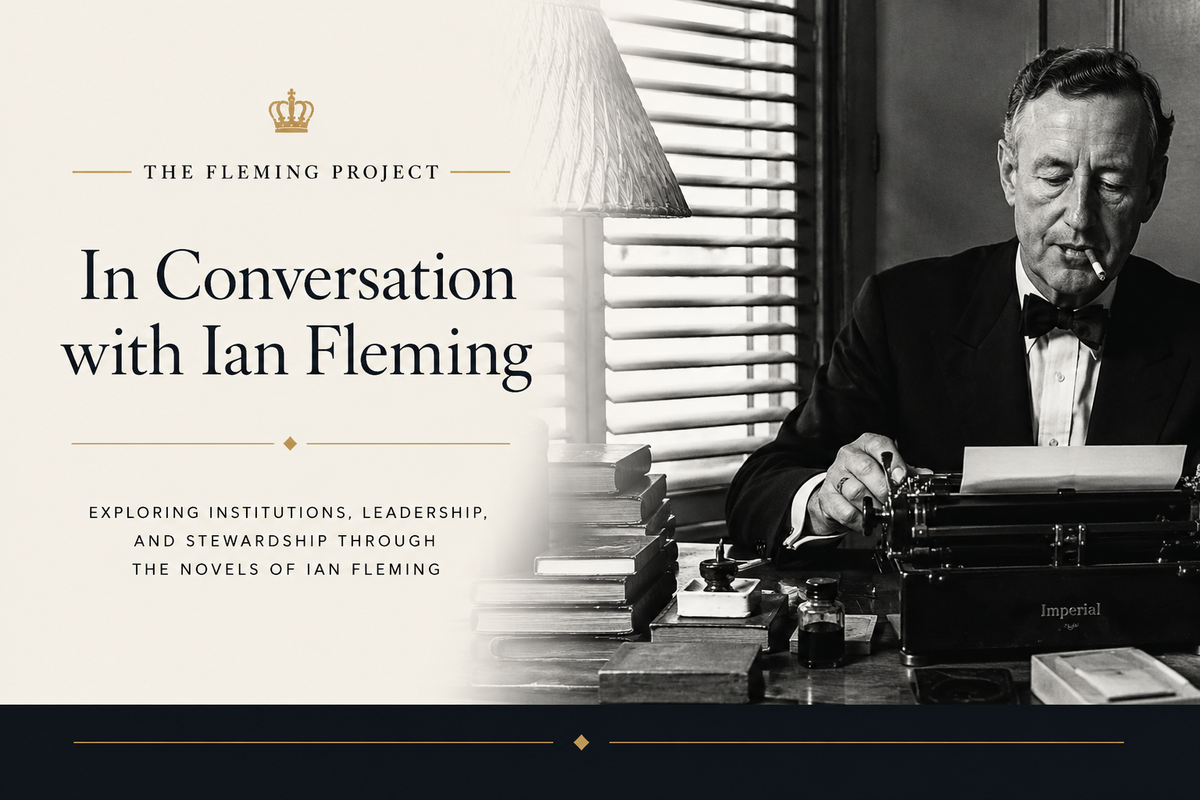
Near the end of Casino Royale, after Le Chiffre is dead and Bond has survived his torture, James Bond and René Mathis begin an extraordinary conversation about the nature of evil. In the previous chapter, I followed that conversation outward through Fleming's later novels, asking how institutions recognize evil when it appears in the respectable forms of patriotism, bureaucracy, expertise, efficiency, and organizational success.
But Bond and Mathis have not finished their conversation. Bond now struggles with a different question: if evil helps us recognize what is good, what is goodness ultimately for? Having explored the problem of institutional judgment, we can now ask a different question of Fleming's novels: What does evil ultimately destroy?
Bond then reaches one of the chapter's most provocative conclusions.
"Le Chiffre was serving a wonderful purpose, a really vital purpose, perhaps the best and highest purpose of all. By his evil existence, which foolishly I have helped to destroy, he was creating a norm of badness by which, and by which alone, an opposite norm of goodness could exist."[1]
Bond is not celebrating evil. He is trying to understand why confronting genuine evil has changed his understanding of goodness. We rarely appreciate justice until we have witnessed injustice. We understand courage because we have seen fear. We cherish fidelity because we have experienced betrayal. Whether Bond is philosophically correct matters less than the struggle itself. Fleming allows him to wrestle with the unsettling possibility that evil, by revealing what it destroys, also clarifies what is worth defending.
But Fleming does not allow Bond to have the final philosophical word.
That privilege belongs to Mathis.
"Surround yourself with human beings, my dear James. They are easier to fight for than principles."[2]
Mathis does not reject principles. He rescues them.
Principles become dangerous when detached from the persons they exist to protect. Institutions can begin speaking endlessly about missions, strategies, efficiency, security, or progress while gradually forgetting the human beings for whom those words were invented.
The later novels give Mathis's advice human form. Fleming turns from the institutions that confront evil to the people who must live with its consequences.
In The Spy Who Loved Me, Fleming shifts from the organization of evil to its human consequences. Bond recedes into the background while Viv Michel becomes the reader's guide. We no longer study evil from a distance; we experience it through the fear and vulnerability of an ordinary woman trapped with two violent men. Horror, one of the gangsters holding her at the motel, gives a casual instruction—
"Let's go, Sluggsy, see to the cabins like I said. Lady, you make us some chow. Keep ya nose clean and co-operate and ya won't get hurt"[3]
—reduces intimidation to everyday conversation. Evil no longer appears as a problem of judgment or administration. It becomes an experience to be endured. Reflecting on the ordeal, Viv realizes that
"Love of life is born of the awareness of death, of the dread of it. Nothing makes one really grateful for life except the black wings of danger."[4]
If institutions ultimately exist to protect people, Fleming reminds us what vulnerability feels like when that protection is absent.

In On Her Majesty's Secret Service, Bond's public duty becomes inseparable from a newly imagined private life. He continues to pursue Blofeld on behalf of the Service, but he also chooses Tracy and the possibility of a future beyond perpetual duty. Mathis's advice quietly echoes through the novel. Principles acquire their meaning through persons and evil reveals its fullest cost when it destroys the person Bond has chosen to love.
We've got all the time in the world.[5]
Then, in You Only Live Twice, Fleming pushes the question of evil beyond politics and institutions. Bond himself has been transformed. Grief has made him ineffective, nearly indifferent to life, and scarcely recognizable as the confident agent of the earlier novels. Blofeld's Garden of Death is unlike anything Fleming had written before. Poisonous plants flourish amid cultivated beauty, and men and women enter willingly to die. Reading these scenes, I find myself thinking less of conventional espionage than of Dante. Evil has become almost metaphysical. It no longer seeks merely to defeat an enemy or advance a political cause. It creates a world ordered toward death and draws the wounded Bond into its center.
Fleming's villains appear wonderfully diverse: celebrated patriots, Soviet bureaucrats, technical masterminds, financiers, criminal executives, sadists, and madmen. Read together, however, they reveal something more profound. Fleming never defines evil once and then repeats himself. Instead, he teaches readers to recognize its disguises. Sometimes evil wears medals. Sometimes it claims technical mastery. Sometimes it speaks the language of efficiency, profit, or patriotism. Sometimes it abandons disguise altogether. Across the Bond books, Fleming seems to be training the moral imagination to recognize what institutions must never forget: evil rarely announces itself honestly.
The conversation between Bond and Mathis gives us a way of reading the novels that follow. I have come to believe that the philosophical key to these later novels appears not at the end of the series but near the conclusion of the first.
Read through the conversation between Bond and Mathis, the later novels suggest that institutions govern well only when they recognize that evil is real, distinguish justice from revenge, refuse to confuse political labels with moral judgment, cultivate leaders capable of recognizing evil’s changing disguises, and remember that institutions ultimately exist not for themselves but for the people entrusted to their care.
Mathis says it more simply—and perhaps more wisely—than anyone else in the Bond novels.
Surround yourself with human beings, my dear James. They are easier to fight for than principles.[6]
[1] Fleming, Casino Royale, 137.
[2] Fleming, Casino Royale, chapter 20.
[3] Ian Fleming, The Spy Who Loved Me (London: Penguin Books, 1962), 80.
[4] Fleming, The Spy Who Loved Me, 92.
[5] Ian Fleming, On Her Majesty’s Secret Service (London: Penguin Books, 1963), chapter 27.
[6] Fleming, Casino Royale, chapter 20.