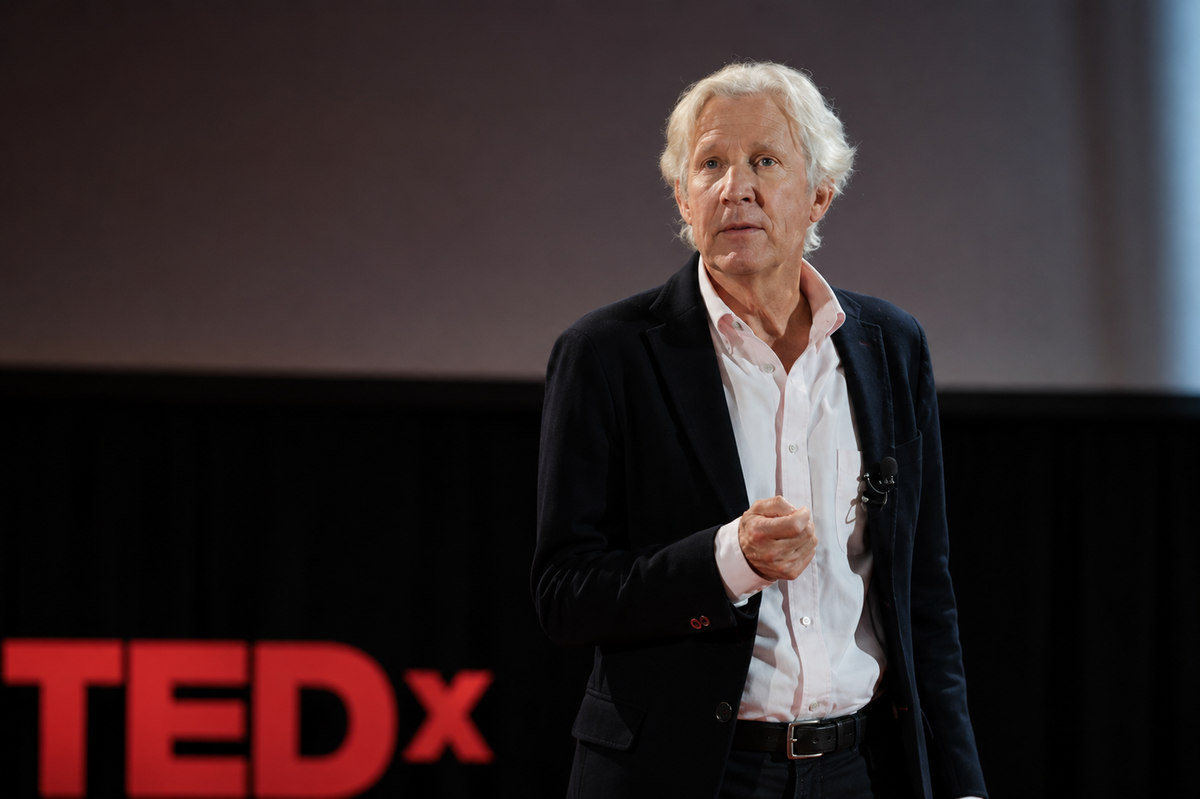
Bill Mundell delivering his TEDxClaremontGraduateUniversity on employee ownership, institutional design, and the future of capitalism. Posted on July 13, 2026.
By the time Bill Mundell and I traveled together to the Taihu World Cultural Forum in China in 2012, we had already become friends and colleagues. The forum, an international gathering of leaders from government, academia, business, and the cultural sector, gave us an opportunity to continue our conversations about U.S.-China relations, healthcare, economics, and the institutional questions that continue to shape both countries. Among the distinguished participants was Professor Robert Mundell, the 1999 Nobel Memorial Prize in Economic Sciences laureate, whose work I also had the privilege of discussing during that visit.
Over the years, I have followed Bill's work with considerable interest. Throughout his work, Bill returns to the same intellectual point of departure. He begins by questioning assumptions that others have long accepted and asks whether the institutions built upon those assumptions remain fit for purpose. That habit of inquiry runs through Bill's work, whether the subject is democratic reform, U.S.-China relations, or contemporary capitalism.
Good scholarship begins by questioning assumptions that have become so familiar they are no longer recognized as assumptions. That process, at times, reveals that what appears to be a policy problem is actually a question of institutional design. Bill's work consistently follows that path.
That quality was evident in Better Angels. At a time when the relationship between the United States and China was interpreted through the language of strategic rivalry, Bill sought a different point of entry. The film did not attempt to erase genuine differences between the two countries. Instead, it examined the assumptions that shape the relationship itself and the human foundations upon which constructive engagement ultimately depends.
“I use film when nothing else works.”
— Bill Mundell
In a 2016 interview with Shanghai Daily about Better Angels, Bill observed, "I use film when nothing else works." The observation reflects a broader conviction that when established approaches fail to produce understanding, it may be necessary to change the way the problem itself is framed. That instinct has become a consistent feature of Bill's work.
The same intellectual approach is evident in Bill's recent TEDx Talk, where he asks whether one of the central assumptions inherited from the industrial age—namely that labor and capital exist in permanent opposition—remains an adequate description of a twenty-first-century economy. He argues that this framework no longer reflects the structure of the modern economy.
In his view, corporate equity has become the principal vehicle through which wealth is accumulated, while ownership of that equity remains concentrated among a relatively small proportion of the population. He suggests that this raises broader questions about confidence in the institutions of contemporary capitalism.
His response is structural rather than ideological. Rather than asking how wealth should be redistributed after it has been created, he asks whether the institutions through which wealth is created remain appropriately designed. Through Work to Own, Bill is developing an Employee Ownership Index designed to measure broad-based employee ownership more precisely. If companies demonstrate that broader employee ownership contributes to stronger long-term performance, expanding ownership becomes a sound business decision with significant social consequences.
From the perspective of institutional governance, Bill's argument is interesting because it shifts attention away from redistribution and toward institutional design. At its core, governance concerns the design of institutions capable of producing durable and legitimate outcomes. Bill approaches capitalism through a similar lens. His concern is whether its institutional arrangements remain fit for purpose.
Whether one ultimately agrees with every aspect of Bill's conclusions is, in some respects, secondary. The more significant contribution lies in the question he asks. Good scholarly inquiry does not merely supply new answers; it challenges assumptions that have become so familiar they escape examination. Bill's TEDx Talk does exactly that. For anyone interested in institutional governance, the future of capitalism, or the relationship between ownership and economic legitimacy, his argument deserves careful consideration.
Looking back on the conversations we began in China more than a decade ago, I am not surprised that Bill continues to ask difficult institutional questions. This TEDx Talk is a natural extension of the intellectual path he has followed for many years. Congratulations, Bill.
Share this article
The link has been copied!
Your link has expired. Please request a new one.
Your link has expired. Please request a new one.
Your link has expired. Please request a new one.
Great! You've successfully signed up.
Great! You've successfully signed up.
Welcome back! You've successfully signed in.
Success! You now have access to additional content.