The Cave Beneath Mr Big: Seeing the Institution in Live and Let Die


Ian Fleming gives away the title of Live and Let Die surprisingly early. James Bond has arrived in New York to investigate Mr Big, a powerful criminal leader whom M identifies as a Soviet agent and a known member of SMERSH.[1] Bond wants to go into Harlem and see Mr Big's territory for himself. Captain Dexter of the FBI agrees reluctantly. The American case is not yet ready, and for the moment, Dexter explains, their policy is “live and let live.” Bond has another view. His motto is “live and let die.”[2] It is pure Fleming: economical, memorable, slightly brutal. It gives the novel its title. It also establishes a question running beneath nearly everything that follows:
What should an institution do when it encounters another institution organized toward purposes fundamentally opposed to its own?
Dexter represents restraint—watch, gather information, build the case. Bond wants to move toward the threat and discover what lies behind it. That movement will eventually carry him into a cave.
For readers who have not recently read Live and Let Die, the journey deserves some explanation. Old gold coins have mysteriously begun appearing in America. They are believed to come from the lost treasure of Sir Henry Morgan, and British intelligence suspects that Mr Big is moving the treasure into the United States and using the proceeds to support Soviet espionage. Bond is sent to discover how. He begins with effects rather than causes. Gold appears. Money moves. People are watched. Mr Big seems to know where Bond is almost as soon as Bond arrives. The investigation leads from New York to Florida and eventually Jamaica. Along the way, another apparently innocent object enters the story: tropical fish. Fish tanks move from Jamaica to Florida aboard Mr Big's yacht.[3]
Bond has facts. What he does not yet possess is the organization.
There is another dimension to Mr Big's power. Fleming presents him not simply as a criminal leader but as a man who has deliberately cultivated supernatural authority. His followers associate him with Baron Samedi and believe his reach extends beyond ordinary human capability. Solitaire tells Bond that they believe “The Big Man is the Zombie of Baron Samedi.” Mr Big encourages the belief, and the consequences suffered by those who disobey him give the mythology practical force.[4] Fleming's treatment of Haitian Vodou, Black Americans, and Caribbean culture bears the racial and colonial assumptions of his period and should not be mistaken for an account of the religion itself. But within the architecture of the novel, Mr Big has done something institutionally important: he has turned belief into governance. He cannot personally watch every subordinate. He does not need to. Fear extends his authority beyond his presence, and his apparent omniscience becomes part of the system by which the organization governs itself.
The cave eventually provides another explanation. Bond reaches Jamaica and swims underwater across Shark Bay toward the Isle of Surprise. Beneath it, he enters the hidden cave containing Mr Big's treasure operation. Men sort gold. Records are kept. Work is assigned. Mr Big examines lists and directs the operation. Then, at the opening of Chapter Twenty-One, “Good Night to You Both,” Bond sees a worker “fitting trays full of gold coin into the centre of the fish-tanks”—scores of which are stacked against the wall.[5]
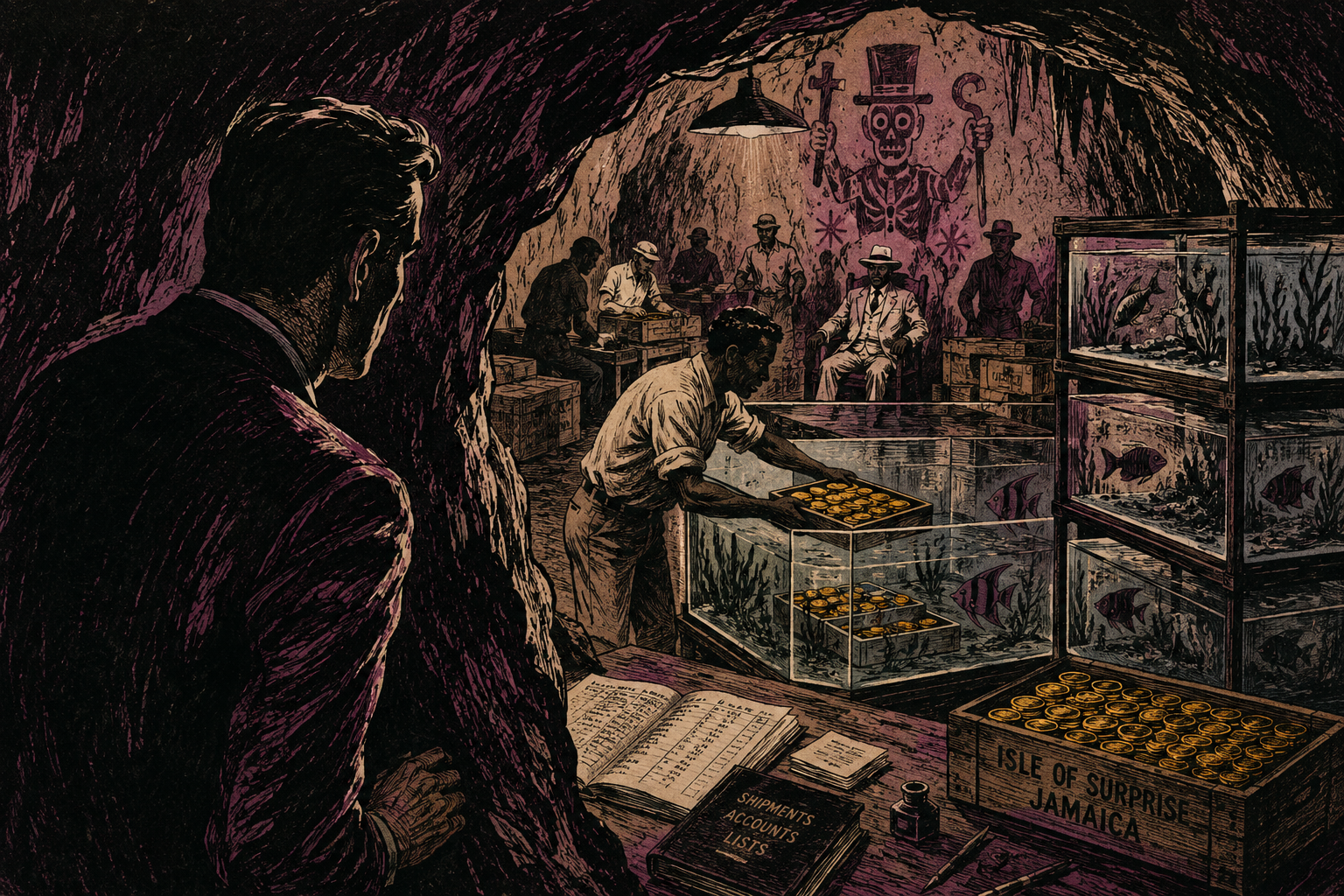
There it is: the gold, the fish tanks, the workers, the records, the commercial cover, the distribution network Bond has followed across America. For the first time, apparently separate events become visible as a single governed system. Bond has entered the cave.
It is difficult not to think of another cave. In Book VII of The Republic, Plato imagines prisoners who have spent their lives facing a wall, seeing only shadows cast by objects behind them. They naturally take those shadows for reality. In Allan Bloom’s translation, “such men would hold that the truth is nothing other than the shadows of artificial things.”[6] The prisoners are not stupid. They are reasoning from what they can see. Their error arises from the position from which they see it. They encounter effects without causes, representations without the machinery producing them. There is no need to claim Fleming consciously intended Plato. The argument does not require it. Plato simply gives us a language for understanding what Bond has been doing throughout the novel.
Bond has been watching shadows. The coins are shadows. The nightclub is a shadow. The fish business is a shadow. The yacht is a shadow. Even Mr Big's supernatural reputation is a shadow. Each is real, but the deception lies in the relationships among them. This is where Fleming's cave becomes useful for thinking about governance. Institutions are difficult to see. We see budgets, reports, policies, organizational charts, and financial statements. Those things may all be accurate and still fail to reveal the institution itself. An institution exists in relationships among authority, information, judgment, resources, and people.
Bond begins the novel knowing that the gold is moving and even suspecting its route. He ends by seeing exactly how the system works. That distinction contains much of institutional understanding. Who knows what? Who reports to whom? How does information move upward? How does authority move downward? Who sees only a task, and who sees the whole? Mr Big sees far more of the whole. Many of his followers see only their portions. That inequality of vision is one source of his power. It also makes him an interesting counterpart to M. Both govern institutions in which knowledge is necessarily incomplete. The difference is what they do with it.
M entrusts. Mr Big controls.
One institution attempts to form people capable of judgment. The other makes people dependent upon the person at the center.
Here Fleming's cave becomes an intriguing inversion of Plato's. Plato's prisoner moves toward fuller sight by turning away from the shadows and ultimately ascending out of the cave. Bond moves in the opposite direction: he descends into one. The outside world in Live and Let Die is where Mr Big's shadows are cast—apparently legitimate commerce, ordinary cargo, individual coins, unexplained deaths, supernatural reputation. Bond has to descend beneath that world to discover the system producing the appearances. The truth is underground.
Once Bond sees the system, Mr Big does not become harmless. But the mystery has gone. The supernatural appearance now stands beside the administrative reality. Mr Big knows because people report to him. Gold moves because someone packs it. Fish tanks arrive because someone transports them. Fear spreads because someone has deliberately cultivated it.
The shadows have acquired causes.
Bond has learned to see the organization. That may be the first obligation of institutional leadership: to distinguish the institution from the representations it produces. Reports matter. Metrics matter. Policies matter. Reputation matters. But none is the institution itself. Plato's prisoners have been looking all along. They simply have not learned to see. Bond enters the cave and does. Once that pattern becomes visible, it becomes difficult to look at an institution—or a Fleming novel—in quite the same way again.
1. Ian Fleming, Live and Let Die (London: Jonathan Cape, 1954), chap. 2.
2. Fleming, Live and Let Die, chap. 4.
3. Fleming, Live and Let Die, chaps. 2, 13, and 16.
4. Fleming, Live and Let Die, chaps. 2 and 11.
5. Fleming, Live and Let Die, chaps. 20–21.
6. Plato, The Republic of Plato, trans. Allan Bloom, 2nd ed. (New York: Basic Books, 1991), 193, 515c; see also 515c–516b.
Fleming, Ian. Live and Let Die. London: Jonathan Cape, 1954.
Plato. The Republic of Plato. Translated with notes and an interpretive essay by Allan Bloom. 2nd ed. New York: Basic Books, 1991.