Why Ian Fleming? An Introduction to The Fleming Project


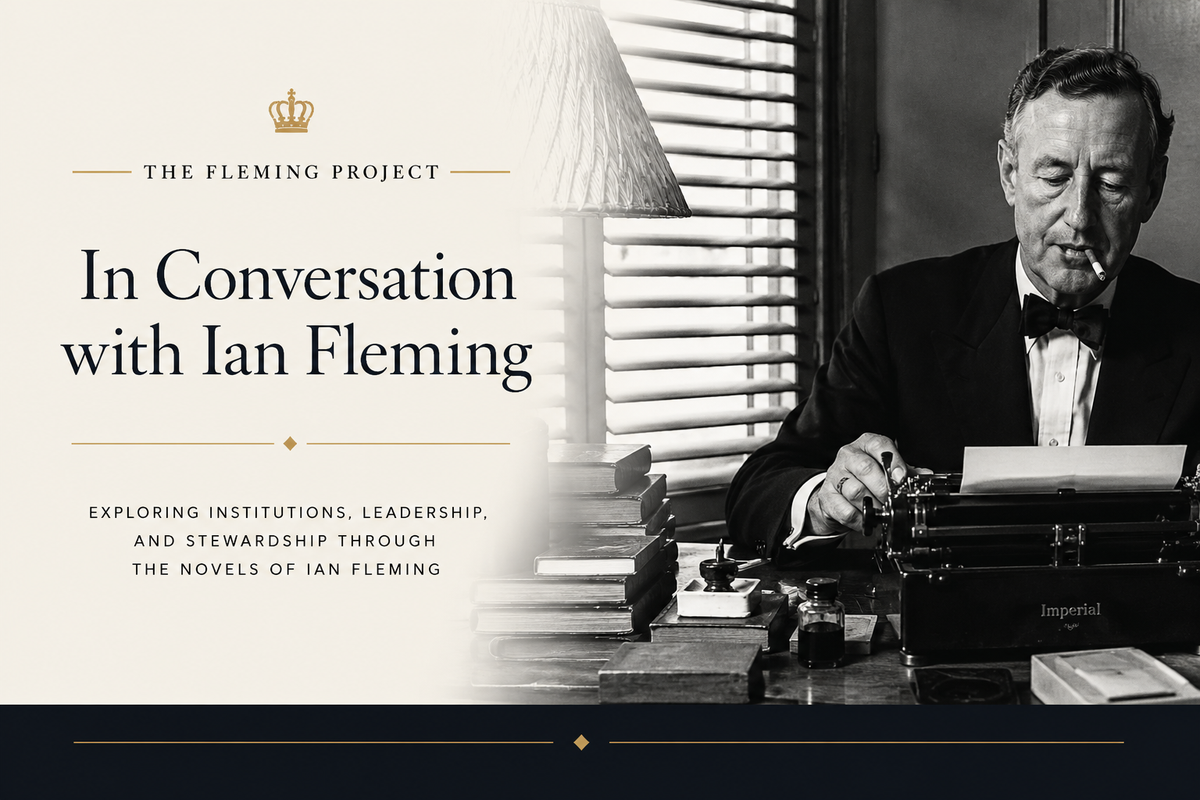
Certain questions have followed me for much of my life. They have surfaced in different settings and through different people, yet they have always returned me to the same subject: institutions. I have wanted to understand why some endure while others slowly lose their way; why some remain faithful to the purposes for which they were established while others become consumed by personalities, politics, or the slow erosion of culture; and what distinguishes stewardship from mere management. Over time, those questions became more than an intellectual interest. They became a way of seeing the world.
Those questions did not originate in books. They were born from experience. Over the better part of my professional life, and particularly during the last decade, I have had the privilege and burden of helping lead an institution through seasons that tested nearly every aspect of its life. There were financial pressures, legal battles, competing visions for the future, broken trust, and moments when reputations, relationships, and the institution itself appeared to hang in the balance. The opposition played for keeps. They always do. Real institutions are not shaped in moments of ease but in moments of consequence, and the consequences are rarely theoretical. They are measured in people, purpose, and the preservation—or loss—of something entrusted to our care.
Those experiences changed me. They changed the way I thought about leadership and governance and, perhaps most unexpectedly, the way I began to read.
For many years I have found great pleasure in reading authors whose work has endured. I have never approached them merely to collect information or to determine whether I agreed with their conclusions. My instinct has always been to understand the work before evaluating it. I want to know what the author intended to say before asking what I think about it. Only after that work is done do I begin bringing my own questions to the conversation.
That has been my habit whether reading Immanuel Kant, Niccolò Machiavelli, Bertrand Russell, historians, theologians, or statesmen. The subjects change, but my questions rarely do. What did this writer understand about human nature? What did he observe about power, duty, judgment, leadership, or institutions that I have not yet seen? Every serious author becomes, in time, a conversation partner.
I have never believed that wisdom belongs exclusively to philosophers or that enduring insight is found only in works of formal theory. Philosophers advance arguments. Historians reconstruct events. Novelists reveal through story what philosophers explain through argument. They create worlds. Within those worlds their understanding of human nature, power, loyalty, institutions, and responsibility finds expression through characters, decisions, conversations, and consequences. Their philosophy is seldom announced. It is lived.
That conviction has quietly shaped the way I have approached every serious writer. My task is not simply to understand what an author wrote, but to appreciate what the author had come to see about the world. What did this writer observe about the world that made the work possible? What truths about leadership, judgment, power, institutions, or the human condition are woven into the work, sometimes consciously, sometimes almost instinctively? Before I ask whether I agree with an author, I want first to perceive the work on its own terms.
This is not literary criticism in the conventional sense, nor is it an attempt to transform literature into organizational theory. It is, if I may borrow a word more commonly associated with theology, an exercise in hermeneutics. Novelists embed their understanding of human nature, power, loyalty, institutions, and responsibility within stories rather than propositions.
That conviction is also why Ian Fleming belongs in the same conversation as Kant, Machiavelli, or Russell. Not because he was a philosopher—he plainly was not—but because serious storytellers cannot help revealing the world as they see it. Fleming's understanding of organizational life is not presented as a theory. It emerges through the choices his characters make, the organizations they inhabit, and the consequences they face.
Writing is where that conversation becomes my own.
I seldom begin with certainty. More often I begin with curiosity. I write because writing forces me to think carefully enough to discover what I actually believe. The page exposes lazy assumptions, tests half-formed ideas, and reveals connections that remain hidden until they are given words. In that sense, every book I have written has been less a declaration than an inquiry.
It may seem unusual, then, that this inquiry should lead to Ian Fleming. Of all the writers I have read, Fleming was the one I least expected to join that conversation.
Like many readers of my generation, I first encountered James Bond through the films. They were entertaining, stylish, suspenseful, and never pretended to be anything other than excellent cinema. Years later I returned to Ian Fleming's novels, expecting simply to revisit the stories from which the films had grown. The novels demanded a different kind of reading—a slower reading—and the more slowly I read them, the more they seemed to disclose. Beneath the espionage, the travel, and the action was an author remarkably attentive to organizations—their customs, their standards, their hierarchies, and the quiet burdens carried by those entrusted with responsibility.
Bond remained the central figure, as he was always intended to be, but the institution surrounding him gradually became just as interesting. Every mission begins long before Bond enters the field. It begins with an executive decision. Someone selects Bond. Someone determines that the mission is necessary and that the risks are justified. Someone accepts responsibility if everything goes wrong.
Read in this way, Fleming raises questions that extend well beyond espionage. Why is Bond entrusted with extraordinary discretion? What kind of executive is M? How does authority move through the Service? What assumptions govern its culture? Why does professionalism matter so deeply? Why does Fleming devote such careful attention to preparation, discipline, judgment, and standards? Read individually, these may appear to be no more than narrative details. Return often enough, however, and a pattern begins to emerge.
I do not suggest that Ian Fleming set out to write a philosophy of institutional governance. He was writing novels, not treatises. Good writers almost always reveal more than they intend. Fleming had observed intelligence work, government, and the machinery of institutions at close range. He understood how organizations functioned, where they succeeded, where they failed, and what was required of those entrusted with difficult decisions. Those observations quietly permeate the novels. They are rarely explained. They simply become part of the world in which Bond operates.
These essays grow from a simple conviction. Ian Fleming's experience inevitably shaped his fiction, and his fiction is worth reading with the same care we would give his biography or correspondence. My purpose is not to turn James Bond into a management consultant or Ian Fleming into a political philosopher. It is to ask whether the accumulated observations embedded within these novels reveal something worth learning about institutions, leadership, and stewardship.
What follows are essays that begin with scenes from Fleming's novels and widen into questions about institutions, leadership, governance, and stewardship. If these essays encourage readers to return to Ian Fleming with fresh eyes while thinking more carefully about the institutions entrusted to their own care, they will have accomplished their purpose. My hope is simply to begin a conversation worth continuing—for myself and, I hope, for you as well.
