The Call That Became a Book


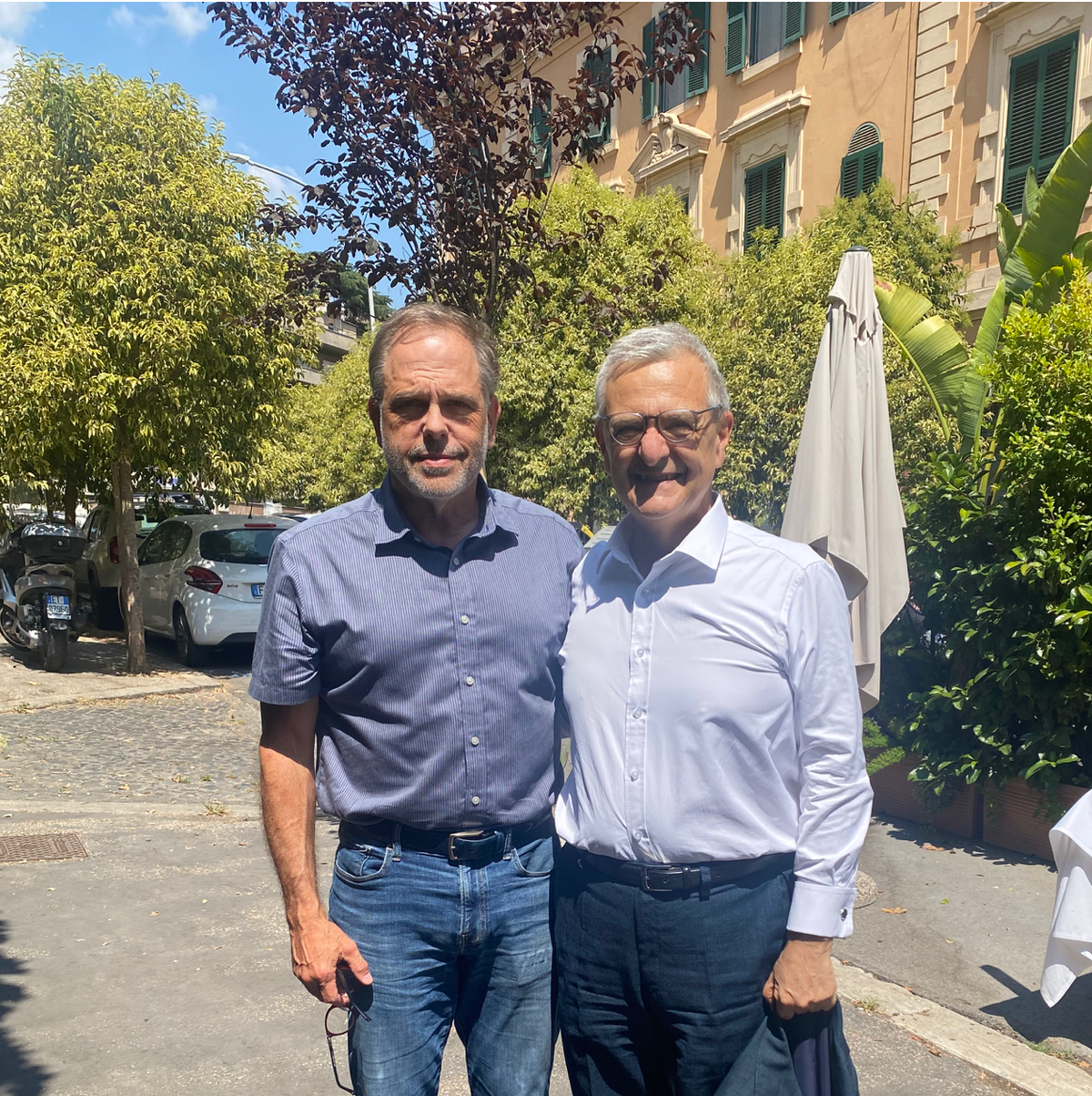
I wanted two friends to know one another. Professor Andrew Kakabadse was one of my dearest friends, someone with whom I had spent years talking about governance, leadership, institutions, universities, politics, and the human arrangements by which organizations try to hold themselves together. Francesco Sisci had entered my life differently. I first met him in New York in 2012 at the eightieth-birthday celebration of Professor Robert Mundell, and afterward I began reading his work. Then I kept reading. For more than a decade, much of our friendship traveled through messages. Francesco would publish a new article on the Appia Institute website; I would write to him about a sentence, an argument, or something that had stayed with me, and he would answer. Another article would appear, and another exchange would follow. We spoke from time to time, including several conversations in 2024. In recent years, that friendship has grown closer.
It seemed natural, then, to bring Andrew and Francesco into the same conversation. On February 24, 2025, I arranged a one-hour Zoom call and introduced them to one another. The conversation was lively from the beginning. Their views differed, sometimes quite sharply, particularly when the discussion turned to Russia, the war in Ukraine, and China, but the disagreement never disturbed the warmth of the exchange. There was an ease to it, a friendly banter in which they could test one another’s arguments, push back, laugh, and continue talking. I mostly enjoyed listening. There was something deeply satisfying in hearing two people dear to me engage one another so freely. I did not know then that, within five months, Andrew would no longer be with us. Knowing that now changes the memory of the conversation and makes me all the more grateful that I brought them together. Somewhere during that call, Francesco mentioned a manuscript. There were notes, chapters, old research, essays written years apart, and arguments he had carried for decades without bringing them into one form. Then he asked whether I might help him. I said yes.
Francesco traces the beginnings of what would eventually become this book to 1990–91, when he was thinking about warfare in ancient China and its relationship to political organization and logic. He wanted to look beyond Sunzi and into the wider pre-Qin world, especially Mozi, where military defense, philosophy, politics, and logic sit surprisingly close together. Over the years, he kept writing, researching, and gathering sources, but he had not yet found the form that would turn all of it into a book. Then life moved. His teachers died. He married. There were children. Journalism followed. Beijing, diplomacy, think tanks, universities, and thousands of articles came after that. China changed, and the world changed with it.
The idea of the book remained. What it needed was form.
By the time the manuscript came properly into my hands, Francesco had more than forty years of thought behind it. That was its strength and its difficulty. There was too much history, too many connections, and too much that was obvious to Francesco because he had lived with it for half a lifetime. A reader had not. So the work began with questions. What is the book? What are you trying to say? Why is this chapter here? What does Mozi have to do with Xi Jinping? Why does geography matter? What connects warfare with political order? Why should a reader who knows little about classical China care?
Francesco later wrote in his acknowledgments that he had accumulated notes for decades but struggled to organize the relationships among military affairs, statecraft, logic, geography, and history. He says our conversations forced him to ask what he wanted to say and why it mattered. That is also how I remember the work. A chapter moved. Another was divided. An argument buried twenty pages later came forward. Gradually, the structure appeared.
At the center of the book is a triangle: strategy, governance, and worldview. Francesco’s argument is that how a society fights cannot be separated entirely from how it governs, and how it governs cannot be separated from what it believes about authority, legitimacy, order, obligation, and the world beyond itself. Geography enters from the center, not as destiny but as pressure. Rivers flood. Mountains obstruct. Seas separate and connect. Agricultural systems demand organization. Trade routes create possibilities no ruler can fully control. Problems repeated across centuries become habits; habits become institutions; institutions eventually make certain choices appear natural.
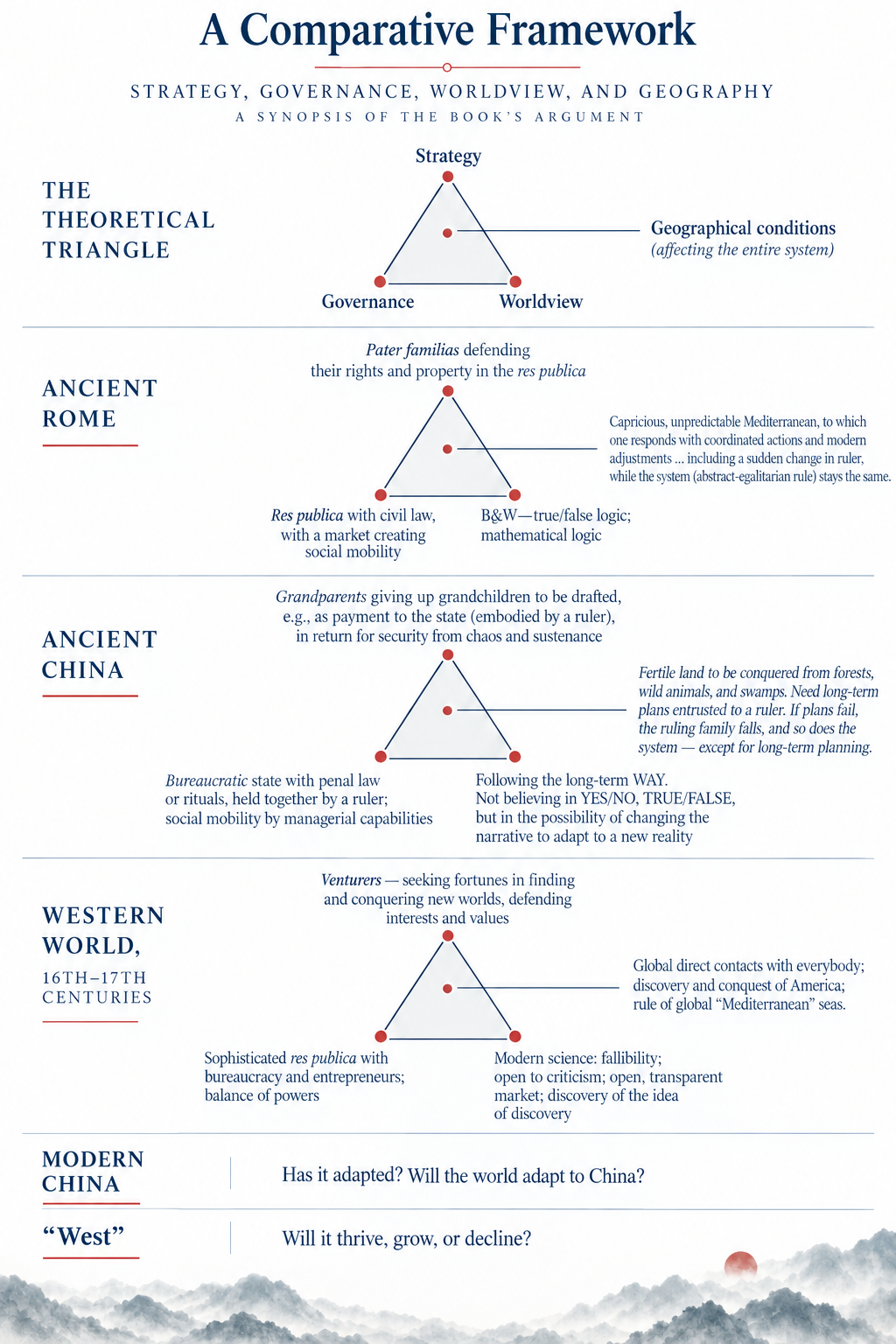
That became the architecture of Thinking from the Tip of the Spear. The book begins a long way from present-day headlines: Mozi, the Warring States, Confucius, Sunzi, ancient warfare, and the rise of political orders that predate the unified China later generations inherited. Francesco argues that this matters because many of the ideas that would influence Chinese strategy were born under political circumstances quite unlike those of the empire that followed. The thinkers of the Warring States inhabited a competitive world of rival states, yet their texts later became part of the inheritance of a civilization repeatedly concerned with restoring unity when political order fractured.
From there the book moves outward. Rome, the Mediterranean, Europe, science, markets, imperial China, Mao, reform, Xi Jinping, and America all enter the argument. The question grows with the journey: why can two intelligent people look at the same facts and find the other person’s conclusion almost incomprehensible? Francesco is interested in what comes before the conclusion—the inherited assumptions about what a state is for, where authority belongs, what counts as order, what strength looks like, when restraint is prudent, and when restraint looks weak.
These are not academic questions when great powers are involved. Misunderstanding can move markets, damage relations, and, in the worst circumstances, cost lives.
Francesco warns that when one side interprets the other through assumptions the other does not share, political errors can become strategic errors, and strategic errors can become wars.
That is where I believe the book matters. There are already many books on China, including important works on the Communist Party, Taiwan, trade, technology, the PLA, economic development, Xi Jinping, and American competition. Francesco goes underneath them. He asks how the habits through which China interprets strategy came to exist at all.
Working on the manuscript also brought me back to questions I have long considered about institutions. As the book took shape, I suggested that I might contribute an Afterword, bringing some of those questions into conversation with Francesco’s argument. He replied that he would be honored to have me do so. A leader never arrives at an empty institution. Someone has already built the room. There are rules, stories, old victories, old humiliations, ceremonies, assumptions, and practices nobody remembers choosing. The dead remain present through inherited form. That became the basis of my Afterword. Governance, as I have come to understand it, involves receiving an inheritance and deciding what must remain, what may change, and what an institution is still for.
By August, the book was close to completion. Francesco and I met in Rome and talked through some of the manuscript’s final revisions. After so much of the work had taken place through calls, messages, drafts, and files moving back and forth, there was something satisfying about sitting together with the book nearly finished.
The final months became less philosophical. There were footnotes, bibliographic entries, names, dates, graphs, captions, page breaks, copyright language, and then another footnote. We read everything again. There is something almost comic about the distance between the size of an argument and the smallness of the last tasks required to release it. A book concerned with civilization, military power, political order, and the possibility of war can still be held up at midnight by a misplaced comma.
As we approached publication, Francesco and I discussed whether to pursue a traditional publishing house or make the book freely available as an open-access edition. Francesco chose open access. He wanted anyone interested in the work to be able to read it without cost or institutional barrier.
“I want the book to be freely available to anyone who wants to read it. These questions are important, and I want the book to reach as many people as possible.”
Eventually there was nothing left to move. On September 9, 2026, Thinking from the Tip of the Spear: Military Power, Political Order, and the Making of China’s Grand Strategy went live on Zenodo. The finished volume includes a Foreword by Ge Zhaoguang of Fudan University, a distinguished historian of Chinese intellectual, cultural, and religious history.
The book was also endorsed by Sarah Allan, emerita professor at Dartmouth College and a scholar of ancient Chinese intellectual history and excavated texts; Guy S. Alitto, associate professor emeritus at the University of Chicago, whose work has centered on modern Chinese intellectual and cultural history; Ambassador Joseph R. DeTrani, former U.S. Special Envoy for the Six-Party Talks and former Director of the National Counterproliferation Center; Donald W. Keyser, former Principal Deputy Assistant Secretary of State for East Asian and Pacific Affairs; Nada Kakabadse, Professor of Policy, Governance and Ethics and head of the Henley Governance Group; Segun Toyin Dawodu, physician, attorney, and founder of Dawodu.com; and William A. Mundell, Chairman of Neurosphere Entertainment, whose work has included projects concerned with the U.S.-China relationship.
My own contribution included the editorial development and digital edition preparation, the cover design, and the Afterword.
It is freely available under a Creative Commons Attribution 4.0 license.
To download the book, see https://zenodo.org/records/22668451.
That openness matters. A book concerned with questions this large should be available to the student without an institutional library, the diplomat, the military officer, the independent scholar, and the reader who wants to understand China more seriously. It should also be available to those who disagree with Francesco, perhaps especially to them.
A useful book does not require agreement. It requires engagement.
I think now about that first call: Andrew, Francesco, and me. I thought I was introducing two people who should know one another. I think of Andrew often, and I wish very much that he were here to see where that conversation led. But I am grateful that I made the introduction, grateful that they spoke, and grateful that Francesco asked the next question: could I help him with a book? A little more than eighteen months later, the book is here. Forty years before that, the question had already begun. Now a reader somewhere neither Francesco nor I know will open the first page. That is the strange life of books. You work on them for years, and then you let them go.