Bertrand Russell’s Logical Atomism as a Framework for Leadership and Institutional Governance



Author's Note: This article does not claim that Russell’s framework was intended for organizational application, but rather that it provides a conceptual structure through which such application can be rigorously developed. This approach complements, but is distinct from, existing traditions in organizational theory that emphasize decision-making, bounded rationality, and sensemaking.
The following analysis draws from the first two lectures delivered by Bertrand Russell at Gordon Square, London, in the early twentieth century, later published as The Philosophy of Logical Atomism (Open Court, 1985). These opening lectures are foundational not merely for analytic philosophy but for what may be understood as a rigorous theory of knowledge—a disciplined method for moving from vague conviction to precise understanding and from belief to demonstrable truth.
Although Russell’s project is philosophical rather than managerial, the implications of his method extend directly into modern organizational leadership and institutional governance. At its core, leadership is an epistemic activity. Leaders form beliefs about reality, act upon those beliefs, and evaluate their adequacy against the world they encounter.
This article develops key principles derived from Russell’s logical atomism and applies them to leadership practice, arguing that governance failures are frequently failures not of intention or intelligence, but of method—failures in how organizations come to know, assert, and evaluate what they believe to be true.
Distinguishing Data from Narrative
A central feature of Russell’s theory of knowledge is the distinction between what is directly known and what is inferred. In organizational terms, this becomes the distinction between data and narrative.
Organizations routinely conflate what is observed (metrics, behaviors, outcomes) with what is inferred (causes, meanings, interpretations).
This conflation introduces error at the point of decision-making. A decline in engagement, for example, is a fact; the explanation for that decline is a belief.
Only then can decisions be evaluated on a clear epistemic foundation.
Russell’s later analysis complicates this distinction further:
“There is no simple entity that you can point to and say: this entity is physical and not mental.” (p. 152)
This observation cautions against overly rigid separations between categories of knowledge. Data and interpretation, observation and experience, are often more interwoven than organizational frameworks assume.
Russell was acutely aware that language can tempt us into treating abstractions as realities. Organizational life is replete with such formulations. One hears that "the market demands" a particular course of action, that "the organization believes" a proposition, or that "culture is shifting." Such expressions are often useful as shorthand, but they become problematic when the shorthand is mistaken for explanation. The apparent entity obscures the underlying reality of individuals, decisions, incentives, and relationships that require analysis.
These expressions often mask a lack of specificity. They reify abstractions—treating them as if they were discrete actors rather than shorthand for complex, analyzable conditions.
Which segment of the market is being described? Which behaviors constitute "culture"? Which individuals or decisions embody "organizational belief"? Governance becomes difficult when the objects of governance remain undefined.
Russell’s concern is not only with what is said, but with the logical structure of what is said. This insight carries directly into governance: not all statements are equally evaluable. Russell's concern is not merely whether a statement sounds persuasive, but whether its structure permits evaluation.
Many strategic statements fail not because they are incorrect, but because they are structurally incapable of being evaluated. They are aspirational rather than propositional.
Leadership requires distinguishing statements that guide action from statements that merely express intention.
The core of Russell’s contribution lies in his systematic account of how knowledge is formed, refined, and tested. This process can be reconstructed through a series of steps drawn directly from the early lectures.
Russell begins with the movement from vague certainty to analytical precision:
“The process of sound philosophizing, to my mind, consists mainly in passing from those obvious, vague, ambiguous things that we feel quite sure of to something precise, clear, definite…” (Russell, The Philosophy of Logical Atomism, Open Court, 1985, pp. 37–38)
This establishes the first requirement of leadership: to treat initial certainty not as conclusion, but as starting point for analysis.
He then introduces the independence of facts:
“The world contains facts, which are what they are, whatever we may choose to think about them…” (p. 40)
Here, Russell separates reality from belief. Organizational consensus does not alter underlying conditions. Facts remain indifferent to interpretation.
What makes Russell unsettling for contemporary institutions is that he leaves little room for consensus as a substitute for truth. Organizations frequently mistake agreement for knowledge. A proposition may be unanimously accepted within a boardroom and yet remain false. Russell's distinction between belief and fact therefore introduces a discipline that institutional life often resists: the possibility that collective confidence and objective reality may diverge. Modern institutions often possess elaborate mechanisms for producing consensus but comparatively fewer mechanisms for testing whether consensus corresponds to reality. Russell's distinction is therefore uncomfortable. It suggests that unanimity may reveal organizational cohesion while telling us very little about truth.
The distinction is especially important in governance because institutions often reward agreement more visibly than accuracy. Consensus reduces friction, facilitates action, and signals unity of purpose. Yet these organizational advantages can obscure a deeper epistemological question: whether the proposition upon which agreement rests is actually true. Russell's framework therefore introduces a useful asymmetry into institutional life. A proposition does not become true because it is accepted; rather, acceptance remains provisional until the proposition is tested against the facts that determine its validity. The function of governance is not merely to organize agreement, but to create conditions under which agreement remains accountable to reality.
He further clarifies that truth does not belong to facts themselves:
“There are only just facts… you would only say of a thing that it was true if it was the sort of thing that might be false…” (p. 43)
Truth and falsity, therefore, apply not to facts, but to beliefs about facts.
This leads to the relational nature of truth:
“There are two different relations… that a proposition may have to a fact… being true to the fact… or being false to the fact.” (p. 47)
Truth is neither internal nor rhetorical—it is a relationship between assertion and reality.
Russell defines the role of facts as truth-makers:
“That sort of thing that makes a proposition true or false… Facts are… something you have to take account of if you are going to give a complete account of the world.” (p. 51)
Facts are not merely inputs; they are determinative conditions. They decide whether a belief succeeds or fails.
Russell extends this framework by refining the meaning of possibility itself:
“When you say of a proposition that it is possible… there is in this proposition some constituent, which, if you turn it into a variable, will give you a propositional function that is sometimes true.” (Russell, The Philosophy of Logical Atomism, Open Court, 1985, pp. 124–125)
Possibility, in this sense, is not conjectural. It is structural. To say that something is possible is to say that it belongs to a class of propositions, some members of which are known to be true.
In organizational life, this distinction is critical. Leaders often invoke possibility in an unstructured way—markets that might emerge, strategies that could succeed. Yet without structural grounding, such claims are indistinguishable from speculation.
A possibility is legitimate only when it can be situated within a recognizable class of propositions already known to be true. Without such grounding, possibility becomes difficult to distinguish from speculation. Without this discipline, possibility collapses into narrative.
Russell further clarifies:
“When I say, for instance, that ‘Lions exist’, I do not mean the same as if I said that lions were possible…” (p. 124)
This distinction is frequently blurred in organizational decision-making. Possibilities are treated as realities; projections are treated as facts.
Russell's framework therefore imposes a necessary discipline. Possibility and actuality are not interchangeable categories, and leadership errs when it treats the former as though it were the latter.
These steps form a coherent epistemological discipline. One begins with beliefs that are often confidently held yet insufficiently examined. Those beliefs are subjected to analysis, rendered into precise propositions, and evaluated against facts understood as independent realities. Truth does not belong to the facts themselves, but to the relationship between belief and fact. The task of leadership, therefore, is not simply to make decisions, but to ensure that the propositions upon which decisions rest correspond as closely as possible to the world they seek to describe.
In organizational terms, this reframes leadership as the management of propositions about reality, continuously tested against conditions that do not bend to internal preference.
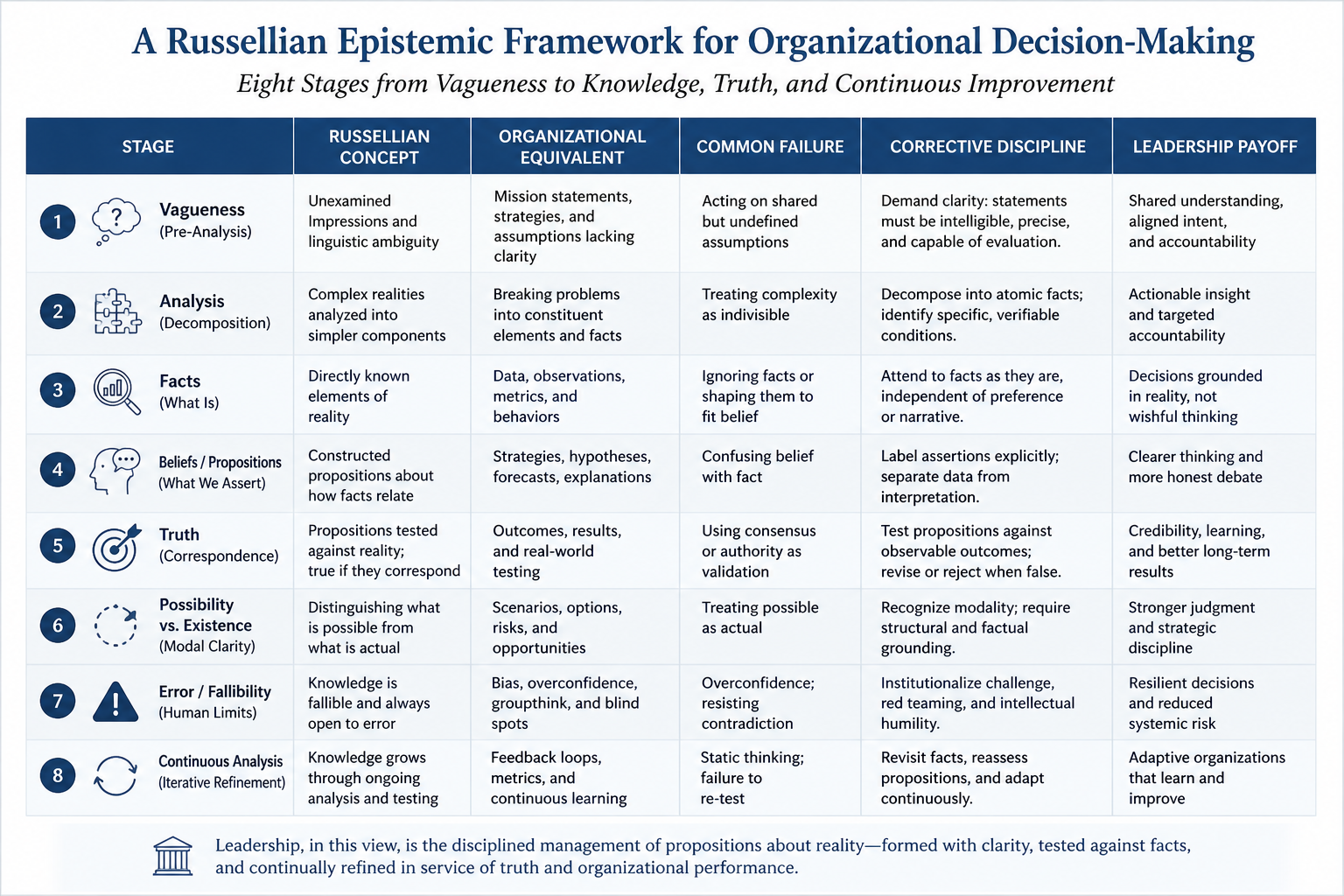
Russell’s method enforces humility—not as a moral virtue, but as a structural requirement. Because beliefs must be tested against independent facts, no assertion is immune from revision.
Institutions committed to Russell's method would require formal mechanisms through which assumptions could be challenged and tested against contrary evidence.
Humility must be embedded in process, not left to individual disposition. The appearance of decisiveness is often mistaken for the presence of knowledge. Yet in the absence of disciplined method, such decisiveness rests not upon tested propositions, but upon unexamined assumptions.
Russell’s own reflections on philosophical inquiry reinforce this structural requirement:
“The longer one pursues philosophy, the more conscious one becomes how extremely often one has been taken in by fallacies, and the less willing one is to be quite sure that an argument is valid…” (p. 153)
This is not a gesture toward skepticism, but toward discipline. It reflects the recognition that error is not exceptional—it is pervasive.
In leadership contexts, this insight carries significant weight. Early certainty is often untested certainty; experience reveals the frequency with which plausible reasoning fails under scrutiny.
Governance failure, in this sense, is rarely the result of ignorance. More often, it arises from confidence that has not been subjected to disciplined scrutiny.
Finally, Russell's method is not episodic. The movement from belief to fact to evaluation is continuous. As conditions change, previously valid propositions may become false.
Leadership, therefore, is not the achievement of a correct conclusion once and for all, but the disciplined re-examination of propositions in light of changing facts. Assumptions must be revisited, evidence re-evaluated, and strategy adjusted in light of changing facts, for propositions that once corresponded to reality may cease to do so as conditions evolve.
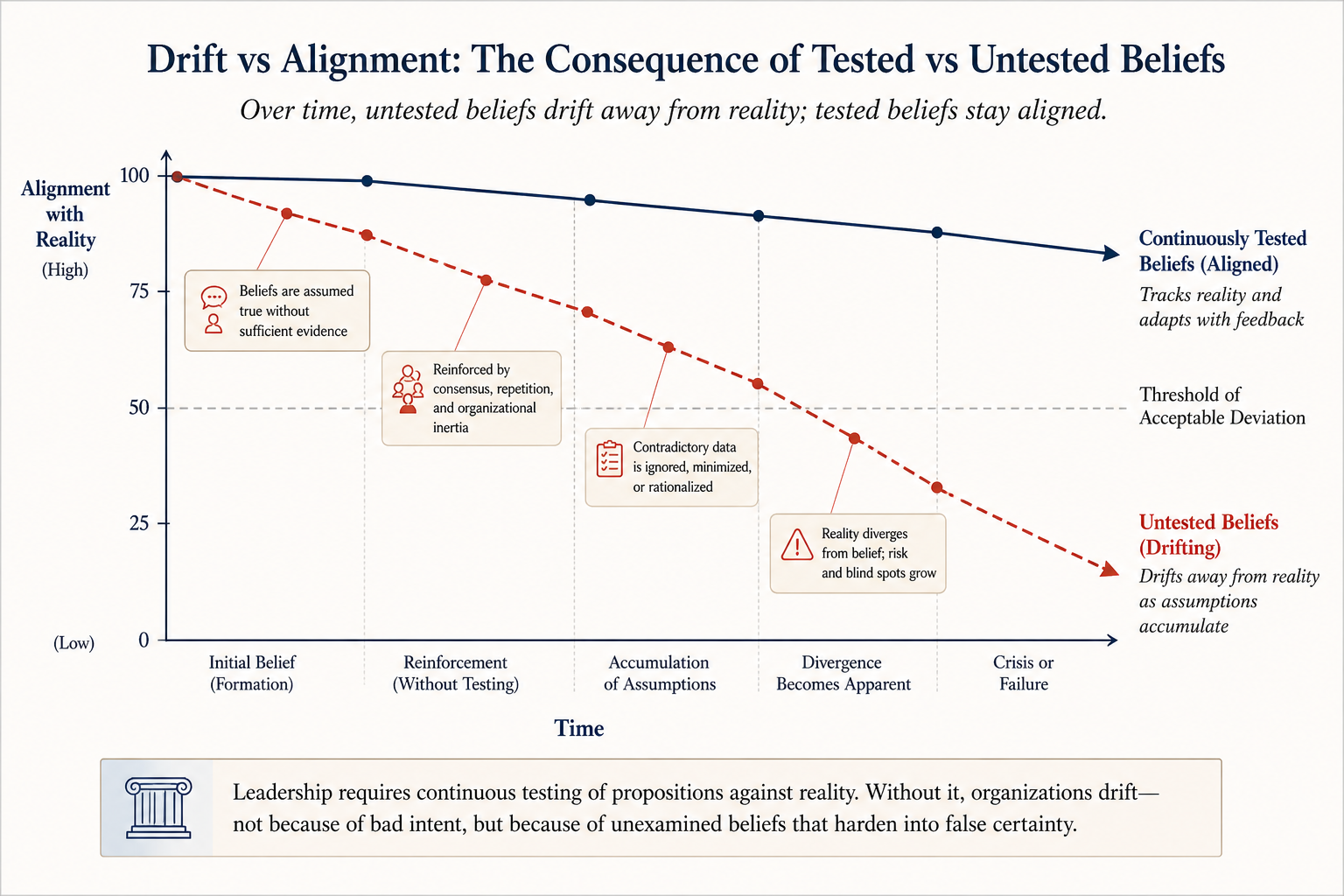
Russell’s own caution reinforces this conclusion:
“I do not profess to know whether it is true or not… I am not without hopes of finding out… but I do not profess to know yet.” (p. 153)
Russell's caution should not be mistaken for indecision. It reflects a disciplined refusal to conclude beyond the available evidence.
In contrast, many organizations are structured to reward decisiveness rather than accuracy. Conclusions are reached quickly; revision is treated as weakness.
Russell's position suggests an alternative model. The strength of an institution lies not in how quickly it arrives at conclusions, but in how rigorously it continues to test them against reality.
Russell’s logical atomism, when read through the lens of leadership and governance, offers more than a philosophical doctrine. It provides a method for institutional thinking—a disciplined approach to how organizations form beliefs, articulate strategies, and evaluate success. This method is not merely analytical; it is corrective. It restores the distinctions upon which sound judgment depends.
The governing task is ultimately epistemic: to know what one believes, to know why one believes it, and to determine whether those beliefs correspond to reality.
Governance failure is often less a failure of intention than a failure of distinction: a failure to separate belief from fact, actuality from possibility, and assumption from knowledge.