America's 250th Anniversary: When No One Is Responsible


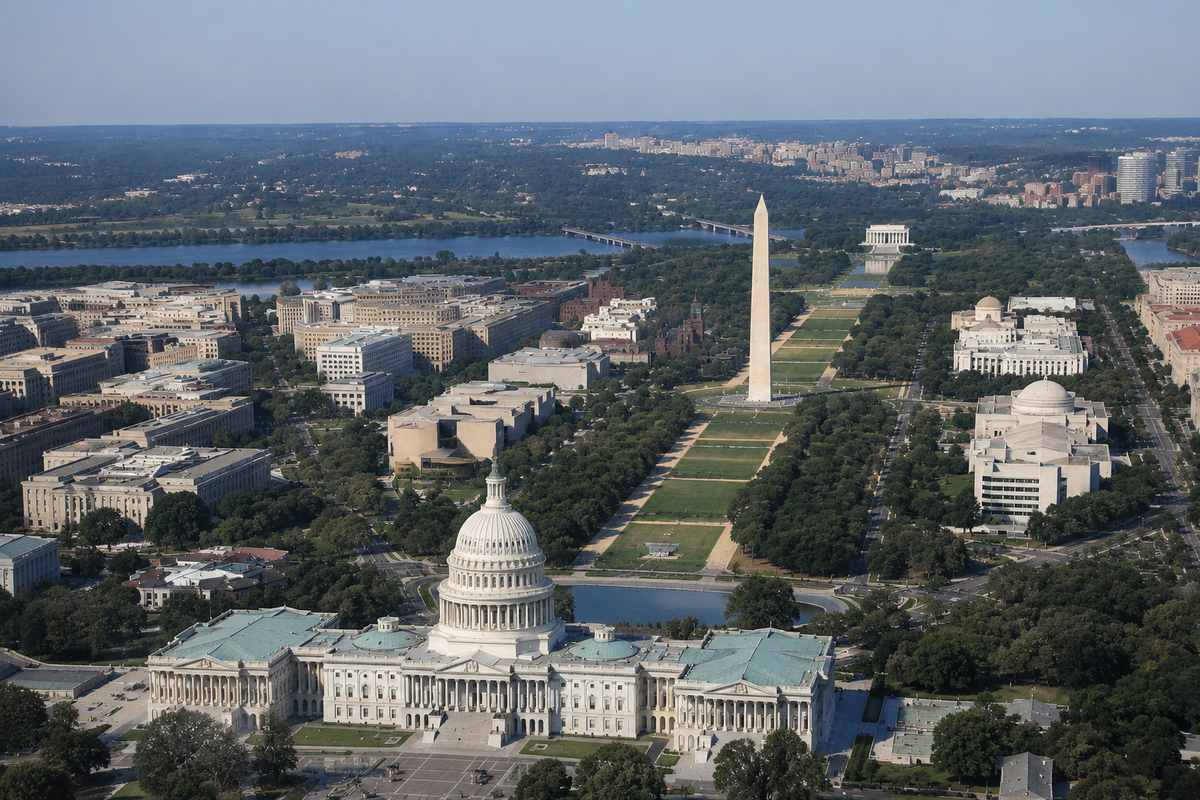
This essay examines the American constitutional system through the lens of institutional governance and organizational leadership. Its focus is the relationship among authority, responsibility, accountability, and purpose within one of the longest-enduring governance systems in modern history.
Institutions are created to pursue defined purposes through structures that assign authority and responsibility. Over time, those institutions evolve. New structures emerge, responsibilities expand, procedures accumulate, and governance becomes more complex. The central challenge for any long-lived institution is whether these adaptations strengthen the original design or gradually distance the institution from the purposes for which it was created.
The title of this essay reflects a governance concern. Authority remains visible throughout the American system of government. Decisions are made, laws are enforced, and institutions exercise significant power. Effective governance requires that responsibility remain equally visible so that citizens can determine who governs, who decides, and who bears accountability for the consequences of public action.
With this in mind, the essay explores how a governance system entering its 250th year adapts, endures, and changes across generations, and whether those changes preserve the relationship among authority, institutional responsibility, and public accountability that underpins constitutional legitimacy.
The Constitution of the United States serves as the foundational framework for the nation's system of government. Drafted in 1787 and ratified in 1788, it establishes the structure, powers, and limitations of the federal government while seeking to secure liberty, maintain order, and promote the general welfare. Central to this framework is the principle of separation of powers, through which governmental authority is divided among three distinct branches. The Constitution allocates legislative power to Congress, executive power to the President, and judicial power to the federal courts. Articles I, II, and III define these branches and their respective responsibilities, creating a system of institutional governance designed to balance authority, promote accountability, and prevent the abuse of power.
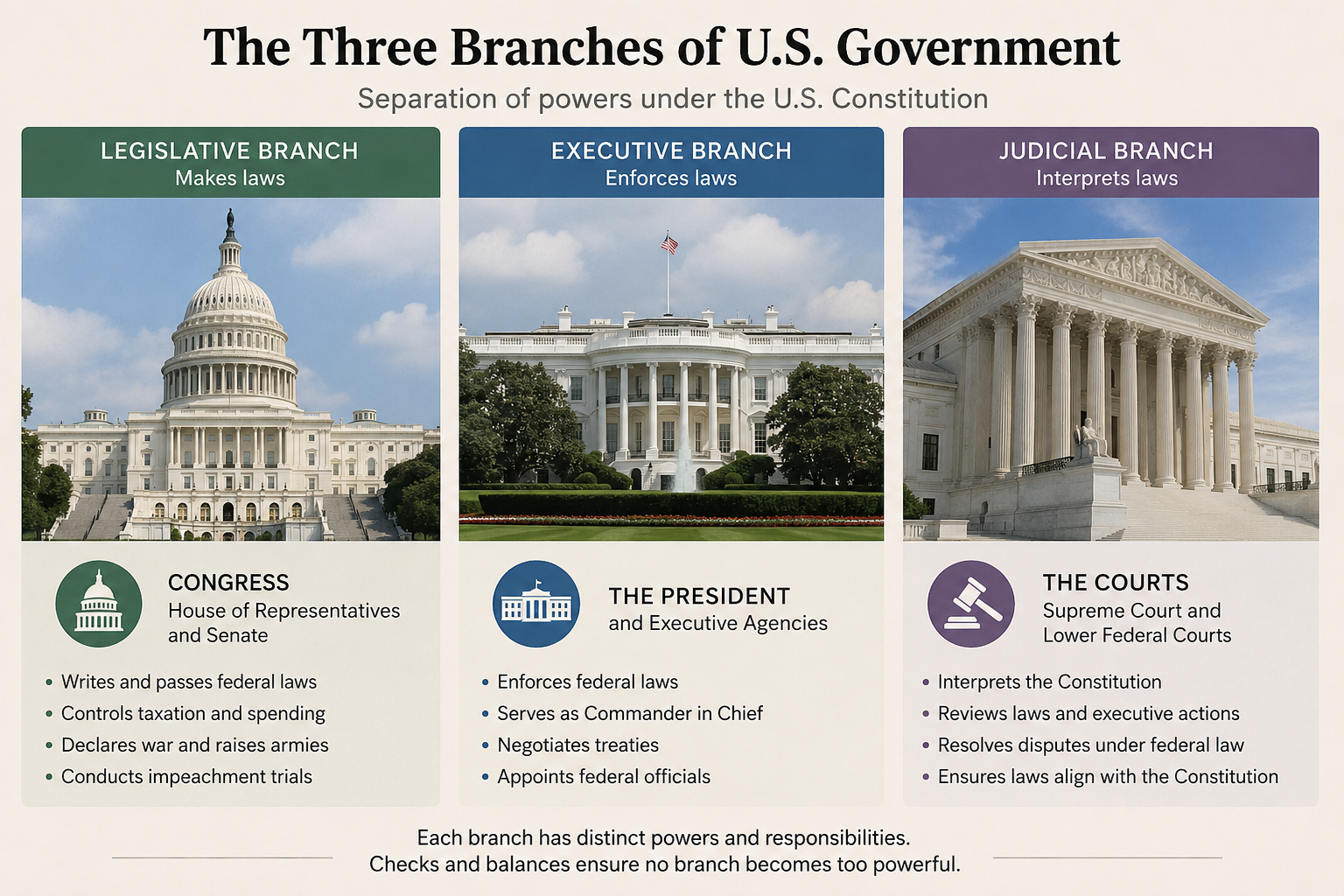
Article I vests legislative power in Congress, consisting of the House of Representatives and the Senate. Congress is responsible for making federal laws and is granted authority to tax and spend, regulate commerce, declare war, raise and support military forces, establish lower federal courts, and enact laws necessary and proper to carry out its constitutional powers. Article I also grants Congress impeachment authority, with the House empowered to impeach and the Senate empowered to conduct impeachment trials.
The Constitution divides Congress into two chambers through a system of bicameralism, meaning a legislature composed of two separate bodies: the House of Representatives and the Senate. This structure requires both chambers to agree before most legislation can become law, creating an internal check within the Legislative Branch itself. A bill must generally pass both the House and Senate in identical form before it can be presented to the President. The House may pass legislation that the Senate rejects, the Senate may amend legislation passed by the House, and either chamber may decline to consider legislation approved by the other. This arrangement prevents either chamber from exercising legislative authority independently.
The bicameral structure of Congress reflects a broader constitutional commitment to representative government. The House of Representatives is based on population and represents citizens through congressional districts, tying legislative authority directly to the people through regular elections. The Senate provides equal representation to the states, with each state receiving two senators regardless of population. Together, the two chambers embody the principle that governmental authority derives from the consent of the governed while balancing popular representation with the interests of the states. This arrangement emerged from the Great Compromise reached during the Constitutional Convention of 1787.
The Constitution further distinguishes the chambers through their respective functions. The House has traditionally been more responsive to shifts in public opinion, while the Senate was designed to serve as a more deliberative and stabilizing institution.
The chambers also possess distinct constitutional powers. The House holds the sole power of impeachment, while the Senate holds the sole power to conduct impeachment trials. Neither chamber can complete the impeachment process independently. The Senate also confirms presidential appointments and provides advice and consent on treaties. These arrangements reflect the Framers' effort to distribute authority not only among the three branches of government, but also within the Legislative Branch itself.
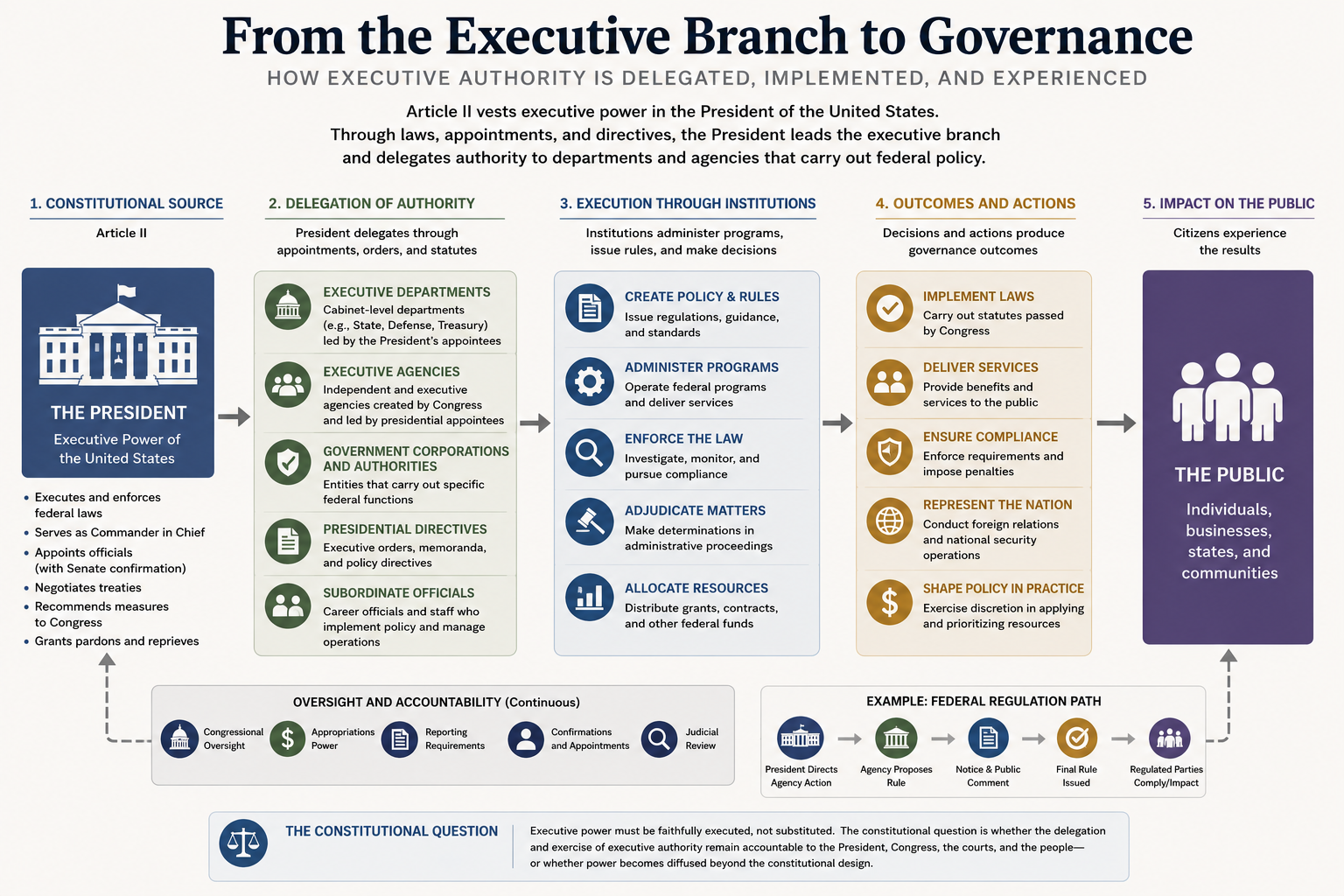
Article II vests executive power in the President of the United States. The President is responsible for executing and enforcing federal laws, serving as Commander in Chief of the armed forces, negotiating treaties and appointing federal officials with Senate approval, granting pardons, recommending measures to Congress, and ensuring that the laws are faithfully executed. The Constitution assigns the President responsibility for administering government rather than creating laws.
The Executive Branch differs from Congress in one important respect. While legislative authority is divided among hundreds of elected representatives across two chambers, executive authority is constitutionally vested in a single President. This design creates a clear line of accountability. Citizens may disagree with presidential decisions, but the Constitution generally makes it possible to identify who bears responsibility for the administration of the executive branch.
The Constitution, nevertheless, anticipates that the President will govern through subordinate officers and departments. Cabinet secretaries, military officers, diplomats, and other executive officials assist in carrying out presidential responsibilities. While these officials exercise significant authority, they do so under powers ultimately derived from the President and from laws enacted by Congress.
The concentration of executive authority in a single office was intended to promote energy, decisiveness, and accountability. Unlike Congress, where authority is distributed among many members and committees, the Executive Branch was designed to provide unified leadership in the execution of the laws. The President may delegate tasks and administrative functions, but constitutional responsibility for faithful execution remains vested in the office itself.
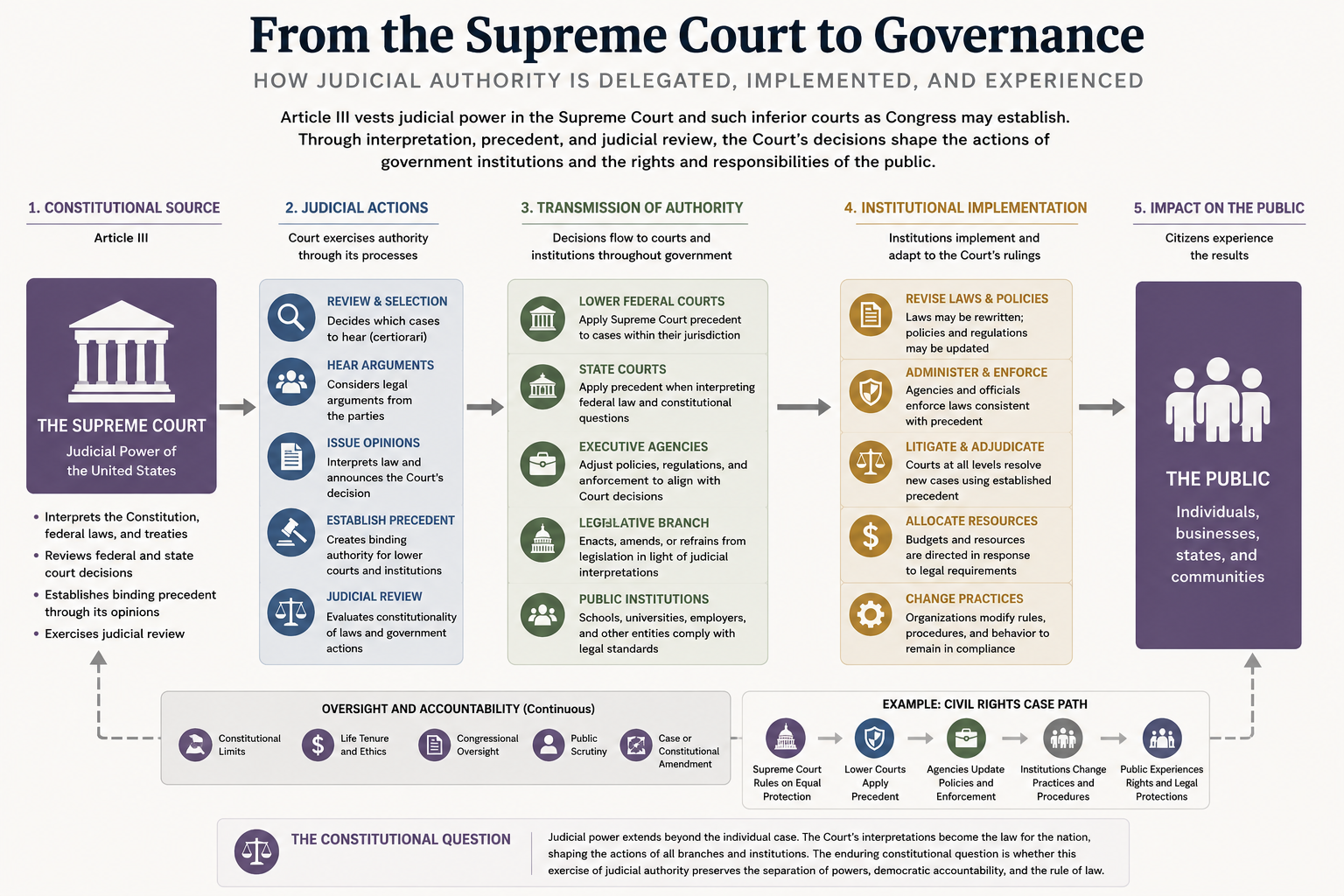
Article III vests judicial power in the Supreme Court and such lower federal courts as Congress may establish. The federal judiciary is responsible for resolving cases arising under the Constitution, federal laws, and treaties, as well as specified controversies involving states, foreign officials, and maritime matters. Article III establishes judicial independence through life tenure during good behavior and provides for jury trials in criminal cases, except impeachment proceedings.
The Judicial Branch differs from the Legislative and Executive Branches in that it does not create law or execute policy. Its constitutional role is to interpret and apply law in the resolution of actual cases and controversies. This design seeks to preserve judicial independence while limiting courts to the exercise of judicial power.
Judicial authority nevertheless carries significant institutional influence. Constitutional interpretation, precedent, and judicial review shape the operation of government and define the boundaries within which legislative and executive institutions operate. Unlike elected branches, however, the judiciary derives legitimacy primarily from the rule of law rather than democratic representation. The principle of judicial review, established in Marbury v. Madison (1803), remains one of the most consequential developments in the evolution of American constitutional governance.
The concentration of judicial authority within an independent court system was intended to promote impartiality, consistency, and constitutional stability. Although judicial decisions can have far-reaching consequences, constitutional responsibility remains tied to the resolution of cases and controversies arising under law.
The constitutional framework established by Articles I, II, and III remains formally intact. Legislative authority is vested in Congress, executive authority in the President, and judicial authority in the federal courts. The Constitution establishes a clear allocation of authority that promotes accountability and effective government.
Constitutional authority alone does not fully explain how governance operates in practice. Over nearly 250 years, the American system has evolved far beyond the institutional landscape envisioned by the Framers. Modern governance operates through agencies, departments, committees, administrative bodies, political parties, and procedural structures that either did not exist or existed only in limited form when the Constitution was drafted.
The Speaker of the House provides a useful illustration. Article I authorizes the House of Representatives to choose its Speaker. The Constitution says little about the powers of the office itself. Much of the Speaker's modern authority derives from House rules, party organization, committee structures, and control over legislative procedure rather than powers expressly enumerated in the Constitution. The office demonstrates how institutional authority can evolve beyond constitutional text while remaining embedded within the constitutional framework.
Political parties, congressional committees, administrative agencies, executive departments, and numerous other institutions play significant roles in the exercise of governmental authority despite receiving little or no direct treatment in the Constitution. Their existence illustrates how governance develops through constitutional design, legislation, institutional practice, and historical evolution.
The challenge is determining whether these developments continue to reflect the allocation of authority established by Articles I, II, and III, or whether they have altered the constitutional balance envisioned by the Framers.
Constitutional scholars have long debated whether the Constitution should be interpreted primarily according to its original public meaning or as a document whose application evolves alongside changing social and institutional conditions. The debate between originalism and theories of a living Constitution concerns how constitutional meaning should be understood across generations. The governance question examined here is related but distinct. Regardless of interpretive approach, institutions must still maintain a visible relationship among authority, institutional ownership, and public accountability if constitutional government is to remain effective and legitimate.
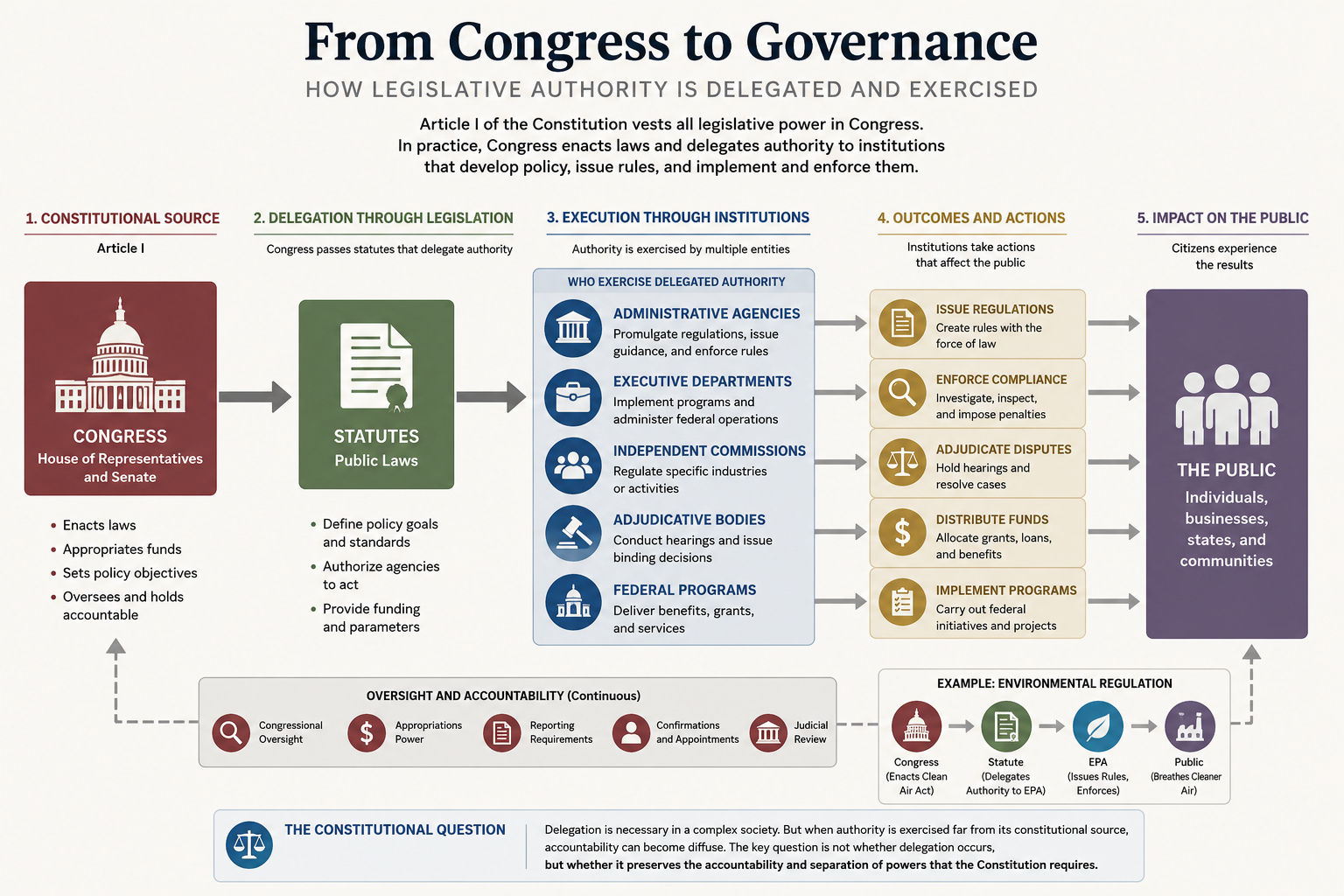
Article I vests legislative authority in Congress. Congress rarely governs through direct legislative action alone. Modern governance operates through a system of delegated authority in which statutes enacted by Congress empower executive departments, administrative agencies, commissions, and regulatory bodies to develop, implement, and enforce public policy. These institutions derive their powers from legislation and exercise substantial discretion in determining how those powers are applied. The practical exercise of governmental power often occurs several institutional layers removed from the constitutional source from which it originates. The constitutional question concerns the extent to which delegation preserves the accountability and separation of powers that Article I was designed to protect.
Modern governance illustrates the scale of this delegation. Congress establishes broad statutory objectives through legislation. Executive agencies develop the regulations, procedures, enforcement mechanisms, and technical standards that determine how those objectives are implemented in practice. Environmental policy, workplace safety, public health, energy regulation, financial oversight, and countless other policy domains are administered through institutions operating under authority delegated by Congress.
Delegation is a feature of governing a modern nation. No legislature can directly administer every aspect of public policy. The challenge emerges when the relationship between authority and responsibility becomes unclear. Agencies may exercise substantial policymaking discretion while citizens struggle to determine whether responsibility lies with Congress, the executive branch, the agency itself, or the broader administrative system. The constitutional source of authority remains Congress. The practical exercise of authority may occur elsewhere.
A quarter millennium after its founding, the United States presents a question familiar to students of institutional governance. Constitutional systems designed in the eighteenth century do not operate exactly as they did in 1789. Institutions evolve, responsibilities expand, populations grow, technologies change, and new governance challenges emerge. Historic institutions can remain formally intact while gradually drifting from the purposes for which they were created. Old buildings are judged by the condition of their foundations, the integrity of their structure, and whether successive modifications have strengthened or weakened the original design. The same principle applies to constitutional governance.
The United States Constitution remains the formal framework of American government. At its 250-year mark, the central question concerns the exercise of authority within that framework and the extent to which it continues to reflect the principles upon which it was built. Has institutional evolution preserved the constitutional allocation of responsibility established by Articles I, II, and III, or have successive adaptations altered the balance between authority and accountability that the Framers sought to create? Constitutional durability and constitutional fidelity are related concepts. They are not necessarily the same thing.
At nearly 250 years old, the American constitutional system warrants evaluation beyond simple survival. Institutions can survive long after the conditions that once made them effective begin to erode. A house may retain its façade while its foundations settle, its beams weaken, and successive renovations obscure the original structure. To an outside observer, the building still stands. The relevant question is whether it continues to bear weight as its architects intended.
This is the institutional governance question facing the United States. The Constitution names the branches, assigns their powers, and preserves the formal architecture of authority. Modern governance operates through layered institutions, delegated discretion, procedural complexity, party structures, administrative agencies, executive offices, judicial doctrines, and bureaucratic systems that sit between constitutional authority and public accountability. The building still stands. The question is whether its load-bearing walls continue to carry the constitutional responsibilities they were designed to support.
The danger is slow institutional decay: the gradual separation of authority from responsibility, responsibility from accountability, and accountability from the people. In that condition, institutions continue to perform their formal functions while losing the discipline that once justified their authority. Congress remains the legislative branch while avoiding the burdens of legislation. The President remains the executive while governing through administrative distance. Courts remain judicial bodies while their interpretations shape public life far beyond the courtroom. The system survives. Survival and institutional health are different measures.
A central governance question concerns complexity and accountability. Has institutional complexity become a mechanism through which constitutionally assigned authority is displaced, obscured, or insulated from responsibility? The Constitution creates offices and assigns responsibilities. Congress legislates and bears responsibility for legislation. The President executes the laws and bears responsibility for their faithful execution. The judiciary interprets law and exercises the judicial function. Authority and responsibility move together within the constitutional design.
As authority migrates away from the institutions charged with its exercise, institutional ownership becomes more difficult to identify. The resulting challenge extends beyond administration. It concerns the constitutional relationship between authority, responsibility, and accountability itself.
The American constitutional system enters its 250th year with remarkable durability. The enduring question is whether the relationship between authority, responsibility, and public accountability that justified the system at its founding remains visible within the institutions that govern today.
The danger extends beyond one branch openly seizing the powers of another. A subtler threat emerges through institutional evasion: Congress avoiding responsibility by delegating difficult choices, presidents expanding discretion through emergency claims and administrative control, and courts resolving disputes in ways that reshape public policy while presenting those judgments as legal interpretation. In each case, the formal structure of Articles I, II, and III remains intact while the accountability those articles were designed to preserve weakens.
Institutional decline rarely begins with collapse. It begins with misalignment. The formal structure of an institution remains intact while the relationships that sustain its effectiveness weaken. Authority becomes separated from responsibility. Responsibility becomes separated from accountability. Procedures multiply. Outcomes become difficult to attribute to any identifiable decision-maker.
In healthy institutions, authority and accountability move together. Those empowered to make decisions explain them, defend them, and bear responsibility for their consequences. In declining institutions, authority becomes diffuse and accountability becomes selective. Decisions emerge from committees, agencies, advisory bodies, leadership structures, administrative processes, and institutional networks. Responsibility becomes difficult to locate. When outcomes are successful, many actors claim credit. When outcomes fail, responsibility becomes difficult to identify.
This dynamic presents a challenge for democratic governance. Representative institutions depend upon citizens being able to determine who exercised authority, why decisions were made, and who bears responsibility for the results. Governance systems lose accountability when responsibility can no longer be traced. Elections, laws, and constitutional procedures may remain intact. Institutional legitimacy depends upon visible responsibility.
Institutional governance requires evaluating how authority is structured and whether the institution continues to achieve the purposes for which it was created. Structure is a means. Purpose is the end. An institution may preserve its procedures while losing sight of its mission. Governance failures emerge when institutional performance becomes disconnected from institutional purpose.
What if the modern governance challenge is not concentrated power, but fragmented responsibility?
The constitutional system was designed to balance liberty with effective government through representative institutions, separated powers, and visible accountability. The governance question concerns whether these structures continue to produce the outcomes they were designed to produce. Do citizens believe their representatives represent them? Can responsibility for public decisions be identified and traced? Are institutions capable of acting effectively while remaining accountable for the exercise of authority?
These questions extend beyond constitutional compliance into institutional performance. A governance system can remain legally valid while experiencing declining trust, diminished accountability, growing complexity, and increasing distance between decision-makers and those affected by their decisions. Under such conditions, the challenge becomes organizational, institutional, and ultimately one of leadership.
The constitutional system assumes that authority and responsibility remain joined. Institutions empowered to act are expected to bear responsibility for their actions before the people and the Constitution. As authority is delegated, dispersed, or obscured among agencies, committees, bureaucracies, advisors, and other institutional actors, accountability becomes more difficult to locate. Citizens may know decisions are being made without knowing who made them. Elected officials may possess formal authority while attributing outcomes to administrative necessity, judicial interpretation, expert recommendation, or institutional procedure. The relationship between government and the governed changes. A constitutional system designed to make power visible and accountable can evolve into one in which power remains active while responsibility becomes diffuse.
An additional governance question follows. If citizens struggle to identify who made decisions, who exercised authority, and who bears responsibility for outcomes, who benefits from that uncertainty?
The question does not imply conspiracy or deliberate misconduct. It reflects a fundamental principle of governance: complexity obscures accountability. As responsibility becomes more difficult to trace, institutions retain authority while becoming less answerable for its exercise. The challenge concerns institutional accountability itself.
The distinction between legality and constitutional fidelity becomes important. An action may be lawful under statute, precedent, or institutional practice while raising questions about whether it honors the constitutional design. The Constitution allocates power. That allocation imposes discipline. If Congress ceases to legislate meaningfully, if the President exercises authority beyond faithful execution, or if courts become substitutes for democratic judgment, the constitutional system can continue to function procedurally while drifting from its governing logic.
These questions extend beyond theory. Public debate increasingly reflects concerns about the relationship between constitutional design and modern governance. Critics argue that presidents exercise powers beyond those contemplated by Article II, that Congress has become detached from the citizens it was designed to represent, and that unelected institutions exercise substantial influence over public policy without direct constitutional accountability. Defenders argue that these developments reflect the realities of governing a modern nation and remain consistent with constitutional principles expressed through legislation, precedent, and institutional evolution. Evaluating these claims requires examining how authority is exercised within each branch and whether contemporary governance remains aligned with the constitutional allocation of power established by Articles I, II, and III.
The constitutional design presupposes that citizens can identify who is responsible for governmental action. Legislative decisions are attributed to Congress, executive actions to the President, and judicial decisions to the courts. Accountability depends upon that clarity. Elections lose their corrective function when citizens cannot determine which institution exercised authority, who made the relevant decision, or where responsibility resides. The constitutional system depends upon the separation of powers and the visibility of power. As authority fragments across agencies, advisory bodies, administrative procedures, and institutional networks, the citizen's ability to hold government accountable diminishes even when the formal constitutional structure remains unchanged.
The preceding analysis has focused on constitutional design, institutional evolution, and the relationship between authority, responsibility, and accountability. The next question concerns observation. Do these governance challenges exist primarily as matters of theory, or do they appear in the practical operation of American government? Developments across multiple administrations reveal patterns that transcend political parties, individual leaders, and specific policy disputes.
From the Reagan administration to the present, several governance trends recur across administrations: the delegation of legislative authority, the growth of the administrative state, the expansion of executive governance, the influence of judicial interpretation on public policy, the institutionalization of political parties, the diffusion of accountability, and declining public trust in governing institutions. Each emerged in response to real governance challenges. Together, they raise questions about whether authority, responsibility, and accountability remain aligned within the constitutional framework.
The following case studies examine how institutional authority has evolved and how those changes have affected the relationship between constitutional design and practical governance.
Article I vests legislative authority in Congress. Much of modern governance operates through delegated authority exercised by administrative institutions. Congress establishes broad statutory objectives and assigns responsibility for implementation to executive agencies and regulatory bodies. This arrangement reflects the realities of governing a complex society and raises important questions about accountability.
Agencies such as the Environmental Protection Agency (EPA), the Occupational Safety and Health Administration (OSHA), the Department of Health and Human Services (HHS), and the Department of Education exercise substantial influence over public policy through rulemaking, enforcement, guidance, and administrative interpretation. These institutions derive their authority from legislation enacted by Congress. Many of the decisions that shape the daily experience of governance are made by administrative officials operating several layers removed from elected representatives.
Delegation is an unavoidable feature of governing a modern state. The central question concerns accountability. Has Congress retained sufficient capacity, oversight, and responsibility to remain meaningfully accountable for the authority it delegates? Institutions may transfer execution. Responsibility remains attached to the authority being exercised.
As delegation expands, the relationship between lawmaking and administration becomes more difficult to distinguish. Citizens experience governance through agencies, regulations, and administrative procedures. The constitutional source of that authority remains Congress. Greater distance between constitutional authority and practical decision-making creates greater challenges for democratic accountability.
The modern presidency presents a different governance challenge. Article II vests executive authority in a single President, creating a clear line of constitutional responsibility. Contemporary governance operates through executive action, administrative discretion, emergency authorities, and institutional mechanisms that extend far beyond the Office of the President itself. The constitutional source of authority remains singular. The practical exercise of that authority is dispersed across a vast executive apparatus.
Events spanning multiple administrations illustrate this trend. Iran-Contra raised questions about the relationship between executive institutions and congressional oversight. The USA Patriot Act, enacted following the September 11 attacks, expanded national security authorities and increased executive discretion in matters of surveillance, intelligence, and military operations. Programs such as Deferred Action for Childhood Arrivals (DACA) highlighted tensions between executive action and legislative inaction. During the COVID-19 pandemic, emergency authorities were exercised at an unprecedented scale across federal, state, and local governments.
The Deferred Action for Childhood Arrivals (DACA) program illustrates the governance challenge. Congress debated immigration reform for years without reaching a legislative solution. The executive branch responded through administrative action, using existing executive authority to defer enforcement against certain individuals brought to the United States as children. Courts were subsequently asked to determine the scope and legality of that authority. Throughout the debate, responsibility became difficult to trace. Supporters and critics directed their arguments toward Congress, the President, federal agencies, and the courts simultaneously. The case demonstrated how authority can become distributed across multiple institutions while citizens struggle to determine which institution bears primary responsibility for the outcome.
These examples differ in their policy objectives and political contexts. They share a common governance theme: reliance on executive institutions to address problems that legislative processes do not resolve. Repeated reliance on executive governance can alter public expectations regarding where decisions are made and who is responsible for making them.
Effective institutions require executive leadership. The governance question concerns the relationship between executive authority and legislative capacity. As executive authority expands and legislative capacity declines, responsibility shifts away from representative institutions and toward administrative and executive mechanisms that citizens influence less directly.
Article III establishes a judiciary responsible for resolving cases and controversies arising under the Constitution and federal law. The influence of judicial institutions extends beyond the courtroom. Through constitutional interpretation, precedent, and administrative law, judicial decisions shape the practical operation of government, private organizations, and public life.
Major constitutional decisions establish rules that influence policy for decades. Administrative law decisions determine the scope of agency authority and the relationship between administrative institutions and elected officials. Debates surrounding judicial deference illustrate the judiciary's role in defining the boundaries of governance itself.
Courts interpret law. That responsibility is central to the judicial function. The governance question concerns the relationship between judicial interpretation and policymaking. Judicial decisions increasingly address questions that legislative institutions leave unresolved and executive institutions administer through delegated authority. Courts are asked to settle disputes with significant policy consequences.
This dynamic places extraordinary pressure on judicial institutions. Courts are expected to remain impartial arbiters while serving as the final venue for some of the most consequential questions in public life. The result is a judiciary that occupies a central position within the broader governance system.
Institutions rarely drift accidentally. They drift because the incentives facing institutional actors change over time. Congress may find it politically advantageous to delegate difficult decisions while retaining the ability to criticize their implementation. Presidents may find it easier to govern through executive mechanisms than through prolonged legislative negotiation. Courts may become the venue for resolving disputes that elected institutions leave unresolved. Agencies may accumulate authority because specialized expertise is required to manage complex policy environments.
Each adaptation appears rational when viewed independently. The governance challenge emerges when those adaptations weaken the alignment among authority, responsibility, and accountability upon which the system depends.
Institutional drift does not require malice, incompetence, or constitutional disregard. It can emerge from incentives that reward the exercise of authority while diffusing responsibility for outcomes. Institutions rewarded for acquiring power rather than maintaining accountability gradually move away from their original design while remaining formally lawful.
Congressional reliance on omnibus legislation, executive reliance on emergency authorities, and increasing resort to litigation as a policymaking mechanism each illustrate how institutional incentives can redirect authority away from its original constitutional pathways.
The Framers designed the Constitution to prevent the concentration of power. Separation of powers, checks and balances, bicameralism, federalism, and regular elections were intended to ensure that no single institution or individual accumulated unchecked authority. For much of American history, the central governance concern focused on the concentration of power.
Mature institutions face challenges different from those present at their founding. As organizations evolve, responsibilities expand, and governance systems become more complex, authority becomes distributed across larger numbers of institutions, agencies, procedures, and actors. Responsibility can become equally dispersed. Accountability becomes more difficult to locate.
The governance challenge changes accordingly. Concentrated power presents a visible challenge because authority can be identified and held accountable. Fragmented responsibility presents a different challenge. Decisions are made, policies are implemented, and authority is exercised, yet citizens struggle to determine who made particular decisions, who bears responsibility for outcomes, and where accountability resides.
This possibility raises a fundamental question for a constitutional system approaching its 250th year. Has the evolution of American governance preserved the relationship among authority, institutional responsibility, and public accountability envisioned by the constitutional framework, or has institutional complexity obscured that relationship? The answer may determine whether constitutional durability and constitutional fidelity remain aligned.
The durability of an institution should be measured by more than its ability to endure. Durable institutions preserve a visible relationship between power, institutional responsibility, and public accountability across generations.
The preceding analysis points to a broader institutional lesson. Constitutional structures do not preserve themselves merely by remaining formally intact. They remain effective only when the relationships they were designed to protect remain visible in practice.
The American system was designed to prevent the concentration of unchecked power. That concern remains essential. Yet mature governance systems can face a different danger: responsibility dispersed across so many institutions, procedures, agencies, committees, and actors that accountability becomes difficult to locate.
The lesson is not that institutional evolution is a failure. Long-lived systems must adapt. The lesson is that adaptation carries a governance cost when authority becomes easier to exercise than responsibility is to trace.
If constitutional government depends upon citizens being able to identify who exercises authority, who bears responsibility, and who is accountable for outcomes, then the central governance question for the twenty-first century may not be whether power has become too concentrated. It may be whether responsibility has become too fragmented.
| Constitutional Principle | Original Design Objective | Modern Governance Reality | Governance Risk |
|---|---|---|---|
| Separation of Powers | Prevent the concentration of unchecked authority. | Authority is distributed across branches, agencies, procedures, and institutional actors. | Responsibility becomes difficult to trace. |
| Bicameralism | Require deliberation and agreement between differently constituted chambers. | Legislation often moves through complex procedures, leadership structures, and omnibus vehicles. | Legislative ownership becomes harder for citizens to identify. |
| Executive Unity | Create energy, decisiveness, and visible accountability in the execution of law. | Executive power operates through departments, agencies, emergency authorities, and administrative discretion. | Presidential responsibility becomes separated from administrative action. |
| Judicial Independence | Preserve impartial interpretation of law through courts insulated from direct political pressure. | Courts increasingly resolve disputes with significant policy consequences. | Judicial resolution can become a substitute for democratic decision-making. |
| Representative Government | Allow citizens to hold decision-makers accountable through elections and representation. | Public decisions often emerge through agencies, committees, experts, courts, and institutional processes. | Citizens may know decisions were made without knowing who owns the outcome. |
| Institutional Durability | Preserve constitutional governance across generations. | The formal structure remains standing while authority operates through increasingly complex institutional layers. | Survival may be mistaken for institutional health. |
Legislative authority is exercised through administrative institutions. Executive authority is implemented through vast bureaucratic structures. Judicial authority extends through networks of precedent and institutional compliance beyond the courtroom. Political parties, committees, agencies, advisors, and administrative bodies shape governance despite receiving little or no direct treatment in the constitutional text.
Institutional governance requires more than survival. It requires preserving the relationships among authority, institutional responsibility, public accountability, and purpose that justify institutional legitimacy.
As the United States enters its 250th year, a central question emerges. Does the constitutional system continue to distribute authority in a manner that allows citizens to identify who governs, who bears responsibility, and who should be held accountable for the exercise of power?
A final governance question follows. The Constitution was designed to prevent the concentration of power. Mature institutions may face a different challenge: fragmented responsibility.
The Framers feared a government in which too much authority resided in too few hands. Modern governance faces the possibility that authority is distributed across so many institutions, agencies, committees, procedures, and actors that responsibility becomes difficult to locate.
Power remains active. Decisions continue to be made. Government continues to operate. Accountability becomes harder to trace.
Institutions rarely fail because they lose authority. They fail because authority survives while accountability erodes.
The American constitutional system enters its 250th year with remarkable durability. The enduring question is, do authority, institutional responsibility, and public accountability remain visibly connected within the institutions that govern today?