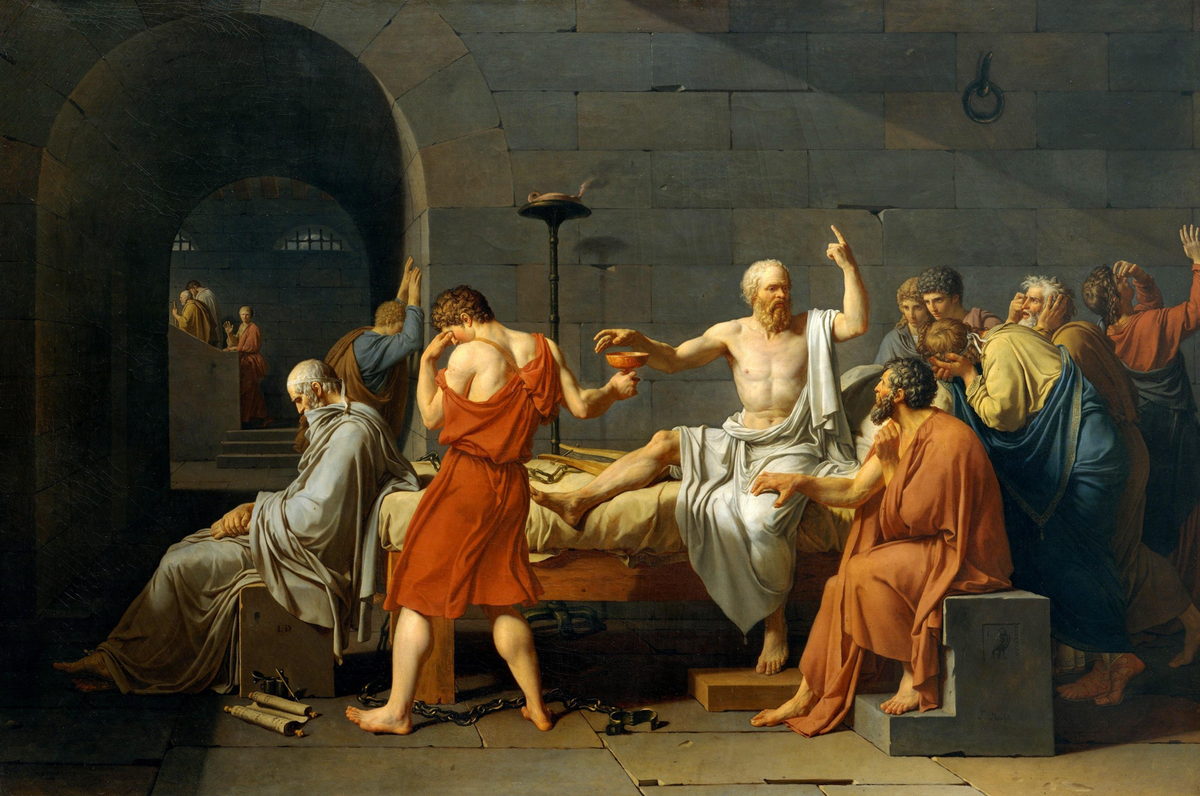
David, Jacques-Louis. The Death of Socrates. 1787. Oil on canvas. The Metropolitan Museum of Art, New York.
In times of political tension, most of the attention goes to what is happening on the surface—policy fights, elections, international disputes. But underneath all of that is a quieter, more important question:
Central Question
What kind of right and wrong is guiding these decisions?
One might think of ethics as the moral infrastructure of governance. Roads, bridges, and communication systems make collective life possible in the physical world; ethical assumptions perform a similar function in the civic realm. They create the conditions under which trust can exist, obligations can be honored, and authority can be exercised without constant coercion. When this moral infrastructure weakens, institutions may continue to operate for a time, but they do so on increasingly unstable foundations.
Governance is, at times, described in terms of institutions, laws, and procedures. Yet these are not self-sustaining. Beneath every constitution, board, court, and legislature lies a prior question: what obligations do people owe one another, and by what standard are those obligations judged? Institutions can distribute authority, but they cannot generate moral purpose. They depend upon it. When those beliefs are clear and widely shared, societies tend to be more stable and more trusting. When they are weak, inconsistent, or missing, institutions begin to strain and sometimes break.
Contemporary democracies are marked not merely by disagreement over policy, but by disagreement over the standards through which policy itself is judged. Disputes increasingly concern the legitimacy of institutions, expertise, and authority, rather than particular outcomes alone. Disagreement itself is not new. What is different is how often there is no shared starting point—no common understanding of what counts as good or right.
This is not a new problem. The thinkers of the ancient world saw it clearly. Aristotle, in Nicomachean Ethics, understood politics as a moral enterprise before it was an administrative one. The purpose of political life was not merely order, but the cultivation of conditions under which human beings might flourish. Aristotle argued,
Politics, as the highest practical discipline, must be ordered toward the good of human beings.
Where that end is abandoned, governance does not simply weaken—it changes in kind, turning away from persons and toward the preservation of power itself.
A similar warning comes from Cicero in De Officiis. Writing about duty and public life, he argued that usefulness without morality is dangerous. His line, “The foundation of justice is good faith,” points to something basic: without honesty and trust, no system—no matter how well designed—can hold together.
The force of these arguments lies in their simplicity. Neither Aristotle nor Cicero treats ethics as an accessory to political life. For both, it constitutes the condition under which political life remains possible.
Why This Matters Now
Many institutions today exhibit a peculiar form of strain. Their formal structures remain intact, yet confidence in them appears increasingly contingent. Trust is extended selectively, motives are questioned more readily, and rules are interpreted through partisan or factional lenses. What appears at first as a political problem often rests upon a deeper issue of ethical grounding.
Ethical decline rarely arrives as scandal. More often, it appears as drift. Immediate advantage begins to outweigh long-term responsibility. Standards that once applied generally become increasingly selective. Trust, accumulated slowly across years and generations, begins to dissipate. By the time institutional failure becomes visible, the underlying ethical erosion has often been underway for some time. Over time, this does more than create disagreement—it erodes the culture that allows a society to function.
The distinction is not between perfect and imperfect societies. No society fully embodies its moral ideals. The more important distinction is between societies whose ethical commitments remain sufficiently stable to orient public life and those in which such commitments become increasingly contingent. Where standards are applied unevenly, where obligations shift according to circumstance, and where public trust depends more upon faction than principle, governance becomes progressively more difficult. Institutions do not merely reflect political conditions; they reflect the moral assumptions that animate them.
Returning to First Principles
The goal is not to eliminate disagreement. Healthy societies will always argue about policy and direction. The challenge is deeper: to make sure those arguments rest on a shared sense of what is right and what is not.
The classical tradition offers a starting point. From Aristotle, the idea that governance should aim at human flourishing, not just wealth or power, but a good life. From Cicero, the insistence that duty, honesty, and good faith are essential, not optional.
These are not abstract ideas. They are practical requirements for institutions that people can trust.
The Work Ahead
Concerns about cultural decline and weakening institutions are often framed in political terms. But politics alone cannot repair what is, at root, an ethical failure.
The challenge is not political but civilizational. Every durable society depends upon a reservoir of ethical commitments that cannot be legislated into existence and cannot be recovered instantly once exhausted. Aristotle understood this when he linked politics to human flourishing. Cicero understood it when he rooted justice in good faith. Both recognized that institutions are strongest when they rest upon moral foundations they did not themselves create.
The question facing modern societies is therefore not merely how institutions should function, but what ethical inheritance sustains them. For when the moral infrastructure of a society begins to weaken, institutions do not collapse immediately. They continue for a time on accumulated trust. Yet eventually the reserves diminish, and what once appeared stable reveals itself to have depended upon foundations no longer actively maintained.
Share this article
The link has been copied!
Your link has expired. Please request a new one.
Your link has expired. Please request a new one.
Your link has expired. Please request a new one.
Great! You've successfully signed up.
Great! You've successfully signed up.
Welcome back! You've successfully signed in.
Success! You now have access to additional content.