The Crisis of Democracy: Reading Richard J. Evans


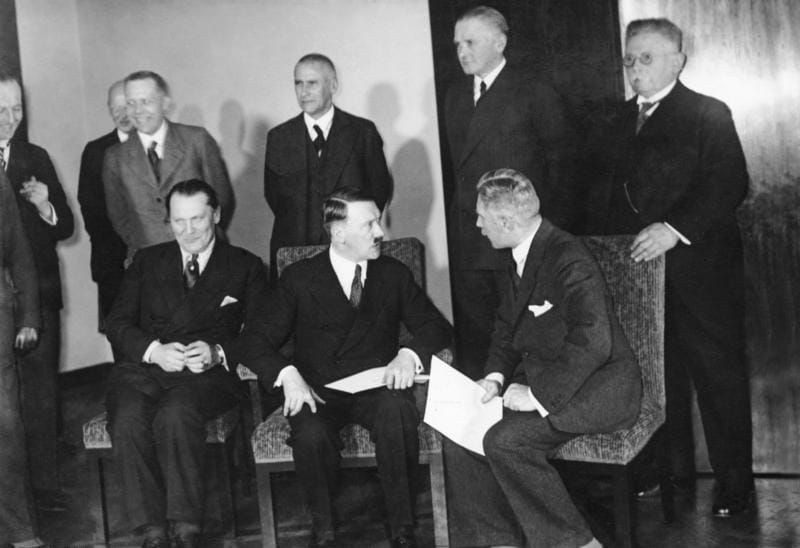
Author’s Note: I have just completed Richard J. Evans’s The Coming of the Third Reich, the first volume of his history of Nazi Germany, and have begun the second, The Third Reich in Power. The first volume has been a remarkable education in the political and institutional history that carried Germany into 1933.. What has remained with me is the long development that preceded Hitler’s appointment as Chancellor, particularly the weakening of democratic institutions and the confidence of those who believed they could manage what followed.
There is a difficulty in reading the history of the Weimar Republic because we know what came next. The knowledge of dictatorship, war, genocide, and destruction reaches backward into the years before 1933 and makes the end appear more certain than it was. Events begin to look like stages in an inevitable progression, as though the republic was always destined to end where it did. Richard J. Evans resists that certainty in The Coming of the Third Reich. He restores uncertainty to the history, which makes the collapse of the republic more disturbing.
Germany did not move in a straight line from the defeat of 1918 to Hitler’s appointment in January 1933. It moved through political choices, economic crises, intellectual movements, violence, institutional weakness, and the repeated failure of those in authority to understand the forces they were attempting to control. Some of the ideas that later became associated with the Nazi state were already present years before Hitler came close to power. Evans discusses Karl Binding and Alfred Hoche and their argument concerning “life unworthy of life,” including the concept of Ballastexistenzen, or “ballast existences.” The language is chilling because of what followed, though its importance here lies partly in its date. This was 1920, before the Nazi state existed and before Hitler had become a serious national political figure. Evans is equally careful to note that such proposals met strong opposition, and that the Republic’s insistence upon individual rights prevented them from becoming official policy.
The political world into which Nazism emerged had already begun to reconsider questions once assumed to be settled: the value of human life, the legitimacy of democratic government, the meaning of citizenship, and the authority of the state. Evans titles one section ‘The Crisis of Democracy,’ a phrase that captures the condition of the Weimar Republic better than any simple account of Hitler’s rise.
The crisis preceded Hitler’s accession to power. Parliamentary government was already being weakened by presidential rule, emergency decrees, political fragmentation, and the growing belief among leading conservative figures that democracy itself had failed.
Antisemitism had its own history, as did extreme nationalism, hostility toward Marxism, resentment over Versailles, and the belief that Germany had been betrayed in 1918. The Nazi movement gathered these currents into a political organization capable of giving them direction. The distinction between political opposition and political treason became salient because, once opponents are understood as enemies of the nation, the ordinary restraints of democratic life become harder to maintain. An opponent can be debated, defeated in an election, or replaced in government. A traitor is understood in an entirely different way.
Evans also shows how political disorder could be manufactured as well as exploited. Nazi propaganda did more than interpret events; it created a world of enemies in which military defeat, economic hardship, political conflict, and social change could be attributed to betrayal from within. Jews, Marxists, republicans, and others were drawn into a single explanatory fiction in which complex national problems acquired visible enemies. Repetition mattered. A claim did not have to be true to become politically useful; it had to become familiar, emotionally persuasive, and capable of directing anger. Once a population is taught to see a particular group as the source of danger, measures taken against that group can be presented as defensive, even when the danger itself has been exaggerated or invented.
In some Nazi propaganda, the language moved beyond accusation into dehumanization. Jews could be represented as parasites, vermin, disease, or contamination within the national body. The distinction is consequential. Once a group of people is described as an infestation rather than as fellow citizens, measures directed against them can be presented as cleansing, protection, or necessity.
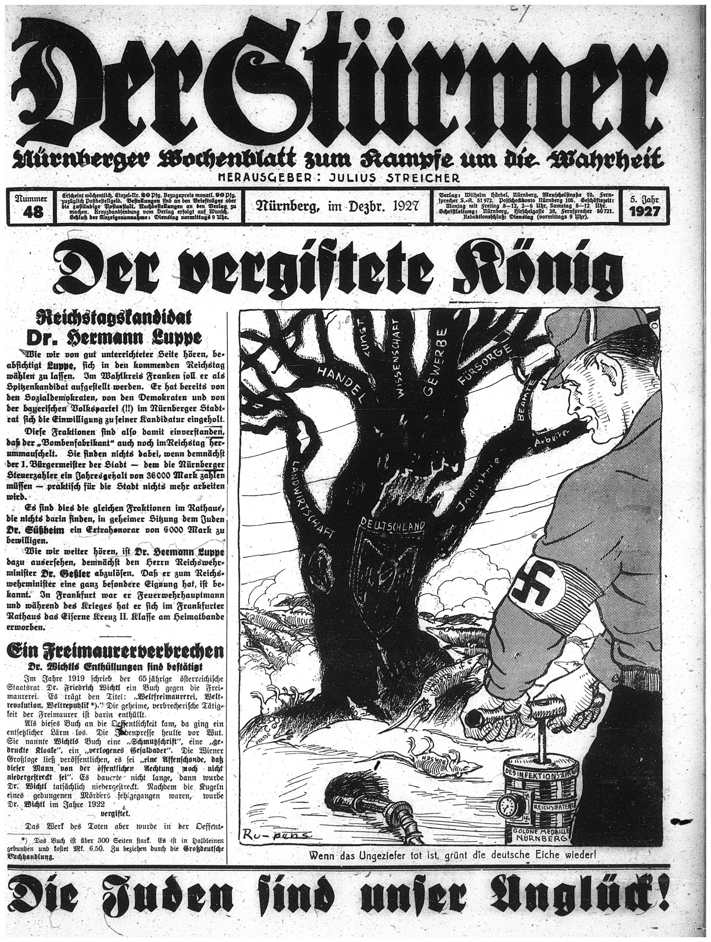
Antisemitic caricature from Der Stürmer, December 1927. Jews are depicted as vermin threatening Germany, while a Nazi figure applies poison to destroy them. German Propaganda Archive.
Violence had also entered political life long before 1933. Germany experienced uprisings, assassinations, paramilitary activity, street fighting, and attempted coups. The Nazi SA made intimidation and physical force part of political organization. Later in the volume, after Hitler had become Chancellor and SA and SS men were given police authority, Evans makes an observation that throws the earlier violence into sharper relief: “putting someone into a policeman’s uniform does not give him a licence to commit murder.” The distinction is important. Political violence changes character when those who employ it acquire the authority of the state.
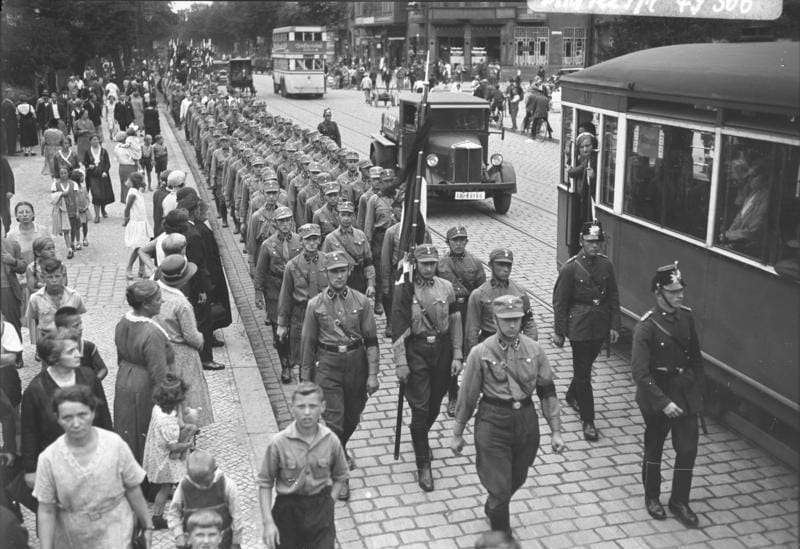
SA propaganda march in Berlin-Spandau, 1932. Bundesarchiv, B 145 Bild-P049500 / CC-BY-SA 3.0.
Considered together these were more than symptoms of an unstable political culture. They became instruments through which Hitler and the Nazi movement weakened the conditions necessary for democratic government to survive. Propaganda turned social grievance toward designated enemies; repeated falsehoods made suspicion familiar; intimidation narrowed the space for ordinary political life; and attacks upon the legitimacy of the Republic weakened confidence in the institutions expected to defend it. Evans does not suggest that every crisis was centrally engineered by the Nazis, but the cumulative direction of the movement is difficult to miss.
Institutions could be discredited before they were controlled, opponents could be placed outside the boundaries of legitimate political life, and disorder could become an argument for stronger authority.
The seizure of power therefore involved more than winning office. It depended upon weakening the political and institutional restraints that might otherwise have prevented power from being concentrated once office had been obtained.
After the failed Beer Hall Putsch of 1923, Hitler repeatedly insisted that he would come to power by legal means. Evans later describes the method by which the Nazis converted legal authority into dictatorship as a strategy of ‘legal revolution.’
Hitler intended to come to power through the legal mechanisms of the existing state and then transform the state itself. Heinrich Brüning recognized the difficulty in claiming legality for a movement whose stated intention was to break the bounds of the law once power had been obtained. The issue was therefore deeper than whether Hitler followed legal procedures in obtaining office. It concerned what legality means when procedures are used by someone who does not accept the limits that give law its force.
“If one declares that, having come to power by legal means, one will then break the bounds of the law, that is not legality.”
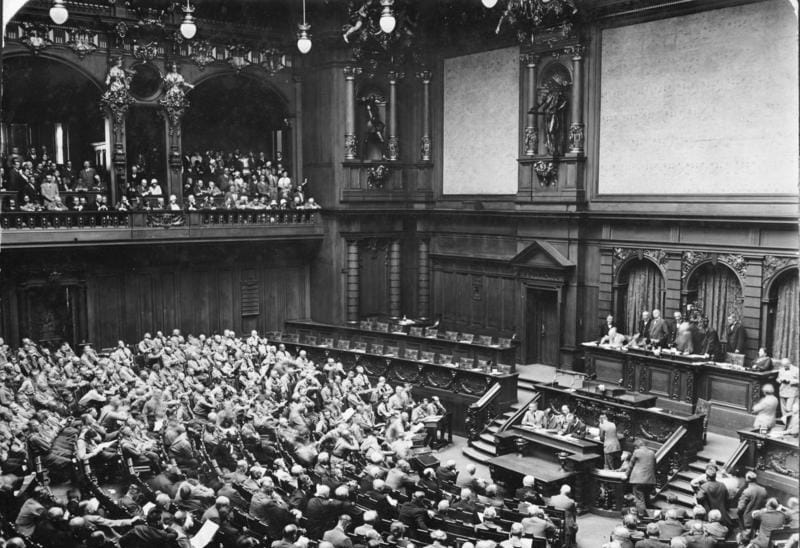
The Reichstag at its opening on August 30, 1932. The 230 National Socialist deputies are seated at left. Bundesarchiv, Bild 102-13801 / CC-BY-SA 3.0.
By the early 1930s this danger was no longer theoretical. Parliamentary government had become difficult, presidential emergency decrees substituted for stable majorities, and authority accumulated around the presidency, the chancellorship, the army, and conservative elites who had lost confidence in parliamentary rule. These men were not Nazis, and many had little respect for Hitler. They sought an authoritarian restoration of their own and believed that Hitler’s mass support might prove useful. His movement could provide what traditional conservatives lacked: numbers, energy, and popular enthusiasm. Hitler could be brought into government and surrounded by experienced men who would limit him.
The calculation rested upon confidence in institutions they assumed would remain stronger than the movement entering them. This is where Evans’s history becomes especially difficult to read with the comfort of hindsight. Those involved knew that Hitler was dangerous. They understood his rhetoric, had heard his threats, and knew that his commitment to legality was conditional. Yet they continued to believe that the presidency, cabinet, army, bureaucracy, and conservative establishment would constrain him.
Evans recounts a warning given to Hans Frank by one of his former teachers after Frank began defending Nazi activists in court:
“Political movements that begin in criminal courts will end in criminal courts.”
The Nazi movement had emerged from political violence, insurrection, prosecution, imprisonment, and repeated confrontation with the law, yet by 1933 those origins had become less disqualifying than they once appeared. What had once placed Hitler outside respectable politics no longer prevented respectable politicians from negotiating with him. The movement did not have to become moderate in order to enter the political establishment; the political environment became willing to accommodate it.
The cultural dimension of this deterioration appears throughout the book as well. Evans recalls Heinrich Heine’s warning from Almansor:
“Where books are burned, in the end people will be burned too.”
Heine wrote the sentence more than a century before the Nazi seizure of power, yet in Evans’s account it carries a terrible retrospective weight. Ideas, symbols, institutions, laws, and human beings do not occupy separate moral worlds. The destruction of one kind of restraint can prepare the ground for the destruction of another. Evans closes the volume by asking whether the Nazi transformation should be understood as a ‘revolution of destruction.’ The question mark matters.
The Nazi Party had never won an outright majority in a free national election. Its vote had fallen in November 1932. Hindenburg had previously resisted appointing Hitler Chancellor. Other outcomes remained possible, although by then few offered a straightforward return to parliamentary government. The republic did not end because every alternative had disappeared. It ended through decisions made while alternatives still existed.
On January 30, 1933, President Paul von Hindenburg appointed Adolf Hitler Chancellor of Germany. Only three members of the new cabinet were Nazis, and Papen and the conservatives around him regarded this as evidence that Hitler had been contained. The presidency remained, the cabinet remained, the army remained, the bureaucracy remained, and the law remained. They believed these institutions would hold.
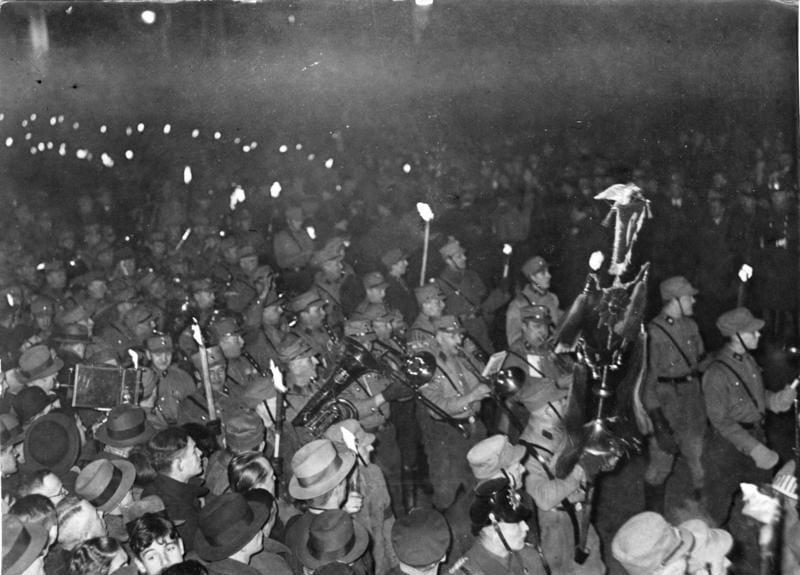
Torchlight procession through Berlin’s Wilhelmstraße on the evening of January 30, 1933, following Hitler’s appointment as Chancellor. Bundesarchiv, Bild 102-02985A.
As I begin Evans’s second volume, The Third Reich in Power, I am reminded of the obligation of responsible citizens to understand the proper boundaries of power, to defend the democratic institutions that give those boundaries effect, and to place citizenship and constitutional responsibility above party loyalty. There remained, through the final political decisions of January 1933, choices that might have produced a different outcome, even as the possibility of a straightforward return to stable parliamentary government had narrowed.
On January 30, 1933, Hindenburg appointed Hitler Chancellor. The dictatorship had not yet been created; that would follow through decisions taken in the weeks and months ahead. Those who brought Hitler into the government understood what they intended. What they could not yet know was what they had made possible.