The Underbabied American Society: What the reaction to Mehmet Oz’s remark revealed about continuity, legitimacy, and institutional modernity



When Mehmet Oz remarked that America was becoming “underbabied,” the reaction was immediate. Many people mocked the phrase. Others heard it as political pressure, demographic panic, or another attempt to turn family life into an ideological argument. Yet the strong reaction revealed something deeper than the awkwardness of the phrase itself.
While reading the reaction to Oz's remark, I was less taken aback by the phrase itself than by the intensity of the response. The phrase was awkward, but the reaction suggested that declining birth rates now touch questions far beyond demographics. What initially appeared to be a discussion about fertility increasingly revealed itself as a discussion about trust, stability, family life, and confidence in the future.
Many people today feel uncertain about the future in ways that previous generations often did not. Young adults delay marriage and children far longer than their parents did. Housing feels unstable. Economic pressure feels constant. Relationships can feel fragile and temporary. Even talking publicly about marriage, children, and family life can quickly become uncomfortable or politically charged.
That wider uncertainty helps explain why conversations about declining birth rates have become so emotionally sensitive. The central issue is not simply whether governments should encourage larger families, nor whether demographic decline should become another political battle. The deeper concern is whether modern life still creates the kind of trust, stability, and hope that help ordinary people build lasting families and welcome children into the future with confidence.
Every society that hopes to endure depends upon people believing the future is stable enough to build a life, raise children, and make sacrifices that will outlive them. Children are among the greatest acts of trust any civilization asks of its people. They are not born merely from biology or economic calculation, but from the belief that love, commitment, family, and a shared future remain real and worth building toward.
The current discussion of fertility—childbearing in particular—is shaped by contradiction. Many affluent societies speak about children as though they were mainly a matter of personal lifestyle choice while still depending upon strong families to hold social life together. Every nation still depends upon future workers, caregivers, parents, teachers, taxpayers, and citizens. Hospitals require future nurses and caregivers. Economies depend upon people willing to work, build, and carry responsibility forward. Communities depend upon individuals willing to care for others and invest in a future they may never personally see.
Yet family life cannot be reduced to economics alone. Families are one of the main places where people experience love, belonging, sacrifice, identity, character formation, and responsibility toward others. They are where children first learn trust, stability, obligation, and care. They are also where older generations pass down memory, wisdom, faith, and cultural inheritance to those who come after them.
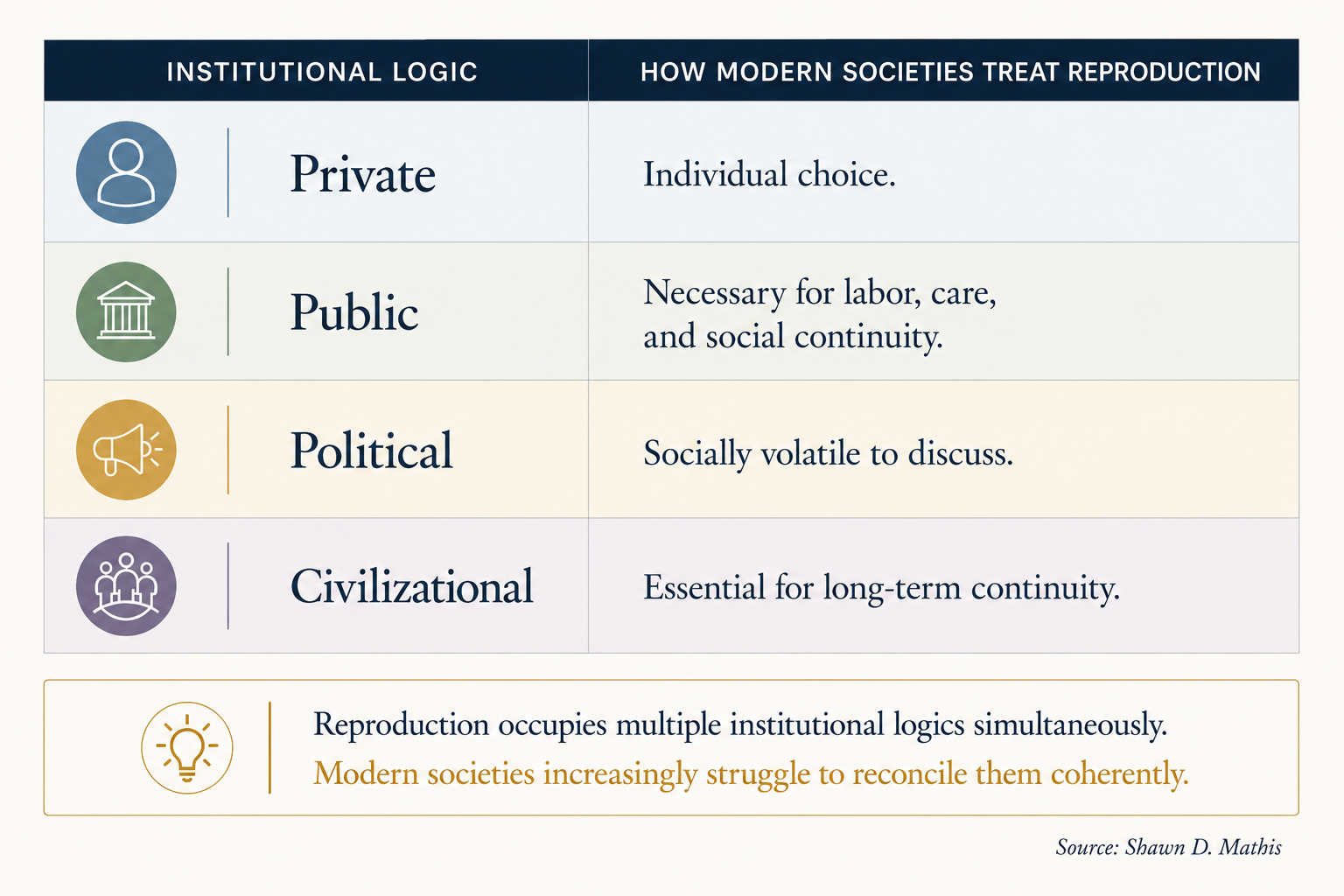
At the same time, many parts of modern life make stable family formation increasingly difficult. Housing is expensive and often uncertain. Work frequently requires people to move, change jobs, or remain constantly available. Many young adults spend years trying to finish school, pay off debt, and establish financial security before feeling ready for marriage or children. People often feel disconnected from neighborhoods, churches, extended family, and long-term community.
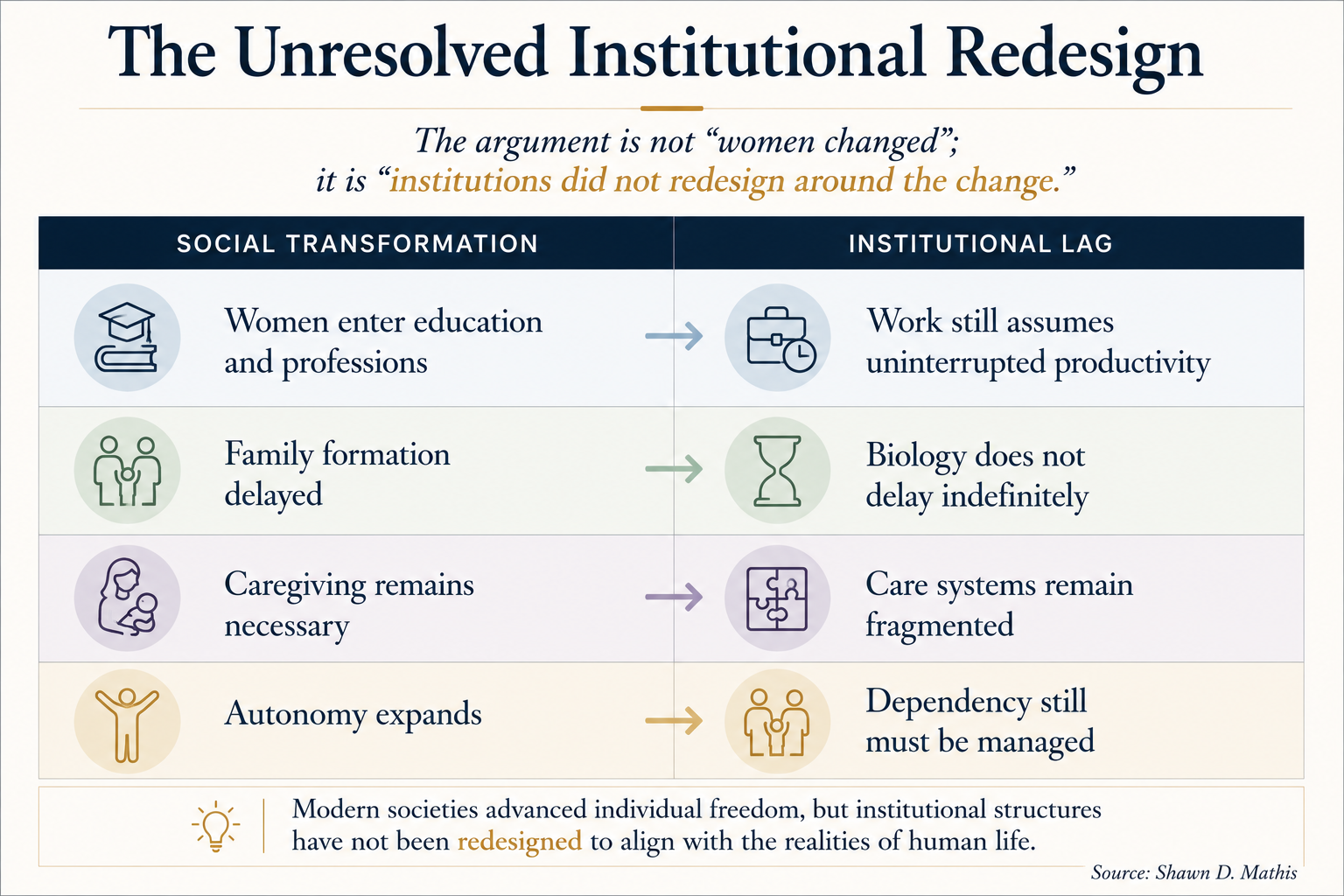
Any serious discussion of declining birth rates must also recognize how much life has changed for women over the last century. The Financial Times has likewise noted that declining birth rates are now appearing across widely different societies at the same time, suggesting broader cultural and social pressures may also be involved. Women today participate in higher education, professional careers, public leadership, and economic life in ways previous generations often could not. Much of that change represents genuine progress and expanded opportunity.
The problem is not that women entered professions once dominated by men. The problem is that many workplaces, economic pressures, and social expectations still operate as though stable family life, caregiving, and childrearing will somehow take care of themselves in the background.
Many women today are expected to build demanding careers, remain professionally competitive, continue their education, stay economically productive, and remain flexible enough to move wherever opportunity requires. At the same time, pregnancy, childbirth, caregiving, and the physical realities of raising children have not disappeared. Technology may change some parts of life, but it has not removed the human demands of family, motherhood, caregiving, and age.
As a result, many women feel caught between competing expectations. Professional life often rewards constant availability, uninterrupted career advancement, and endless productivity. Family life, however, depends upon time, emotional presence, stability, and care for others. Human beings are not machines, and family life cannot simply be organized around endless work.
The result is not simply that fewer people are having children. Many people also feel increasingly unsure about what adulthood, marriage, family life, and long-term responsibility are supposed to look like anymore. Modern culture often pushes people toward ways of living that make stable relationships, caregiving, and family formation harder to sustain over time.
At the same time, confidence in long-term commitment itself has weakened. In many countries, people are marrying later, fewer people are marrying at all, loneliness continues to rise, and growing numbers of young adults report declining relationships, lower sexual activity, and increasing distrust between men and women. These trends are often discussed mainly through politics or ideology. More fundamentally, they may reflect growing uncertainty about whether lasting love, mutual sacrifice, stable homes, and lifelong commitment are still truly possible.
Children are not born from biology alone. People are more likely to build families when they trust one another, believe lasting commitment is possible, and feel hopeful enough about the future to sacrifice for it. Strong families depend upon love, trust, responsibility, and the willingness to remain committed to other people over time.
Yet many parts of contemporary culture encourage people to avoid permanent obligations, keep their options open indefinitely, remain endlessly flexible, and place personal advancement above long-term commitment. As a result, lasting relationships often become harder to build and sustain.
The concern is not simply that fewer people are having children. Societies can continue functioning for long periods even with declining birth rates. The more serious problem appears when growing numbers of people no longer feel confident enough about the future to make permanent commitments at all. Marriage, caregiving, and raising children all require people to believe the future is stable enough to build a life within it.
That helps explain why even modest public conversations about declining birth rates can quickly become emotionally charged. Many people sense that governments, businesses, and public institutions are worried about weakening family formation while also distrusting public conversations about reproduction, marriage, and long-term responsibility. Even discussing children and family life openly can now feel politically dangerous or socially awkward.
In many earlier societies, family life was connected to larger structures that helped people move more naturally into adulthood and long-term responsibility. Families often lived closer together. Religious traditions remained stronger. Communities were more locally connected. Social expectations were clearer. Many of those older arrangements had real limitations and could become restrictive. Yet they also gave people a stronger sense of continuity, belonging, and shared responsibility across generations.
By contrast, modern life often rewards constant movement, flexibility, personal optimization, and keeping options open for as long as possible. Those freedoms can create important opportunities, but they also carry hidden costs. Societies organized around instability and constant change often weaken the very relationships and forms of trust upon which strong family life depends.
Economics clearly matter. Expensive housing, student debt, unstable work, delayed adulthood, and the rising cost of raising children all shape decisions about marriage and family life. Many people simply do not feel financially secure enough to build the future they hoped for.
One of the defining features of modern life is how long many people now delay marriage, family formation, and stable adulthood. Education takes longer. Career pressure lasts longer. Housing feels increasingly uncertain and expensive. Many young adults spend years trying to establish financial security, complete degrees, build careers, and remain professionally competitive before feeling ready for marriage or children.
Yet human biology does not completely adjust itself to those delays. Fertility medicine has helped many families and relieved real suffering for countless people. But technology alone cannot fully solve the tension created when societies increasingly encourage people to postpone family life while still depending upon future generations to sustain society over time.
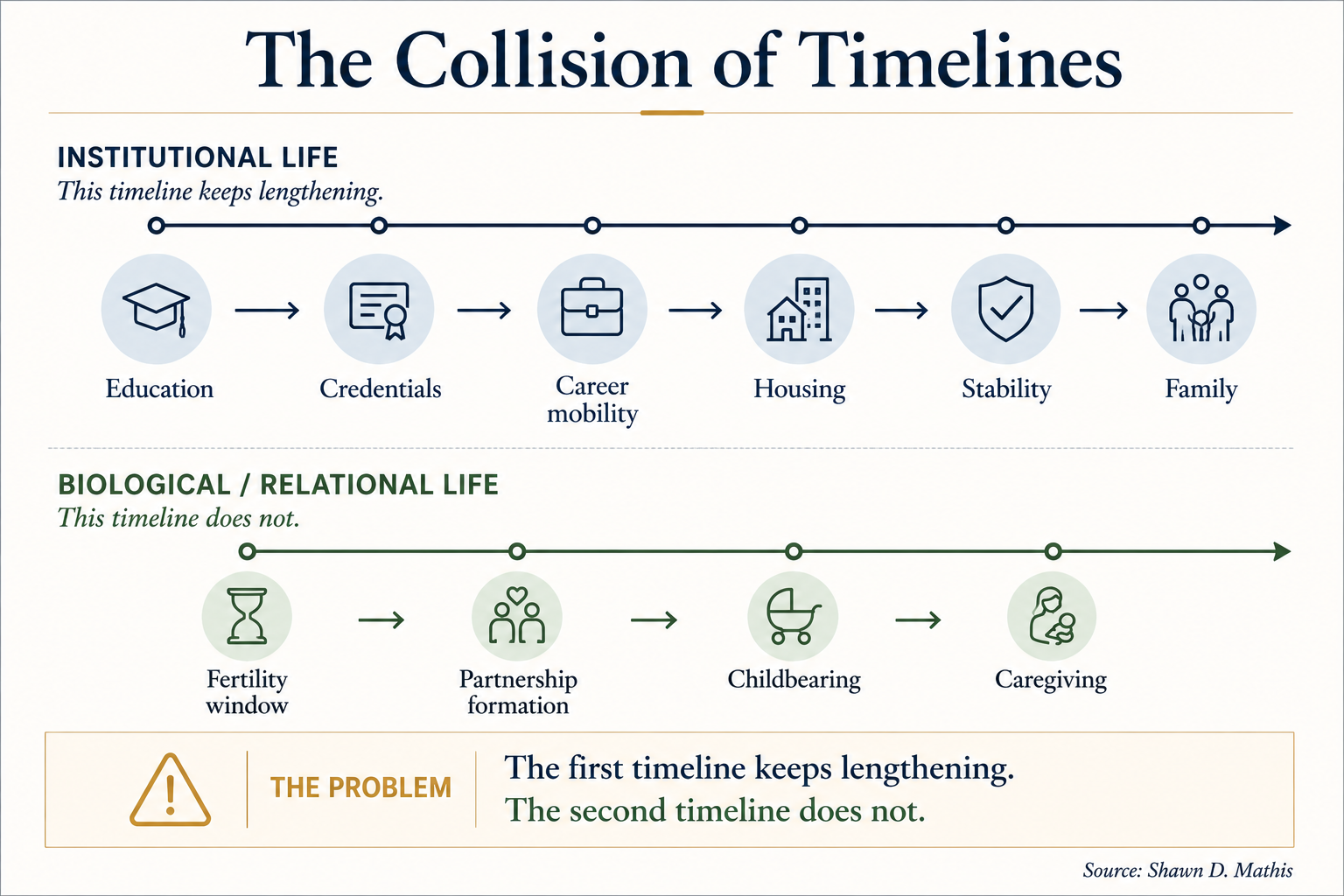
What we are witnessing is a growing tension between the way modern life is organized and the basic human realities upon which family life depends. Many wealthy nations assumed that economic growth, advanced technology, professional expertise, and efficient public systems would naturally create flourishing societies even as marriage, local community, and long-term commitment weakened.
Yet history offers very few examples of societies remaining healthy while the conditions that naturally support family life steadily erode. Across much of the developed world, the warning signs are no longer theoretical. South Korea’s birth rate has fallen to the lowest ever recorded in the modern world. South Korea’s fertility rate fell to 0.72 births per woman in 2023. Japan’s population has declined for more than a decade. In Japan, sales of adult diapers have exceeded baby diapers for years. Similar concerns now appear across many affluent nations.
These changes cannot be explained by economics alone. Across much of the developed world, fertility rates now remain below replacement level. Financial pressure matters, but something deeper also appears to be happening. Many wealthy societies became more technologically advanced and more individually free while also becoming more lonely, uncertain, and disconnected from long-term forms of belonging and responsibility.
A healthy society depends upon more than money, technology, or government programs. It depends upon ordinary people continuing to build families, care for children, maintain communities, support one another, and sacrifice for future generations. Societies remain strong when people still believe the future is worth building.
History also shows that societies rarely fall apart all at once. Researchers at Oxford’s Institute of Population Ageing have also warned about the long-term social and economic pressures associated with aging populations and declining fertility. More often, they slowly lose forms of trust, responsibility, and social cooperation that earlier generations spent decades building. Over time, people continue depending upon strong families and stable communities while becoming less certain how to sustain those things themselves.
That tension becomes visible when modern life continues depending upon marriage, caregiving, and long-term responsibility while also organizing life in ways that make those commitments harder to maintain. Many parts of contemporary culture reward constant movement, career advancement, endless flexibility, and continually redefining oneself. Yet human beings still need lasting relationships, stability, and belonging in order to flourish across generations.
Technology alone cannot sustain a civilization. Markets alone cannot sustain a civilization. Governments alone cannot sustain a civilization. Societies endure because ordinary people continue loving, sacrificing, caring for children, supporting families, honoring obligations, and building lives that extend beyond themselves into future generations.
For many years, wealthy societies relied upon forms of trust, family stability, and community strength built by earlier generations. Strong marriages, close neighborhoods, religious communities, and long-term family responsibility created social stability that many people simply inherited without thinking much about it.
But those inherited strengths are not unlimited. A society can continue living off earlier forms of social trust and stability for a long time while gradually weakening the conditions that once produced them. Eventually the effects begin to appear openly. Schools close because there are too few children. Communities grow older. Churches shrink. Public institutions struggle to renew themselves. Governments and economies increasingly rely upon immigration, debt, bureaucracy, and expanding public systems to compensate for weakening family and community life.
Part of the problem is that many societies now celebrate personal freedom, mobility, flexibility, and constant self-reinvention while still depending upon strong families, stable relationships, and social trust to hold society together. Greater personal freedom has brought many genuine benefits and opportunities. The problem is not freedom itself. The problem appears when societies begin weakening the very relationships and responsibilities that make stable freedom possible.
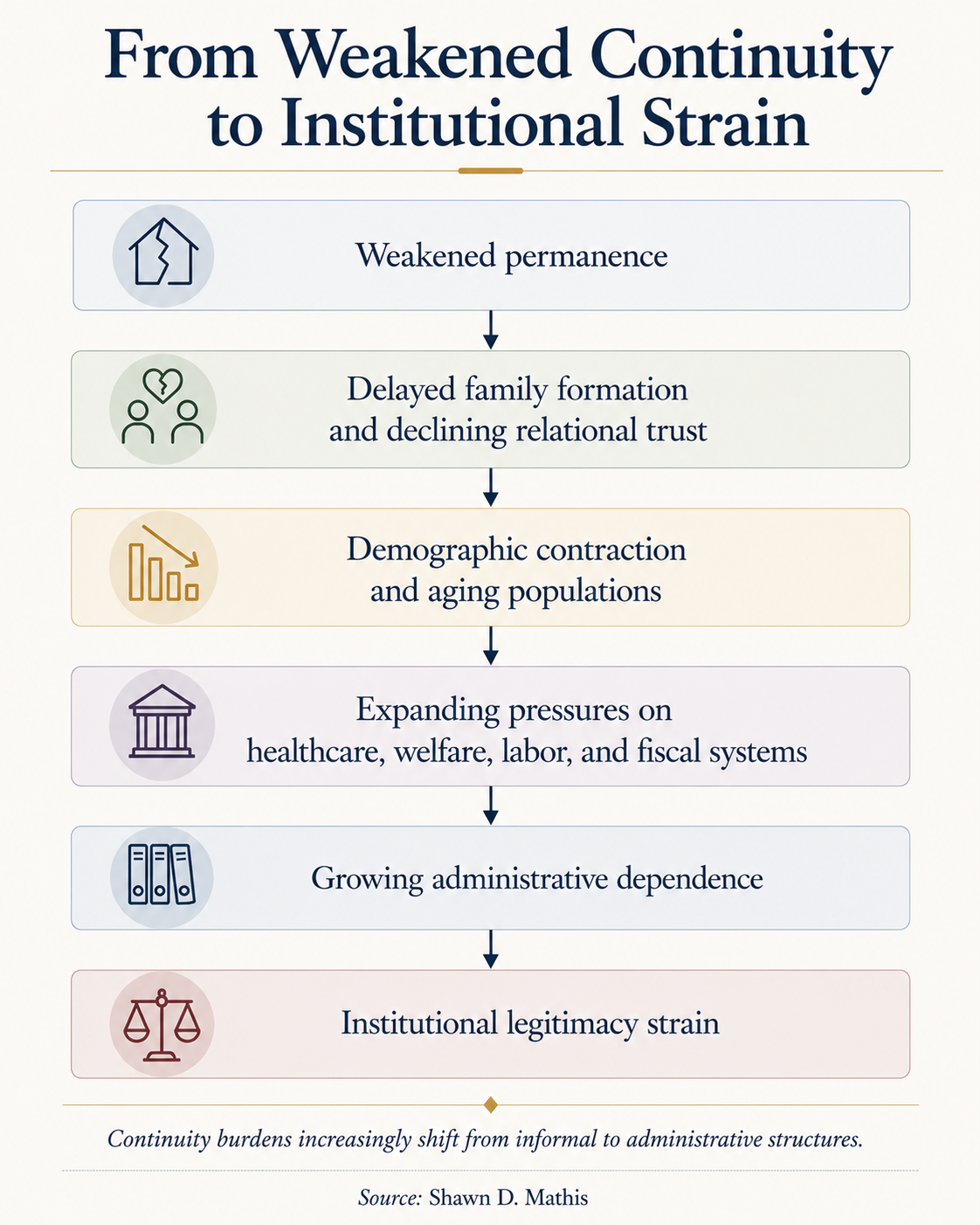
Human beings never become completely independent. When families, neighborhoods, churches, friendships, and local communities weaken, other systems must increasingly step in to carry burdens those relationships once absorbed more naturally.
Loneliness becomes a medical and psychological problem. Delayed family formation increases dependence upon fertility medicine and reproductive technology. Weakened relationships and community life produce growing layers of bureaucracy, regulation, oversight, and institutional management. As informal human relationships weaken, governments and large public systems are increasingly asked to carry responsibilities they were never fully designed to bear.
At the same time, many people are encouraged to think of life mainly in terms of personal advancement, endless flexibility, and keeping options open indefinitely. Yet healthy societies still depend upon people willingly making permanent commitments, caring for others, building families, raising children, and investing in lives larger than themselves.
Much of the anxiety surrounding falling birth rates may reflect a growing fear that modern life no longer makes lasting love, family stability, and long-term commitment feel realistic or secure.
At that point, declining birth rates become more than a demographic statistic. They may begin revealing a deeper loss of confidence in the future itself. Healthy societies cannot be sustained through government programs, economic incentives, technology, or administrative management alone. In the end, societies remain healthy because large numbers of ordinary people continue choosing love, sacrifice, responsibility, caregiving, and long-term commitment across generations.
Falling birth rates are beginning to expose deeper problems within modern society itself. Many wealthy nations still depend upon future generations to sustain schools, healthcare systems, economies, communities, and public life. Yet many of those same nations are becoming less successful at creating the kinds of relationships and communities that make people feel confident enough to raise children in the first place.
As family stability weakens, governments and public institutions increasingly try to manage the consequences through programs, policies, medicine, technology, and expanding administrative systems. Fertility clinics grow. Reproductive technologies advance. Governments debate childcare programs, financial incentives, immigration policy, labor reform, and demographic planning.
None of this diminishes the genuine good accomplished through fertility medicine or the compassion involved in helping families struggling with infertility. Much of that work relieves real suffering and deserves respect. The World Health Organization estimates that infertility affects roughly one in six adults globally.
Yet many underlying problems remain unresolved. Loneliness, instability, economic pressure, delayed adulthood, weakened community life, and declining trust continue shaping everyday experience for many people. Public institutions often attempt to manage the consequences of social instability through larger systems and technical solutions while struggling to rebuild the relationships and commitments upon which strong family life depends.
At some point, declining birth rates stop being only a private family matter or a cultural trend. They begin affecting nearly every part of public life. Healthcare systems, schools, labor markets, retirement systems, immigration policy, and government budgets all become increasingly shaped by weakening family formation and declining social stability.
As families, churches, neighborhoods, and long-term community ties weaken, governments and large public systems are increasingly asked to carry responsibilities those relationships once supported more naturally.
Many leaders still view these problems mainly through economics, public policy, administration, or technology. Yet the deeper issue may be that many societies are gradually losing the forms of trust, belonging, and long-term responsibility upon which healthy social life depends.
The danger is not sudden collapse. Wealthy societies still possess enormous resources, advanced technology, and powerful institutions. The greater danger is slower and less visible. Governments and large public systems increasingly inherit social burdens they were never fully designed to solve on their own.
Over time, people may continue depending upon systems they trust less and less, while those same systems continue taking on responsibilities they struggle to sustain effectively in the long run.
This may help explain why the “underbabied” remark created such a strong reaction across political and cultural lines. The phrase touched an anxiety many people already feel but struggle to describe clearly. More and more people seem uncertain whether modern life still provides the emotional, economic, and moral conditions necessary for stable family life and lasting commitment.
As a result, many societies struggle even to discuss family stability and generational responsibility calmly and coherently.
Yet every society still depends upon future generations willing to care for children, support families, preserve communities, maintain social trust, and carry responsibility forward. The deeper question is whether modern life still creates enough trust, stability, belonging, and hope for people to willingly invest themselves in the future.
This is why declining birth rates should be approached carefully but also seriously. Fertility rates are not merely population statistics. They may also reveal how much confidence people still possess in the future itself. A society becomes “underbabied” not when people stop loving children, but when growing numbers of people stop believing that stable family life, lasting commitment, and a trustworthy future remain realistically attainable.
That is what made the controversy so revealing. The discomfort surrounding even modest public discussion about declining birth rates suggests that many societies recognize their dependence upon future generations while simultaneously losing confidence in the conditions necessary to sustain stable family life over time.
No society can continue weakening long-term commitment while still depending upon long-term commitment to survive. Every civilization still depends upon future parents, caregivers, workers, neighbors, teachers, and citizens. Yet many parts of modern life increasingly weaken the forms of trust, rootedness, and responsibility upon which family life depends.
In that sense, declining birth rates may reveal something deeper than demographic change alone. They may reflect a growing loss of confidence that the future remains stable, meaningful, and trustworthy enough to build a life within.
The deeper issue is not simply whether populations are shrinking. The deeper issue is whether modern societies still create enough trust, belonging, and confidence in the future for people to willingly build lasting lives, marriages, families, and communities.
History shows that societies rarely become unstable only because they grow poorer or weaker. More often, deeper problems begin when the assumptions shaping everyday life slowly drift away from the human realities upon which stable family life and social trust depend.
None of these problems can be solved simply by trying to recreate an earlier era. Modern societies cannot completely return to older social arrangements, nor should they ignore many of the genuine freedoms and opportunities modern life has created. The real challenge is whether modern societies can still build forms of life stable enough for people to trust one another, form strong families, care for future generations, and believe the future remains worth investing in over the long term.