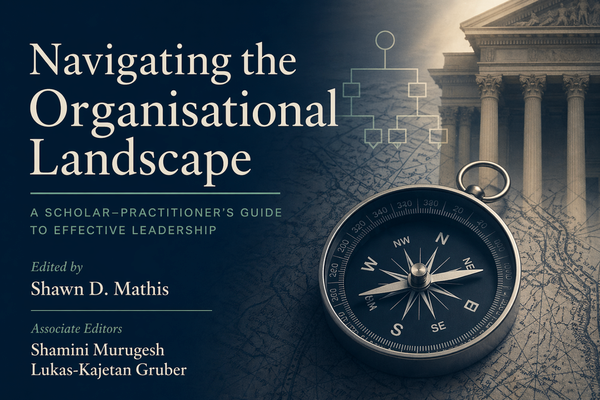
Leadership operates within the structures governance creates. The essays collected here examine judgment, responsibility, and the exercise of authority, and the conditions under which leadership strengthens—or undermines—institutional life.
In April 2026, I led a three-part seminar series titled “Leading Change in Complex, Resource-Constrained Health Systems: The Reality of the DRC.” Hosted by the Higher Institute of Nursing Sciences (ISSI), the series brought together healthcare professionals working in conditions that resist easy description. The sessions began, as such things
Navigating the Organisational Landscape brings together scholar–practitioner reflections on leadership, responsibility, and institutional life. The volume reflects the practical and intellectual concerns that shape much of the work gathered at That Remains: how leaders exercise judgment, how organizations endure complexity, and how authority is tested within institutions.
Access the
Author’s Note: This article forms part of an ongoing reading of Immanuel Kant’s philosophical corpus, exploring its relevance for organizational leadership and institutional governance.
In an age that celebrates outcomes—quarterly returns, strategic wins, measurable impact—it is almost unfashionable to ask whether leadership is good in itself.
Developing the Adaptive Strategy Framework: Bridging Theory and Practice in Leadership. The creation of the Adaptive Strategy Framework resulted from an in-depth exploration of strategy, adversity, and resilience within the academic context of the Saïd Business School and the Nuffield Department of Primary Care Health Sciences at the University of
Author’s Note: This article forms part of an ongoing reading of Immanuel Kant’s philosophical corpus, exploring its relevance for organizational leadership and institutional governance.
There is a particular kind of setting in which serious thought becomes possible—not in isolation alone, but in environments where distraction recedes just
Institutions rarely unravel through open confrontation alone. More often, they are weakened through slower and less visible processes: the erosion of memory, the reinterpretation of purpose, and the gradual displacement of truth by more useful stories. When this occurs, conflict no longer unfolds only in boardrooms, court filings, or public
Institutions rarely collapse because of a single failure. More often, crises emerge when governance weaknesses, reputational conflicts, and external pressures converge simultaneously. In such moments, leadership is tested not only by legal or financial challenges but by the power of narrative itself. The stories told about an institution—true or
Institutional crises rarely begin where they appear; they begin where authority has outgrown its form.
Institutions rarely fail for the reasons they announce. They rarely collapse at the precise point where doctrine weakens or morality frays. More often, the visible fracture appears at the surface while the deeper stress lies