From Pure Reason to Practice: A Kantian Framework for Leadership



Author's Note: The reflections presented here form part of an extended reading of Groundwork of the Metaphysics of Morals by Immanuel Kant. Written in the late eighteenth century, the Groundwork remains a text of unusual severity, returning insistently to questions that admit of no easy resolution: what it is to act from principle, what it means to will universally, and how reason is to determine the will independently of inclination.
In this installment, particular attention is given to Kant’s transition from common moral understanding to the domain of pure practical reason, and to the implications of that transition for contemporary leadership. The aim is not merely interpretive, but constructive: to consider how the demands of a priori moral law—so often treated as abstract—bear directly upon the lived realities of organizational life, institutional governance, and the exercise of authority.
This series approaches Kant not as a historical figure alone, but as a continuing interlocutor, whose arguments, rigorously attended to, illuminate the moral architecture that underlies decision, responsibility, and the ethical burdens of leadership.
Immanuel Kant’s Groundwork of the Metaphysics of Morals is not merely an abstract exercise in moral philosophy; it is a disciplined attempt to identify the conditions under which moral action is genuinely possible. The transition from Section I (“Transition from common rational to philosophic moral cognition”) to Section II (“Transition from popular moral philosophy to the metaphysics of morals”) marks a decisive shift from observing moral life as it appears in experience to grounding morality in pure practical reason itself. This movement is not academic in the pejorative sense; it is foundational. And for leaders, especially those operating in complex organizational and institutional contexts, this transition offers a powerful framework for thinking about integrity, decision-making, and responsibility.
This essay argues that Kantian leadership begins not with outcomes or even with values in the conventional sense, but with a commitment to pure practical reason: the capacity to act from duty, rather than merely in accordance with it. From this foundation, we can then examine how such a commitment translates into everyday leadership practice.
Kant opens Section II by dismantling a tempting assumption: that we can derive morality from experience. He writes, “it is by no means to be inferred from this that we have treated it as a concept of experience.” Indeed, experience fails us precisely where moral certainty is most needed.
Consider his striking claim:
“It is always doubtful whether it is really done from duty and therefore has moral worth.”
This insight cuts sharply against contemporary leadership discourse, which often equates observable behavior with ethical integrity. A leader may comply with regulations, promote diversity initiatives, or make philanthropic contributions, yet the underlying motive remains opaque. Is the action performed from duty, or from self-interest, reputation management, or institutional pressure?
Kant presses further:
“It is absolutely impossible by means of experience to make out with complete certainty a single case in which the maxim of an action… rested simply on moral grounds.”
For leadership, this implies a sobering conclusion: no external audit, no performance metric, no stakeholder perception can definitively establish moral worth. The true locus of ethics lies not in the visible act but in the invisible principle—the maxim—guiding the will.
The true locus of ethics lies not in the visible act but in the invisible principle— the maxim—guiding the will.
This is where Section I leaves us: with the recognition that the “good will” is the only thing “that could be considered good without limitation.” But Section II insists that we cannot stop there. We must ask: what grounds the good will itself?
Kant’s answer is radical: morality must be grounded not in experience, inclination, or social norms, but in pure reason. He argues that moral laws must hold “not only for human beings but for all rational beings as such… with absolute necessity.”
This move is decisive. If morality were based on experience, it would be contingent—varying across cultures, situations, and psychological dispositions. But Kant insists that moral law must be universal and necessary. It must arise a priori.
He warns against the opposite approach:
“One cannot give worse advice to morality than by wanting to derive it from examples.”
Examples may inspire, but they cannot justify. Even the figure of moral perfection—Christ in the Gospel—as Kant notes, must be evaluated against the idea of moral perfection—universal laws or truths, not the other way around. The standard is not empirical but rational.
For leadership, this is a crucial corrective. Many leadership models rely heavily on case studies, best practices, and benchmarking. While these have pragmatic value, they cannot serve as the ultimate foundation of ethical judgment. A leader who simply imitates successful examples risks substituting conformity for principle.
Instead, Kant directs us inward to reason itself as the source of moral law.
One of Kant’s most unsettling insights concerns the difficulty of identifying truly moral motivation. He observes that even when we act in accordance with duty, we cannot be certain that we act from duty:
“We like to flatter ourselves by falsely attributing to ourselves a nobler motive… whereas in fact we can never… get entirely behind our covert incentives.”
This psychological realism has profound implications for leadership. Leaders often operate under mixed motives: ambition, loyalty, fear, compassion, self-interest. Kant does not deny this complexity; rather, he insists that moral worth depends on whether reason—not inclination—determines the will.
He goes so far as to suggest that a cool observer might doubt “whether any true virtue is to be found in the world.” Yet this skepticism does not undermine morality; it clarifies its basis. The question is not whether perfect virtue has been empirically demonstrated, but whether reason commands it.
“What is at issue here is not whether this or that happened… but that reason by itself… commands what ought to happen.”
For leadership, this reframes ethics as a matter of rational commitment rather than empirical validation. A leader does not wait for evidence that integrity “works”; rather, integrity is required because reason demands it.
The following analysis is philosophical in nature, concerned with the structure of moral reasoning rather than the attribution of motive in any specific case. To see how this plays out in practice, consider the widely discussed case of Johnson & Johnson’s response to the 1982 Tylenol poisoning crisis. Seven people died after ingesting cyanide-laced capsules. The company faced a decision: protect its financial interests or prioritize consumer safety.
The widely praised response—recalling millions of bottles at great cost—has often been cited as an example of ethical leadership. But from a Kantian perspective, the key question is not the action itself, but the maxim behind it.

A drugstore clerk removes Tylenol capsules from the shelves of a pharmacy Sept. 30, 1982. Photo: Yvonne Hemsey/Getty Images
Was the recall motivated by duty to protect human life, or by a calculated assessment of reputational risk?
A Kantian analysis does not deny that both considerations may have been present. But it insists that the moral worth of the action depends on whether the guiding principle could be universalized: Act only on that maxim whereby you can at the same time will that it should become a universal law.
If the maxim were: “Recall products only when reputational damage outweighs financial loss,” it would fail the test. But if the maxim were: “When a product poses a risk to human life, remove it regardless of cost,” it aligns with duty grounded in reason.
What made the Tylenol response exemplary—at least in its ideal interpretation—is not merely that it produced good outcomes, but that it appeared to reflect a principle that could be universally affirmed.
This is Kantian leadership in action: not reactive, not merely strategic, but principled in a way that transcends circumstance.
Before acting, pause and test the principle behind your decision:
Kant is clear that metaphysics must precede application:
“The doctrine of morals is first grounded on metaphysics and afterwards… is provided with access by means of popularity.”
In other words, practical ethics must be built on a rigorous foundation. Without this, we risk what Kant calls a “disgusting hodgepodge of patchwork observations and half-rationalized principles.”
Modern leadership discourse often falls into this trap blending psychological insights, cultural norms, and anecdotal evidence without a clear grounding in principle. The result is guidance that may be useful in the short term but lacks coherence and authority.
Kant’s alternative is demanding but ultimately liberating. By grounding leadership in pure practical reason, we free it from the contingencies of context and the volatility of public opinion. We establish a standard that is both universal and internally compelling.
This does not eliminate the need for judgment; rather, it clarifies its basis. Leaders must still interpret situations, weigh competing duties, and navigate uncertainty. But they do so with a compass that points not to outcomes or preferences, but to reason itself.
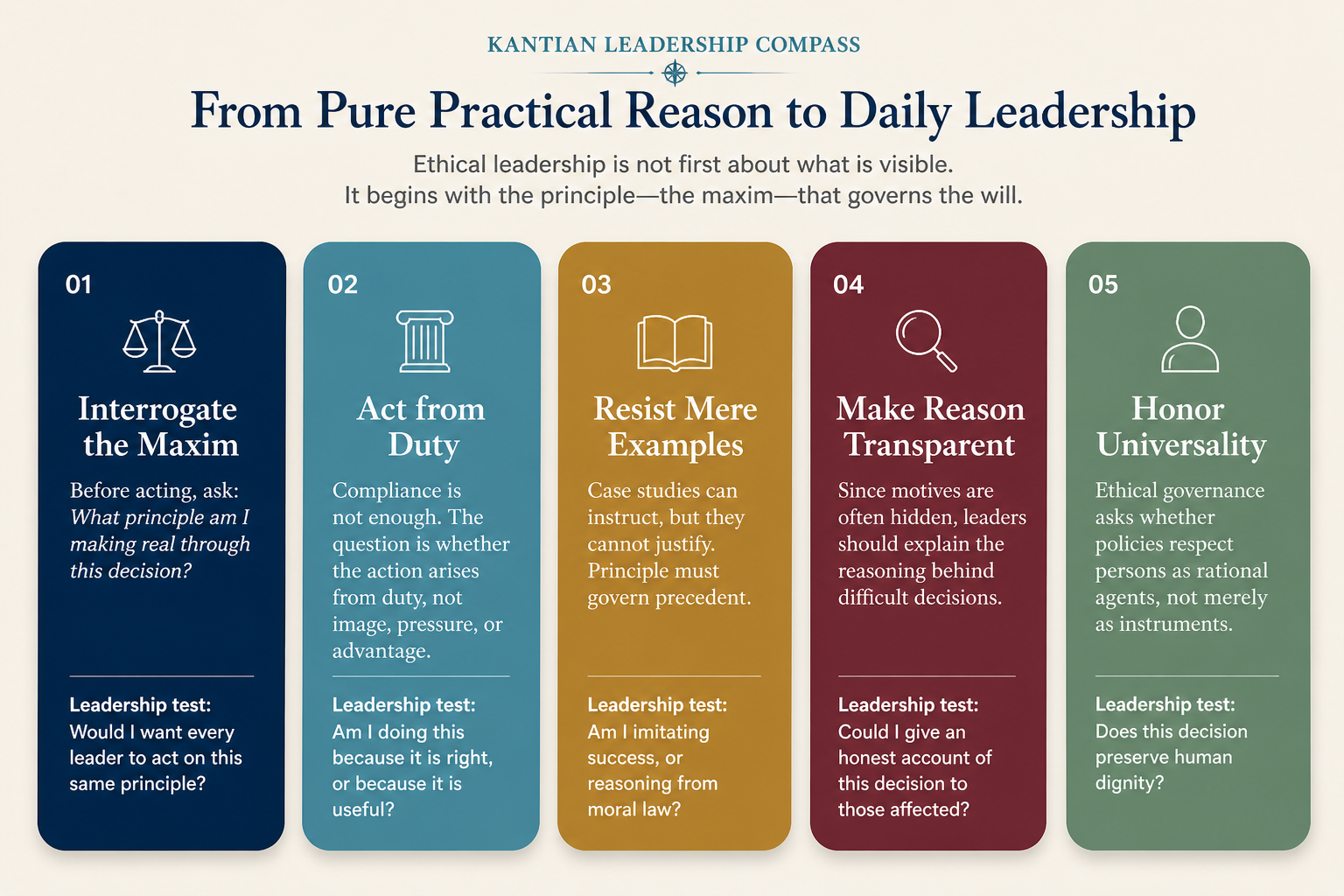
How, then, does this translate into the day-to-day life of a leader? The following principles distill the Kantian framework into actionable guidance: Before approving a profitable but ethically ambiguous strategy, a leader pauses, tests the maxim for universality, and rejects it despite pressure. They articulate their reasoning publicly, accept short-term loss, and ensure policies remain defensible to all affected, choosing integrity of principle over success shaped by convenience, precedent, or hidden advantage in every case.
In doing so, they reshape organizational culture, signaling that decisions are governed not by expediency but by reason. Teams learn that justification matters as much as results, and that trust is built when leadership demonstrates consistency between principle, judgment, and action across every level of responsibility.
The transition from Section I to Section II in Kant’s Groundwork is more than a philosophical pivot; it is a methodological imperative. It calls us to move from observing moral life to grounding it in pure reason. For leaders, this means rethinking ethics not as a set of practices or outcomes, but as a commitment to principles that hold with necessity and universality.
Kant’s warning remains timely: without this foundation, we risk reducing morality to a “patchwork” of convenient ideas. But with it, leadership becomes something more demanding—and more meaningful. It becomes the exercise of reason in action, guided not by what is expedient, but by what is right.
And that, in the end, is the essence of Kantian leadership.