
Pragmatism in Practice: A Cambridge Reverie and Its Afterlives

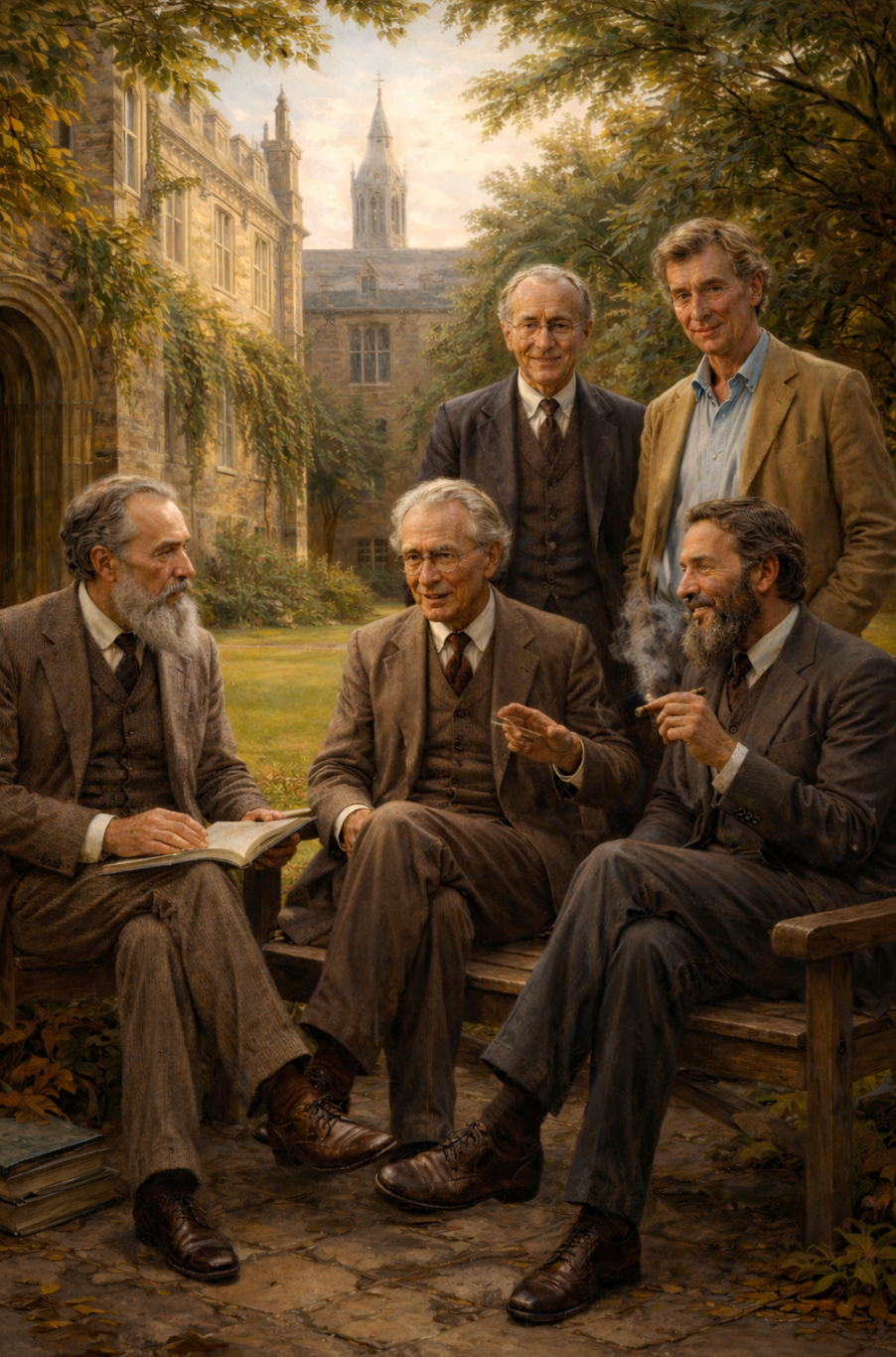
There are certain places where thought seems to linger in the air, as if ideas themselves possessed a kind of afterlife. The courts and passageways of the University of Cambridge are among them. Stone and silence, worn steps and narrow cloisters do not merely house history; they appear, in some quiet way, to participate in it. It was there, during an unhurried walk some years ago, that pragmatism first impressed itself upon me, not as a formal doctrine but as a disposition, a manner of proceeding in the absence of certainty.
“It was there, during an unhurried walk some years ago, that pragmatism first impressed itself upon me, not as a formal doctrine but as a disposition, a manner of proceeding in the absence of certainty.”
Since those early days, I have returned to pragmatism with a quiet anticipation, as one revisits a familiar quarter only to discover that it has subtly altered in one’s absence. The volumes I have since encountered did not disappoint; rather, they deepened that initial impression, lending articulation to what had first been sensed only in outline.
There is, in Cambridge, a stillness that is not emptiness but accumulation. Thought settles there in layers, almost imperceptibly, and one becomes aware, gradually, that inquiry is not an event but a continuity. It is perhaps in such a setting that pragmatism reveals its essential character: not a system imposed from above, but a habit of mind formed through sustained attention to experience.
My reading has not been confined to these more recent volumes. I have had occasion to study each of these figures, and have done so with a degree of attention that has proven quietly formative. I have spent time with the works of William James, whose prose moves with a certain restless immediacy; with Charles Sanders Peirce, whose rigor underwrites the very possibility of pragmatic inquiry; and with John Dewey, who extended pragmatism into the fabric of democratic and educational life. Dewey, in particular, must be understood not merely as adjacent to pragmatism but as one of its more expansive architects, transforming it from a theory of meaning into a philosophy of social practice.
To these figures must be added George Herbert Mead, whose reflections on the social self locate thought not within the solitary mind but in the interplay of gesture, response, and recognition, and, later, Richard Rorty, who recast pragmatism for a more contemporary age, dissolving the search for certainty into a vocabulary of conversation, contingency, and redescription. With Rorty, pragmatism becomes at once more elusive and more immediate, less a theory of truth than a practice of discourse shaped by the communities in which it circulates.
What unites these figures, despite their differences in tone and method, is a shared resistance to finality. They offer not closed systems, but orientations, ways of proceeding that remain responsive to the contingencies of the world. In this, they mirror the very environment in which my own interest first took root, a place where the past is never entirely past, and where thought continues, quietly and without declaration, to revise itself.
This sensibility is carried forward, in distinct but complementary ways, in four more recent works: Cambridge Pragmatism: From Peirce and James to Ramsey and Wittgenstein, and The American Pragmatists by Cheryl Misak, The Cambridge Companion to Pragmatism edited by Alan Malachowski, and Pragmatism's Evolution: Organism and Environment in American Philosophy by Trevor Pearce.
In Cambridge Pragmatism, Misak offers a careful corrective to more casual understandings of the tradition. Her account, attentive to figures such as Frank Ramsey, presents pragmatism not as a retreat from truth but as a disciplined engagement with it. Belief, on this view, is neither arbitrary nor fixed; it remains subject to revision, answerable to evidence, and sustained through inquiry. What works, therefore, is not what merely succeeds in the moment, but what can endure the longer test of experience.
In The American Pragmatists, Misak turns to the more familiar lineage, tracing the development of pragmatism through Peirce, James, and Dewey. Here the philosophy expands outward, becoming inseparable from questions of democracy, communication, and social life. Dewey’s insistence that democracy is a mode of associated living, rather than a settled institutional arrangement, retains a particular resonance. It suggests that collective life, like inquiry itself, must remain open, experimental, and corrigible.
The essays collected in The Cambridge Companion to Pragmatism resist any singular interpretation. Instead, they present pragmatism as a constellation of approaches, unified less by doctrine than by a shared suspicion of abstraction detached from practice. This plurality is not a weakness but a condition of vitality. It reminds us that no single framework can fully capture the complexity of human experience, and that philosophical strength often lies in the interplay of perspectives rather than their resolution.
Pearce’s Pragmatism’s Evolution situates the tradition within a broader intellectual history, tracing its development alongside evolutionary thought. Here pragmatism appears not merely as a philosophical position but as an adaptive response to changing understandings of science and society. Knowledge itself is shown to evolve, shaped by the environments in which it is produced and applied. The pragmatist, in this light, is not simply a problem-solver but an attentive observer of processes, alert to how ideas take hold, shift, and persist.
“In their convergence, these works suggest that pragmatism is best understood not as a settled doctrine but as an ongoing practice.”
It does not dispense with ideals, but neither does it allow them to remain untouched by experience. It asks, instead, that ideas prove themselves in use and remain open to revision when they do not.
In contemporary parlance, to be pragmatic is often to be merely practical, even expedient. Yet this is a diminished understanding. The pragmatism encountered in these works is more exacting. It requires a willingness to proceed without certainty, to test without cynicism, and to revise without embarrassment.
Leadership, in this sense, becomes less an assertion of authority than a form of stewardship, the careful cultivation of processes through which better outcomes might emerge.
For organizational leadership and institutional governance, the implications are not merely general but immediate and exacting. To adopt a pragmatist orientation is to relinquish the expectation that decisions, once made, will stand as settled. Policies cannot be treated as immutable, nor strategies as definitive. They must instead be approached as provisional, subject to evaluation in light of their consequences and open to revision in response to changing conditions.
This carries with it a shift not only in method but in temperament. The pragmatist leader does not seek certainty in advance of action, but clarity through it. Decisions are not endpoints but instruments, tested in practice and refined through their effects. What matters, in this sense, is not the preservation of authority but the cultivation of processes through which better judgments may emerge.
In institutional settings, this requires structures that permit correction rather than conceal it. Feedback must be more than symbolic; it must be operative. Failures are not aberrations to be explained away, but sources of information, revealing the limits of prior assumptions. To govern pragmatically is therefore to create conditions under which learning is continuous and distributed, rather than episodic and controlled.
There is, too, an ethical dimension to this approach. If beliefs and policies are understood as revisable, then accountability cannot rest solely on intention. It must extend to consequences. The measure of leadership becomes not the assertion of coherence or vision alone, but the willingness to adapt in light of what experience discloses.
In this light, pragmatism aligns less with decisiveness in the conventional sense than with attentiveness. It favors responsiveness over rigidity, and inquiry over insistence. It asks, not whether a principle can be maintained without alteration, but whether it can sustain itself in practice without doing violence to the realities it encounters.
Such an approach does not resolve tension; it acknowledges and works within it. It asks leaders to balance competing demands, to remain attentive to evidence, and to sustain conditions under which learning can occur. In this, pragmatism offers not a formula but a discipline, one that is at once intellectual and practical.
It seems fitting that my own encounter with pragmatism should have begun with a walk. It is, after all, a philosophy that moves, through ideas, through institutions, and through time. The works considered here do not so much conclude that movement as extend it, inviting us to participate in a tradition that remains, in the best sense, unfinished.