Six Thousand Miles from Oxford: A Reunion in Thailand



Graduates of Oxford's Advanced Management and Leadership Programme gathered in Hua Hin, Thailand, to confront a world transformed by technology, geopolitical change, and competing demands on leadership. The reunion raised a consequential question: What remains of an education when the world for which we were prepared has changed?
Nearly six thousand miles separate Oxford from Hua Hin, a coastal town on the Gulf of Thailand. In June 2026, graduates of the Oxford Advanced Management and Leadership Programme at Saïd Business School, University of Oxford, traveled there from across the world to resume a conversation that, for some, had begun decades earlier. The program belonged to an executive-education environment of considerable international standing. In 2018, the Financial Times ranked Saïd Business School second worldwide for open-enrollment executive education, up from fourth in 2017 and ninth in 2016. Participants came from different countries, professions, institutions, and generations of the program, carrying experiences shaped by governments, businesses, universities, and organizations confronting very different challenges.
My wife, Vida, and I had traveled more than thirty hours to reach Hua Hin.
There was something worth considering in the journey itself. We were traveling halfway around the world to spend several days with people I mostly did not know. The few participants I had expected to know were unable to attend. What connected us in Hua Hin was an institution, a shared educational experience completed at different moments in our lives, and Lalit Johri. From 2007 to 2019, Lalit directed the Oxford Advanced Management and Leadership Programme, overseeing 25 cohorts comprising more than 875 alumni. He remained in contact with alumni across those generations and continued to bring them together long after they left Oxford.
None of these connections guaranteed that the gathering would matter. Universities are good at creating affiliations. They confer degrees, develop alumni networks, and occupy consequential places in the memories of those who pass through them. Reunions can renew friendships, revive memories, and remind people of experiences that once shaped them. These are worthwhile purposes. They do not, by themselves, establish that the intellectual tradition associated with an institution remains alive.
An intellectual tradition is not identical to the institution from which it emerges. Institutions preserve knowledge, convene communities, and create conditions for education, but a living intellectual tradition depends upon the habits of inquiry and judgment cultivated within it remaining active in people and relationships beyond the institution itself.
The world we gathered to discuss had changed considerably since many participants first arrived at Oxford. Artificial intelligence was altering work, knowledge, and decision-making. Economic integration had encountered strategic rivalry and competing political systems. Technological capability was spreading even as control of infrastructure, capital, data, semiconductors, and advanced research remained concentrated. Climate pressures were exposing the distance between institutional commitments and the capabilities required to fulfill them. Demographic and social change were unsettling assumptions about work, authority, and leadership. Trust in institutions—and in those responsible for leading them—remained fragile.
These were not simply new subjects to be added to an old curriculum. They raised a more difficult problem about education itself. Education occurs at a particular moment in history. People acquire knowledge, encounter frameworks, develop professional identities, and learn to interpret institutions under conditions that will not remain unchanged. The longer they lead, the more likely they are to confront technologies, conflicts, responsibilities, and forms of social organization their education could not have anticipated. If the value of an intellectual tradition depends principally upon the continued usefulness of the conclusions it transmits, historical change will eventually make every tradition obsolete.
The reunion raised a question larger than the gathering itself: How do we know an intellectual tradition has endured?
What follows is one participant’s attempt to answer that question: an account of what I heard in the conference room, what I observed in the relationships that formed around it, and what I came to understand more clearly through the messages and reflections that continued after we left Hua Hin. Others may have carried different questions home. A gathering shaped by so many countries, professions, and experiences should permit more than one account of what mattered. Hua Hin cannot establish what all education leaves behind, but it offered an unusual opportunity to observe what remained active among people formed at different moments within a shared educational experience.
The program began with the individual and widened steadily outward: from attention, resilience, and purpose to geopolitical change, technological dependence, artificial intelligence, sustainability, competing interests, trust, and the reinvention of leadership. The questions became progressively more difficult. How should leaders act when the capabilities they depend upon are not theirs to control? What responsibilities remain when legitimate claims exceed available resources? How should people exercise authority and preserve values when competing interests cannot be reconciled?
| Session | Question We Explored | Reading & Argument | What We Carried Forward |
|---|---|---|---|
| Personal Mastery Focus, resilience, and purpose | How do we preserve focus, resilience, and purpose in an age of overload? | The Attention Economy's Challenge Digital technologies and AI threaten sustained attention and intellectual autonomy, requiring deliberate protection of the capacities necessary for thought and judgment. | Protect attention. Purpose and resilience require the disciplined investment of time and energy. |
| The State of the World Adaptive leadership | How should leaders navigate technological, demographic, economic, and social change? | Leading for Today and Tomorrow Continuous change requires leaders who can navigate complexity, learn, adapt, and act before uncertainty is resolved. | Remain curious and build adaptive capability. Leaders must learn continuously rather than rely upon settled assumptions. |
| The New Global Order Multi-order world | How should leaders understand a world of competing systems, values, and centers of power? | The Emerging Multi-Order World Leaders must reconsider inherited frameworks as different international orders increasingly coexist without necessarily converging. | Reconsider inherited frameworks. Learning requires intellectual humility and the willingness to revise assumptions. |
| Technological Dominance Digital authority | Where does technological power reside, and what dependencies does it create? | Technology Predictions Infrastructure, capital, semiconductors, energy, data, and platforms increasingly determine technological capability and institutional agency. | Understand digital authority. Leaders must know which capabilities they control, which dependencies they accept, and where concentration creates vulnerability. |
| AI and Automation Embedded AI | How should we master, collaborate with, and compete through AI without replacing human judgment? | How to Compete in the AI Era When Everyone Has Access to the Same Technology As AI becomes widely accessible, advantage shifts from possessing technology to the capability to integrate it into strategy, work, and judgment. | Use AI as a capability, not a shortcut. Technology should strengthen judgment, creativity, productivity, and learning. |
| Climate Reality Strategic sustainability | How should leaders determine which sustainability responsibilities their organizations are positioned to address? | Getting Strategic About Sustainability Sustainability requires strategic choice among competing priorities by aligning purpose, science, stakeholder expectations, and business value. | Think beyond today's results. Long-term value depends upon sustainable business practices, governance, and responsible leadership. |
| The Era of Competing Interests Transformational governance | How should leaders act when legitimate stakeholder interests conflict and cannot all be satisfied? | Revealing the Incrementalism Trap in Corporate Sustainability Stakeholder engagement can produce visible activity without transformation when institutions avoid difficult choices and consequential trade-offs. | Govern among competing interests. Leadership requires difficult decisions rather than comfortable consensus. |
| The Reinvention of Work and Leadership Trust-based leadership and strategic agility | How do leaders build trust, distribute authority, preserve accountability, and create organizations capable of adapting? | What It Takes to Make Trust-Based Leadership Work Trust becomes durable when institutions build the systems, learning capacity, accountability, and leadership practices necessary to sustain empowerment. | Build trust through execution and leave organizations stronger. Develop people, create adaptive organizations, and practice stewardship. |
Read separately, these subjects might describe a management conference organized around the major challenges confronting contemporary leaders. Considered together, they posed a more demanding question: What capacities remain necessary when problems change faster than the conclusions people once learned?
The answer, I came to believe, lay less in the conclusions we carried into the room than in what we remained capable of doing when those conclusions proved insufficient.
The distinction between knowledge and formation is essential. Education transmits disciplines, theories, methods, cases, and the accumulated experience of those who confronted difficult questions before us. Serious education requires intellectual content. But the need to revise conclusions does not make knowledge temporary, expertise unimportant, or every interpretation equally valid.
The existential question is what happens when knowledge encounters conditions for which it is insufficient.
The first session in Hua Hin began with attention. The choice initially appeared unusual. A program concerned with geopolitical change, technological power, artificial intelligence, climate, and leadership began by asking whether individuals remained capable of directing their own attention. As the problems became more difficult, that first question became more consequential.
Judgment requires the capacity to remain with a problem before reaching for an answer. Leaders must distinguish urgency from importance, information from understanding, and activity from progress. They must resist environments that reward immediate response, constant availability, and the appearance of certainty before serious inquiry has occurred. A person incapable of sustained attention may possess considerable intelligence and experience while becoming increasingly dependent upon inherited assumptions, organizational routines, and the judgments of others.
Peter Lawrence carried the question of attention from the conference room into his own behavior. Years earlier at Oxford, he had photographed autumn leaves and titled the image “Time waits for no-one.” The phrase returned to him after Hua Hin as he considered the relationship between time, distraction, and leadership.
“Time is certainly waiting for no-one, but if you think about leading, being present in the moment is the most effective gift you can give to your team.”
Peter had begun acting on that conclusion deliberately, leaving his devices elsewhere so that they could not interrupt his attention. “And I feel better for it in myself,” he wrote.
His reflection gave the discussion a practical consequence. Attention is not protected by recognizing its importance. It is protected through choices about what leaders permit to interrupt them and whether the people before them receive their full presence.
Attention alone, however, is insufficient. Leaders can examine the wrong framework with extraordinary discipline.
Around the conference table, participants interpreted the state of the world through different experiences. They had lived and worked within different political systems, economies, industries, and institutions. Geopolitical shifts that appeared threatening from one perspective could create opportunity from another. Technological change looked different to those working near the centers of advanced technological development than to those leading institutions dependent upon capabilities developed elsewhere. Sustainability appeared differently to governments, businesses, universities, and communities confronting unequal resources and consequences.
The value of these conversations did not depend upon agreement. It depended upon whether people could expose their interpretations to examination, listen long enough to understand the experience behind another position, and remain open to perspectives formed under different conditions.
Lalit placed the problem of attention in still larger terms.
“Leaders must actively protect their cognitive excellence,” he wrote. “Succumbing to the hyper-optimized traps of Silicon Valley digital agents risks not just psychological depletion, but the erosion of our civilized discourse.”
Lalit later extended the argument from individual cognition to institutions and civilizations. Societies, he argued, survive partly through what they collectively choose to attend to. Institutional failure does not always result from a lack of information. It can also occur when sustained attention is directed toward immediate spectacle, familiar assumptions, or short-term pressures while slower threats remain insufficiently examined. Attention, in this account, is not merely a personal discipline. It is strategic and civic infrastructure.
What a civilization—or a company—attends to, it preserves; what it stops attending to, it loses.
George Molakal, reflecting afterward on what had made that kind of conversation possible, connected the question of attention to the experience of the gathering itself.
“What stayed with me is a simple realisation: in an age of overload, presence itself has become a leadership act. The depth of our conversations in Hua Hin was possible only because everyone in the room chose to give their full attention—and that choice is the discipline our era demands.”
Vittorio Molinari complicated the argument. Shorter attention, he suggested, should not automatically be understood as cognitive decline. In an environment of overwhelming information, the ability to scan widely, filter quickly, and identify signals that deserve closer examination may itself be an adaptation. He compared the distinction to the work of a pilot: landing requires concentrated attention, while flight also demands awareness of instruments, weather, traffic, and communications.
“The skill is knowing which one the moment calls for.”
The distinction matters. The opposite of sustained attention is not necessarily distraction. It may be breadth. Leaders need the capacity to move between modes of attention: to scan widely enough to detect changes that established frameworks might miss, and to concentrate deeply enough to examine what matters once it has been identified. As Vittorio put it, the ability to scan, filter, and identify what deserves attention is “not instead of depth, before it.”
Experience allows people to recognize patterns, anticipate consequences, and act without relearning every lesson. It can also become a source of intellectual closure. Frameworks that once illuminated institutions can become obstacles when conditions change and accumulated authority makes revision more difficult.
Julia Jalil offered a concrete example of what can endure even as the problems under examination change. Reflecting on the questions she had brought to Hua Hin, she traced them to Lalit’s advocacy of learning “to challenge the dominant logic” and to skills she had developed a decade earlier, in June 2016. The subjects under examination had changed. The habit of questioning assumptions had remained.
An enduring intellectual tradition must accomplish something more demanding than teaching people to defend what they once learned. It must form people capable of distinguishing conviction from rigidity and intellectual humility from indecision. They must remain open to evidence that challenges their frameworks without treating every new idea as progress. They must be capable of changing their minds without abandoning standards of argument, evidence, and responsibility.
Nathan Andrews carried a related question away from Hua Hin. The reunion, he wrote, had strengthened his resolve to pursue “purposeful leadership” more intentionally. He then posed a question that extended the inquiry beyond the gathering:
“Can a leader without a personal sense of purpose build a purposeful organisation?”
Education remains alive when it returns people to old questions with greater clarity about what those questions now require of them. It should interrupt habit, renew attention, and reorient experience and judgment toward more deliberate purposes.
Degrees, professional achievement, and institutional affiliation tell us that people have passed through an educational experience. More meaningful evidence lies in what people do when confronted with unfamiliar problems and interpretations different from their own. Can they attend closely enough to understand before responding? Can they question assumptions that experience has made comfortable? Can they revise without becoming intellectually unmoored? Can they remain serious when certainty is unavailable?
These capacities do not provide answers to the problems confronting contemporary leaders. They make responsible judgment possible.
The middle sessions moved from the habits of the individual to the systems within which leaders must act. Technological dominance and artificial intelligence raised questions about agency and dependence. Climate and sustainability raised questions about capability and responsibility. Competing interests brought us to the problem of legitimate claims upon an institution that may nevertheless be incompatible.
The subjects differed, but an underlying problem connected them. Knowledge, technology, and process can improve decisions. They cannot remove the necessity of choosing.
Around the table, technological dominance did not appear simply as a contest among firms and nations. Participants spoke from countries and institutions occupying very different positions within the technological system. For some, artificial intelligence represented access to capabilities that would once have required enormous capital and expertise. For others, the same technologies raised questions about dependence upon infrastructure, platforms, semiconductor supply chains, energy, data, and decisions made elsewhere.
Participation in a technological system is not the same as agency within it.
The more consequential question is whether dependencies are understood well enough to become objects of judgment rather than vulnerabilities discovered only when disruption occurs.
The discussions around artificial intelligence revealed a structural tension. Advanced capabilities are becoming accessible to organizations that could never have developed them independently, while the infrastructure, capital, computing resources, semiconductors, data, and expertise required to build frontier systems remain concentrated among comparatively few actors. The democratization of access can coexist with the concentration of power.
That paradox changes the meaning of institutional capability. If many organizations can access similar technologies, advantage cannot rest solely on possession of the tool. It shifts toward the capacity to integrate technology into strategy, work, learning, and decision-making without allowing adoption to substitute for capabilities the institution has not developed.
Technology can expand analysis. It cannot determine institutional purpose.
An AI system can identify patterns, generate alternatives, compare scenarios, and accelerate work. It cannot assume responsibility for deciding which purposes should be pursued, whose interests should receive priority, which risks are acceptable, or which consequences an institution is prepared to impose upon others.
Delegating analysis is not the same as delegating judgment.
Vittorio Molinari challenged the assumption that preserving human judgment necessarily means treating human intelligence as the standard against which artificial intelligence should be measured.
“We keep framing this as humans versus machines, with humans as the standard being defended. Worth questioning that.” In some domains, he argued, machine intelligence already exceeds human capability, and its absence of ego may be consequential. “It doesn't need to be right. It doesn't bend conclusions to protect a reputation.”
His argument exposed a weakness in any easy defense of human judgment. Intelligence does not operate independently of character, incentives, or power. Leaders can possess considerable knowledge and analytical ability while distorting evidence to preserve authority, reputation, or self-interest.
“A lot of what we call leadership failures aren't failures of intelligence,” Vittorio observed. “They're intelligence corrupted by self-interest.”
This does not eliminate the distinction between analysis and responsibility. An AI system cannot be held morally or institutionally accountable for the purposes an organization chooses to pursue or the consequences it imposes upon others. But Vittorio's challenge makes the human side of the distinction less comfortable. Preserving human judgment is defensible only if leaders are willing to examine the biases, incentives, loyalties, and self-interest that can corrupt its exercise.
Dr. Nav Sedaghati, reflecting after the reunion on earlier technology cycles he had lived through, resisted both technological panic and fashionable enthusiasm.
“The question is not simply, ‘Are we using AI?’” he wrote. “The better question is, ‘What real problem are we solving, what value is being created, and are we acting responsibly with the resources entrusted to us?’”
His question returned the problem from technology to judgment. Access to capability does not determine purpose, and adoption does not relieve leaders of responsibility for deciding which problems deserve attention, which investments create genuine value, and how resources entrusted to them should be used.
The conversations about climate and sustainability brought the same problem into another setting. The question was not whether environmental responsibility matters, but what particular institutions are responsible for doing when the scale of the problem exceeds the capability of any individual organization, resources are finite, incentives conflict, and consequences unfold across generations.
Acknowledging a responsibility is not the same as possessing the capability to discharge it.
Institutions can make commitments beyond their operational capacity, adopt aspirations without changing incentives or capital allocation, and substitute declarations for implementation. Yet complexity and limited capability can also become convenient explanations for action that remains far below the scale of a problem already acknowledged.
Constraints do not eliminate responsibility. They make judgment necessary.
The discussion of competing interests brought that problem to its sharpest point. Shareholders provide capital and assume risk. Employees contribute labor, knowledge, and years of their lives. Customers depend upon products and services. Governments create legal and political conditions. Communities absorb consequences that may never appear on financial statements. Future generations inherit conditions they had no role in creating.
Each claim may be legitimate. Legitimacy does not produce compatibility.
Resources are finite, time horizons differ, and benefits and burdens are distributed unequally. Protecting employment may delay changes necessary for institutional survival. Investments made for future generations may impose costs upon people with immediate needs and little confidence that promised benefits will reach them.
The language of stakeholder alignment can obscure this difficulty by implying that sufficiently capable leaders will discover arrangements through which every legitimate interest can eventually be reconciled. Sometimes interests can be aligned, and responsible leaders should seek those opportunities.
Often they cannot.
The purpose of judgment is not to make conflict disappear. It is to determine what should be done when conflict remains.
Here the conversations touched most directly on my own interest in institutional governance. Boards, executives, and public officials do not exist merely to administer procedures. Institutions require people authorized to choose when expertise, rules, consultation, and technology do not produce a single answer.
Good governance should improve judgment. It should clarify authority, expose assumptions, discipline power, provide access to relevant knowledge, and preserve accountability. It should make it more difficult for leaders to act arbitrarily, ignore evidence, or conceal conflicts of interest.
Governance can also become a defense against responsibility.
Boards can demand increasing quantities of information without clarifying institutional purpose. Risk systems can demonstrate procedural compliance while obscuring uncertainty. Collective decision-making can make accountability difficult to locate. Leaders can invoke stakeholders without explaining how competing claims were weighed.
Institutions can become highly governed in form while remaining uncertain about who is responsible for judgment.
The necessity of choosing creates powerful incentives to hide from that responsibility. Leaders can defer to process: the proper procedures were followed. To experts: specialists recommended the decision. To markets: conditions left no alternative. To stakeholders: consensus could not be reached. To technology: the model produced the recommendation. To time: more information is required.
Each response may sometimes be justified. None eliminates responsibility.
The test is not whether leaders can eliminate conflict, master every system upon which they depend, or guarantee correct outcomes. It is whether they can make consequential choices among legitimate claims, explain the purposes and assumptions shaping those choices, remain open to revision when evidence changes, and accept responsibility for the consequences that follow.
Lalit did not offer a formula for doing this.
He asked questions, introduced distinctions, listened, challenged assumptions, and allowed questions to remain open when premature resolution would have narrowed the inquiry. The microphone moved around the table, carrying perspectives shaped by different countries, professions, institutions, and experiences. The conversation accumulated rather than converged. No one was relieved of the responsibility to decide what they believed.
After the reunion, Lalit circulated eight reflections distilling what he regarded as the central points of our discussions and invited the group to “delete, add, refine and enrich” them. Rajesh Sharma compiled the posts into a single document, and participants continued the work Lalit had invited: questioning how the ideas applied across different institutions, proposing revisions, and extending the argument. The synthesis did not close the conversation. It returned the ideas to the community for further examination.
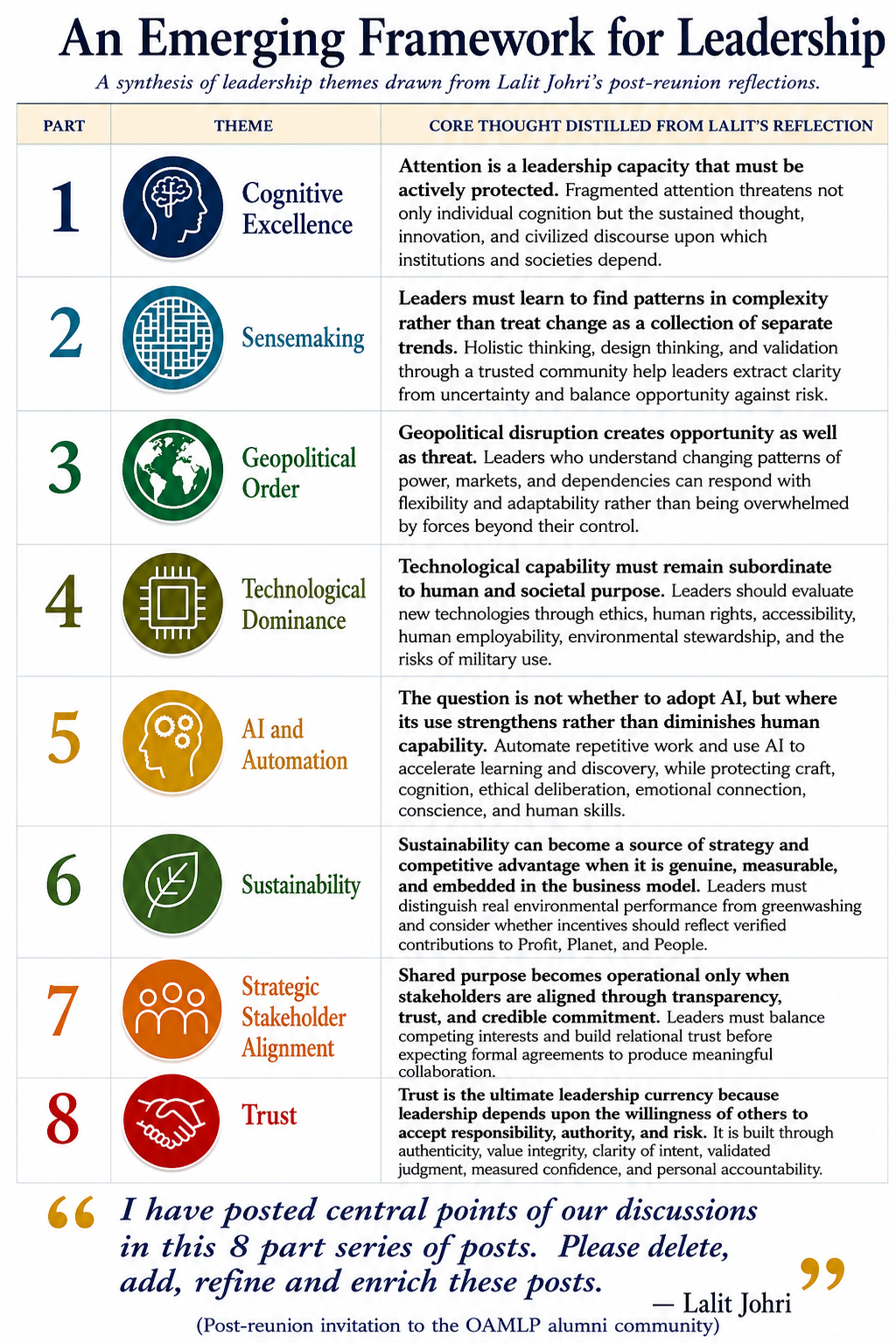
That restraint became increasingly important to my understanding of what the gathering revealed. A teacher can provide an answer and demonstrate knowledge. A more consequential form of teaching prepares people to remain responsible when no answer can be provided.
Suppose an institution succeeds in forming people capable of sustained attention, intellectual revision, and responsible judgment. Suppose those capacities remain visible decades later as graduates confront circumstances their education could not have anticipated.
The tradition has endured within them.
But can it survive them?
Judgment is never exercised by isolated individuals alone. Leaders depend upon knowledge they do not possess, people whose experiences differ from their own, institutions capable of translating decisions into action, and relationships strong enough to sustain candor, intellectual difference, and the demands of collective judgment.
Judgment is not merely an individual capacity. Its quality depends upon whether people can expose their assumptions to others, receive knowledge they do not possess, disagree without withdrawing from inquiry, and act together after disagreement remains.
Trust is, then, more than a desirable leadership quality. It is one of the conditions that make collective judgment possible.
I had arrived in Hua Hin largely among strangers. Most participants had attended Oxford in different years, lived in different countries, and worked within professions and institutions unfamiliar to me. We shared an affiliation and a relationship with Lalit. We did not yet share relationships with one another.
The relationships that brought us there had been sustained deliberately over time. During the final five years of his tenure as director, from 2015 through 2019, Lalit organized annual OAMLP reunions in Oxford while also convening alumni gatherings in New Delhi, Bangkok, Singapore, and Hong Kong. The reunions later resumed in Hua Hin in 2024. We had gathered there again in 2026 for the seventh OAMLP reunion, with an eighth planned for Hua Hin in 2027.
The 2026 gathering was therefore not an isolated act of nostalgia. It belonged to a continuing effort to keep people, relationships, and intellectual exchange alive beyond the institution where they had begun. Participants traveled across the world because of a shared educational experience and trust in the person who had continued to convene the community around it.
Julia Jalil saw in that continuity a form of leadership whose effects extended beyond the program itself.
“Prof. Lalit has demonstrated that leadership is measured not only by the institution, initiative, or programme one leads, but by the lives one continues to touch.”
Her observation shifted the measure of leadership from the duration of a formal appointment to the relationships and capacities that continue developing after institutional authority has ended.
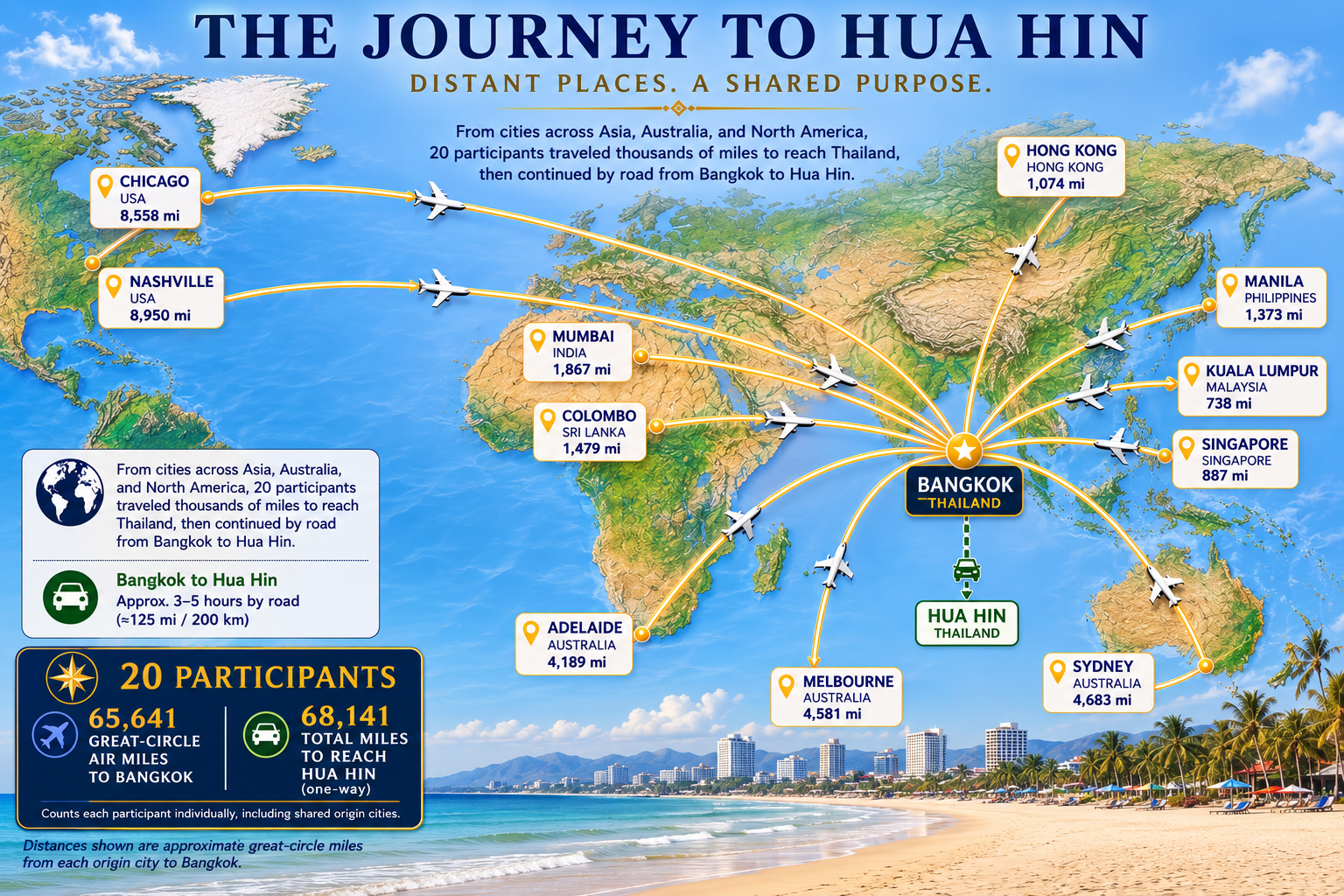
The distances involved make that relationship worth examining. Twenty participants traveled from cities across Asia, Australia, and North America to reach Bangkok before continuing by road to Hua Hin. Counted individually, their one-way journeys represented approximately 65,641 great-circle air miles and another 2,500 miles by road—a combined distance of 68,141 miles merely to arrive. The return journeys still awaited them.
No institution required them to come. No credential depended upon attendance. There was no professional obligation to spend the time, bear the expense, or cross the distances involved. People came voluntarily, many years after completing the program, because Lalit asked them to gather.
That fact should not be romanticized. Affection for a teacher, loyalty to an institution, and the pleasure of reunion are not evidence by themselves that an education has endured. But voluntary commitment on this scale does reveal something consequential: trust accumulated over time had become strong enough to move people across continents and bring strangers into relationship with one another.
The journey to Hua Hin was more than a measure of distance. It was evidence of what education can set in motion when the relationship between teacher and student survives the classroom. Across more than a decade of reunions and alumni gatherings, Lalit had remained present in the lives of alumni across generations of the program. When he invited them to return to conversation, they came.
One of Lalit's habits showed how those relationships began.
He would bring two people together, make a brief introduction, and leave them to continue the conversation.
“Shawn, this is Jackson. Jackson, this is Shawn.”
There was no extended explanation of why we should know one another and no attempt to manage what happened next. Yet the introduction mattered. Neither person encountered the other without context. Each knew Lalit. Each understood that the other had been invited into the same gathering.
His introduction provided neither proof of character nor a guarantee of friendship. It created something more limited and more useful: sufficient initial confidence to begin a relationship that otherwise might not have existed.
Trust cannot simply be transferred from one person to another. A trusted leader can lend credibility to the possibility of relationship. The people introduced must then justify, deepen, or lose that initial confidence through their own conduct.
Leadership can create the conditions in which trust begins. Only conduct can cause it to endure.
Over the following days, those relationships developed inside and outside the formal program: as the microphone moved around the conference table, over breakfast, during walks to dinner, and in conversations that continued after the sessions ended. We learned things about one another that would never have emerged from professional biographies or conference introductions.
None of these moments appeared on the formal agenda, yet they became part of the education. Those conditions did not create themselves. Participants repeatedly recognized Sukanya Lee, whose sustained care, hospitality, and organizational work allowed the rest of us to give our attention more fully to one another and to the questions we had come to examine.
The reunion had sunlight in it.
That mattered.
Reflecting afterward on the relationships that sustained the gathering, Lalit put the matter more simply:
“There is nothing more valuable in life than to spend time with positive and passionate friends!”
Intellectual communities cannot live by argument alone. The conversations outside the conference room gave context to the perspectives expressed within it. Positions that appeared abstract looked different after learning something about the institutional, political, or personal circumstances from which they emerged. People who had approached the same questions from different experiences continued those conversations over dinner later that evening.
Reflecting after returning home to Adelaide, Kelly Keates identified something unusual about the conditions in which those conversations had occurred.
“No one seemed to have any agenda other than being present and contributing from the heart, and I can't recall experiencing a space quite like that before.”
Maria Zappala, who had attended both the 2024 and 2026 reunions, also thought about how to identify what made such conditions possible. Reflecting later after participating in another intensive leadership program, she considered several explanations: high emotional intelligence, shared values, and a common desire to contribute beyond oneself. All mattered, she concluded, but none was sufficient.
“In my mind there is a single driving and unifying force that leads to the success of the time we spent together. Professor Lalit Johri.” She attributed that influence to Lalit’s “quiet and inclusive style, his wisdom, kindness and love for each of us,” which, she wrote, helped create “an atmosphere of calm and trust.”
Responding to Kelly, Lalit described the conversations as being “in the nature of Socratic debates and dialogues.” The comparison clarified an important feature of the gathering. Openness was not valuable because it produced agreement. It created conditions in which assumptions could be exposed, arguments tested, and participants challenged to reconsider what they believed.
Trust did not eliminate intellectual difference.
It made difference more intelligible.
Aditi Ghosh described the experience after leaving Hua Hin:
“There's something about reconnecting with people who challenge you to think differently, regardless of where life has taken each of us. The conversations linger long after the room empties — that's the mark of a meeting that mattered.”
A gathering of several days at a beach resort cannot tell us how to create trust within complex institutions. Hua Hin provided favorable conditions that organizations rarely possess: participants chose to attend, formal hierarchy was limited, and no one returned to the conference room responsible for determining another participant's compensation or promotion.
The harder institutional problem remains. Organizations must create conditions for collective judgment among people who may not like one another, know one another well, share common backgrounds, or possess equal authority.
Friendship cannot carry that burden.
Structures matter. Authority must be clear. People require information necessary to exercise responsibility. Competence and accountability matter. Leaders must behave consistently enough that others can anticipate how power will be used. Candor and differences of judgment must be possible without fear of retaliation. Values must remain visible when honoring them becomes costly.
Trust becomes an institutional capability when people can act without constant supervision because expectations, authority, accountability, and standards of conduct are credible enough to support responsible agency.
After the reunion, Lalit described trust as “the most valuable and volatile currency of a leader.” Money lost could be recovered, he argued, but “loss of trust is rarely reversible.” His conclusion carried both urgency and hope: “Build your trust and use it boldly—the world is waiting for trustworthy leaders.” The language treated trust not as sentiment but as leadership capital: something to be earned, protected, and spent in service of others.
Julia Jalil pressed the question further. If authenticity, integrity, clarity of intent, validated judgment, and measured confidence are necessary to trustworthy leadership, she asked, how should people move alongside leaders who do not practice them?
Lalit’s answer was unequivocal: “If my CEO, department head, or team leader fails on these five criteria, then I will move out of the organisation.”
His answer introduced a consequence that statements about values often avoid. Trust cannot remain a leadership aspiration that people profess while accepting indefinitely the conduct that destroys it. Principles become consequential when people are prepared to bear costs for them, including, in some circumstances, the decision to leave institutions whose leadership persistently violates the standards upon which trust depends.
But the experience in Hua Hin suggested something beyond the institutional importance of trust.
Trust creates obligations.
People who have been given opportunities, introduced to others, challenged by teachers and colleagues, and entrusted with responsibility must eventually decide what they will do with what they have received.
Inheritance describes what has been received.
Stewardship concerns what happens next.
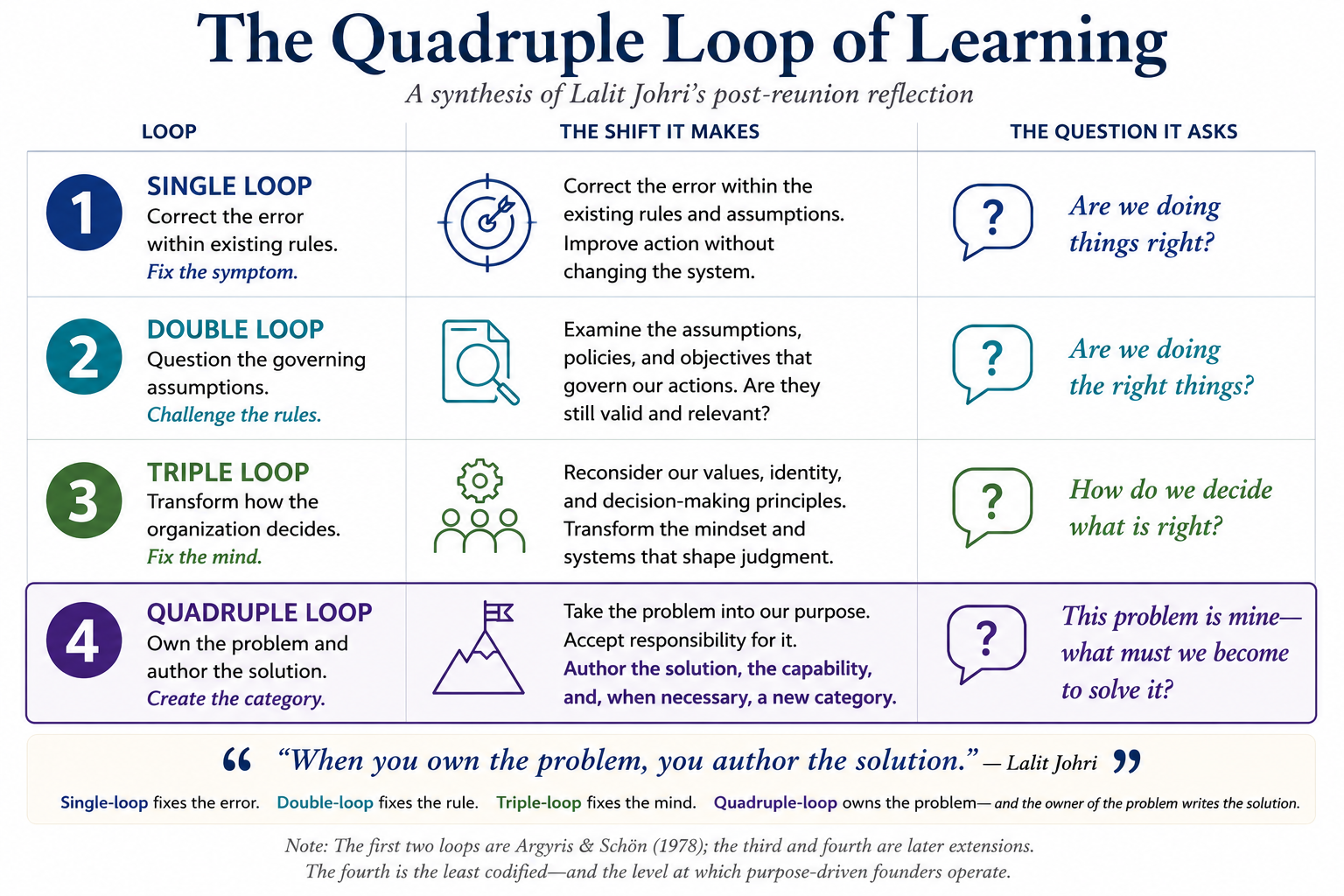
In another post-reunion reflection, Lalit described learning as a progression through increasingly demanding forms of responsibility. Single-loop learning corrects errors within existing rules. Double-loop learning questions the assumptions governing those rules. Triple-loop learning asks how an organization determines what is right. At the fourth loop, the relationship between learning and responsibility changes more fundamentally.
“When you own the problem, you author the solution,” Lalit wrote.
Quadruple-loop learning begins when leaders stop asking only how to improve existing systems and accept responsibility for problems that must become part of their purpose. In Lalit’s formulation, learning at its deepest level becomes authorship: the willingness to ask not merely what should be done, but what we must become capable of doing.
The alumni continued interpreting the gathering after leaving Hua Hin. Maria turned deliberately—and playfully—to AI to create two poems from the reunion’s discussions and personalities. One described what had occurred in language that returned me to the question with which I had arrived:
“This was no conference. No retreat.
This was Oxford, finding its feet
on a beach in Hua Hin…”
The poem was generated by AI; the experiences, conversations, and judgment from which it drew were human. Its appearance returned us, in miniature, to a question we had debated throughout the reunion: what technology can produce, what people contribute, and where meaning resides.
An intellectual tradition can endure within individuals without renewing itself. People may continue to read seriously, question assumptions, exercise judgment, and lead responsibly throughout their lives. But if the capacities developed through education remain confined to those who originally received them, the tradition eventually contracts into memory.
George Molakal captured the responsibility of renewal in a single sentence:
“The greatest teachers do not create followers; they cultivate leaders who go on to build institutions and develop other leaders.”
Formation becomes generative when those who were formed begin accepting responsibility for the development of others.
By the end of our time in Hua Hin, I understood Lalit's role in the gathering differently. He had organized the program, shaped its questions and readings, and brought people together without placing himself at the center of its intellectual work. The eight sessions were chaired and facilitated by fourteen alumni. Lalit was, as he later put it with characteristic humor, among those expected to “raise your hand to speak.” He moved easily between the seriousness of the conference room and the informality of meals and conversations. He knew which people should meet. He listened. He allowed relationships to develop without managing them and questions to remain open without resolving them for us.
Kishan Nanayakkara, reflecting after he returned home, described the cumulative effect of that leadership:
“So many years, so many interactions, so many initiatives. Amazing rigor. Amazing commitment. Amazing delivery. Watching you from a distance is the greatest leadership lesson I have learnt.”
Responding to another alumnus after the reunion, Lalit described the purpose of that work in his own terms:
“For me, the greatest joy lies in seeing people and organizations grow to make a difference for humanity. I strongly believe that enabling others increases the stock of kind leaders.”
The evidence was found in what people began doing with one another.
Relationships developed among people who had not previously met. People expanded one another's understanding, offered assistance, extended invitations, and imagined future gatherings that would require their own effort to sustain.
Lalit remained important to what was happening.
He was no longer required to remain at the center of every relationship that emerged from it.
On the final evening, someone said that we should do this again.
Around the table, the suggestion became a collective appeal.
We must do this again.
Lalit smiled.
He listened, nodded, and offered no immediate commitment.
The subject returned the following day. Again, participants said that the gathering should continue. By the end, the possibility had become an intention. The significance became clearer as people began to leave.
George needed to leave in the middle of the night. He sent a message saying that he wanted to stop by and say goodbye to Vida and me. I saw it too late. The following morning, I found his reply: had he known I was awake, he would have come by, and he was sorry we had missed one another.
Before Hua Hin, George (lives in Chicago) and I (live in Nashville) had spoken once, briefly, on the telephone. Several days later in Thailand, we had formed the kind of relationship in which missing the chance to embrace and wish one another safe travels mattered.
A relationship existed where one had not existed before.
As I prepared to leave, Nav asked when I was coming to Australia. I had a place in his home. Giles and Suzanne Gunesekera extended invitations in the same spirit. After returning to Jakarta, Vittorio Molinari wrote that if any of us found ourselves in Singapore, Jakarta, or Manila, we should reach out. Vida and I invited our new friends to Nashville.
The gathering had begun with people traveling across the world because of an institution and trust in the person who invited them.
It ended with people inviting one another into their countries, homes, and lives.
The conversations continued after we left Hua Hin. Participants returned to different continents and institutions, but messages continued. Photographs were shared. Reflections, essays, poems, films, and other materials moved through the group. The physical conditions of the gathering disappeared, yet something created within them remained.
In a reflection published after the reunion, Giles Gunesekera, described what remained as a set of commitments carried back into practice.
“I left with a set of commitments that will shape the next stages of this journey: protect my attention, stay curious about change, learn continuously, lead with purpose, build trust through execution, use AI as a capability rather than a shortcut, create organisations that can adapt, balance competing interests, think beyond today’s results and leave every organisation stronger than I found it.”
The conversations had been translated into responsibilities carried beyond the gathering.
Friendship alone does not establish that an intellectual tradition has endured; meaningful relationships require no larger intellectual justification. These relationships mattered because they created pathways through which inquiry, challenge, judgment, trust, and opportunity could continue.
A conversation begun in Hua Hin could be resumed months later between people on different continents. Someone confronting an institutional problem now knew people whose countries, professions, and experiences differed from his own.
The intellectual community had expanded beyond the institution in which its members were originally formed.
Reflecting afterward on the depth of the conversations and the different backgrounds represented in Hua Hin, Lalit concluded that
“it takes a global village of leaders to continually create and share new knowledge.”
Nearly six thousand miles from Oxford, the question with which I arrived in Hua Hin had acquired a different meaning.
How do we know an intellectual tradition has endured?
Not because everyone agrees. Not because conclusions learned years earlier remain unchanged. Not because graduates achieve professional success, retain affection for an institution, or remember a teacher with gratitude.
The evidence lies in what people remain capable of doing.
They can direct attention toward questions that resist immediate answers, examine inherited frameworks without abandoning intellectual discipline, and use technology and expertise without pretending that either removes responsibility. They can exercise judgment when legitimate claims cannot be reconciled, remain open to perspectives different from their own, and create conditions in which the capacities they received remain available to others.
An intellectual tradition endures not because its conclusions survive unchanged, but because it continues to form people capable of exercising judgment when the world for which they were originally prepared has changed.
Hua Hin suggested something further.
Capacities formed within people must eventually become responsibilities exercised toward others. Those who inherit institutions, relationships, and intellectual traditions must decide whether merely to preserve what they received or to renew it through the development of others.
We came to Hua Hin because Lalit invited us.
We left inviting one another.
The difference between those two moments revealed what renewal might begin to look like.
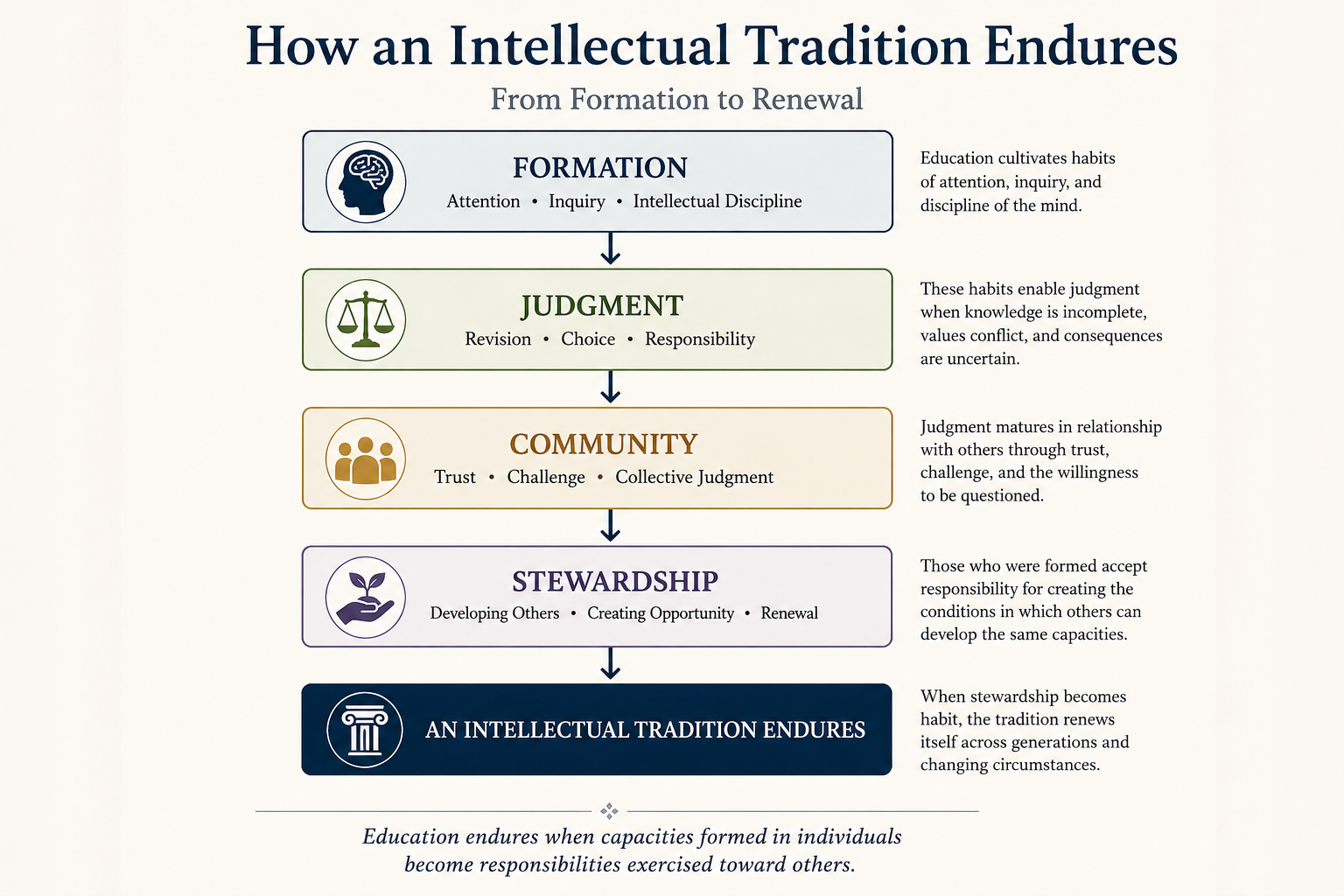
An intellectual tradition endures when those formed within it remain capable of exercising judgment in a changed world and accept responsibility for creating the conditions in which others may learn to do the same. It is renewed when inheritance becomes stewardship and those who received opportunities begin creating them for others.
What remains of an intellectual tradition, in the end, depends upon what those who inherit it are prepared to cultivate in others.
The strongest evidence of formation may be what continues to happen when the teacher is no longer at the center of the room.
The 2026 OAMLP Alumni Reunion in Hua Hin brought together Peter Lawrence, Rajesh Sharma, Kishantha Nanayakkara, Maria Zappala, Nav Sedaghati, Aditi Ghosh, George Molakal, Nathan Andrews, Kelly Keates, Shawn and Vida Mathis, Giles and Suzanne Gunesekera, Vittorio Molinari, Kay Alcantara, Jackson Lam, Lau Mei Tse, Julia Jalil, Sukanya Lee, and Lalit Johri.