
The Responsibility of Elders in the Church of Christ to Provide Global Missional Leadership

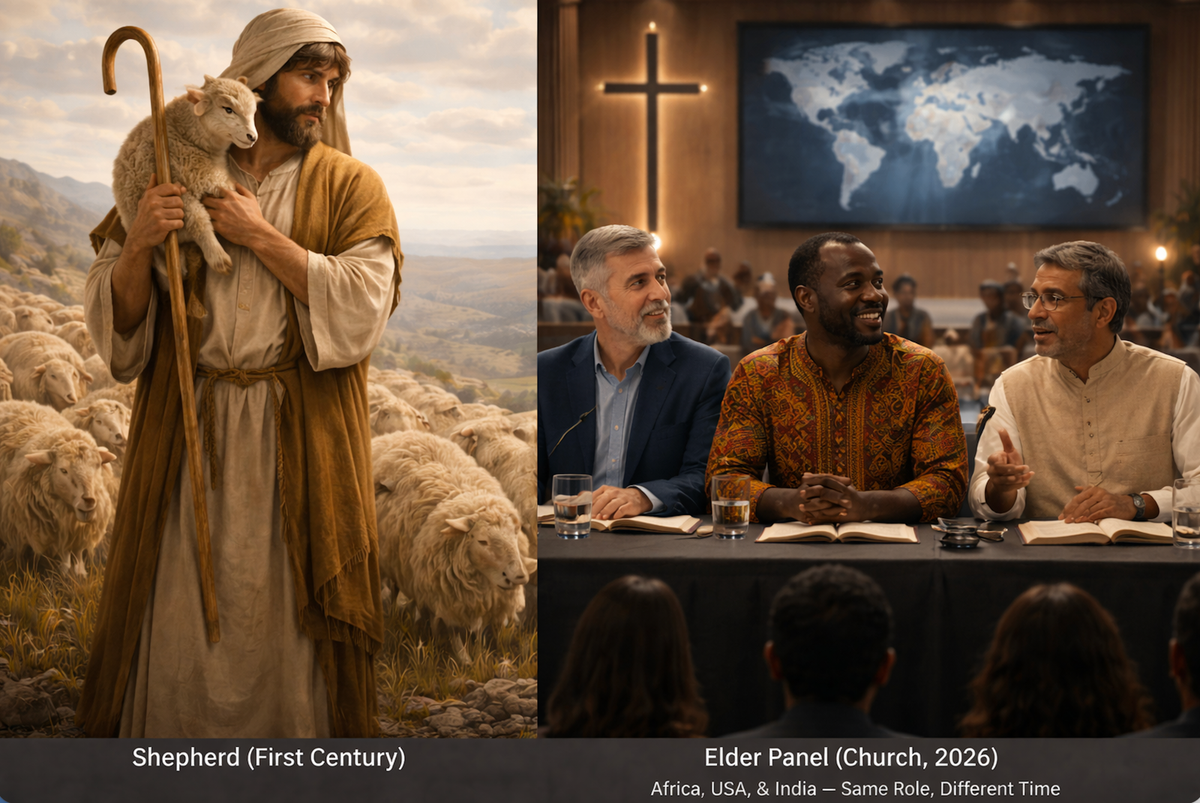
This was presented at LeadersConnect at Faulkner University in Montgomery, Alabama, on June 18, 2024, by Shawn D. Mathis, PhD.
The responsibility of elders in the Church of Christ is traditionally framed in terms of local oversight: shepherding the congregation, guarding doctrine, and ensuring the spiritual well-being of the flock. While these responsibilities remain essential, they are not sufficient in themselves when considered in light of the Church’s foundational mandate. The New Testament presents a mission that is global in scope, comprehensive in intent, and enduring in duration. Consequently, the leadership required to fulfill that mission must also be global in vision and execution.
This study argues that the New Testament provides a basis for understanding the eldership in more than narrowly local terms. While elders are ordinarily charged with local oversight, the global scope of the Church’s mission suggests that their leadership must also be shaped by missional responsibilities extending beyond the immediate congregation. This argument is grounded not primarily in modern missional theory, but in the language of Scripture, especially in key Greek terms within the Great Commission passages.
This study proceeds in two stages. First, it offers a close reading of key Greek terms within the Great Commission passages to clarify the scope and nature of the Church’s mission. Second, it develops a theological argument concerning the implications of that mission for the role of elders. While the exegetical observations establish the global scope of the mission, the application of those observations to ecclesial leadership requires theological reasoning and is presented as an inference rather than a direct lexical conclusion.
A fundamental step in understanding this responsibility is distinguishing between global leadership and indigenous leadership.
Global leadership refers to leading organizations or initiatives operating across multinational contexts. It requires navigating cultural diversity, political complexity, and economic variation while fostering collaboration across geographically dispersed teams. Indigenous leadership, by contrast, is rooted in local or regional communities and shaped by the traditions, values, and lived realities of those communities.
| Category | Global Leadership | Indigenous Leadership |
|---|---|---|
| Definition | Leadership across multinational, cross-cultural, and geographically dispersed contexts. | Leadership rooted within a local culture, community, and lived experience. |
| Primary Focus | Vision alignment, coordination, and large-scale mission strategy. | Contextual faithfulness, local ownership, and cultural relevance. |
| Strengths |
• Broad perspective across regions • Resource mobilization • Strategic coordination |
• Deep cultural understanding • Trust within the community • Sustainable local leadership |
| Risks |
• Cultural distance • Imposing external models • Over-centralization |
• Limited global awareness • Isolation from wider mission • Resource constraints |
| Time Horizon | Long-term, multi-region planning. | Immediate and generational within a specific context. |
| Leadership Task | Integrate global mission strategy and maintain unity across contexts. | Apply truth faithfully within cultural realities and develop local disciples. |
| Best Outcome | Integration of both: globally aligned vision with locally faithful execution. | |
Effective mission leadership requires both global coordination and indigenous ownership working together.
These two forms of leadership are not mutually exclusive. Rather, they are interdependent. Effective missional leadership requires elders to think globally while empowering leadership locally.
The Church’s global mission is realized through indigenous expressions of faith, while local leadership is strengthened through broader vision and support.
Both forms of leadership share essential characteristics: cultural intelligence, ethical integrity, adaptability, and a commitment to community well-being. Yet global leadership introduces an additional layer of complexity—requiring coordination across nations, systems, and cultures while maintaining unity in purpose and doctrine.
Having established the scope of the Church’s mission, it is necessary to consider the resources and competencies required to sustain it.
Capacity is quantitative, referring to the resources available to the Church—financial, personnel, infrastructural, and organizational. It raises practical questions: How far can the Church go? How many regions can it sustain? What scale of missionary work is possible?
Capability, by contrast, is qualitative, referring to the ability to carry out the mission faithfully and effectively. It asks, "Do elders understand Scripture deeply?" Do they grasp the seriousness of the Great Commission? Are they equipped to lead across cultures and contexts?
This distinction is critical. A church may possess capacity without capability, resulting in ineffective or misguided mission efforts. Conversely, it may possess capability without sufficient capacity, limiting its reach. Faithful global missionary leadership requires both. Together, capacity and capability inform mission readiness.
Capacity (resources) and capability (leadership competence) together determine the effectiveness of global mission.
Global leadership is inherently complex, requiring navigation of cultural, political, and economic differences while fostering collaboration across geographically dispersed communities.
For elders, this means that leadership cannot remain narrowly local in perspective. Every local congregation participates in a global body—the church—and every local decision has potential global implications.
The Church’s mission is not a collection of isolated efforts but a unified endeavor composed of many interconnected parts.
Elders must thus lead with an awareness that the whole is greater than the sum of its parts, even as it depends on those parts for its realization.
The theological core of this argument is that the Great Commission presents the mission of the Church in unmistakably expansive terms.
Each Gospel account expands the scope of the mission—from nations to the ends of the earth to all creation—culminating in disciple-making across all peoples.
This claim is not merely rhetorical; it is grounded in the specific language of the New Testament.
The following analysis focuses on the language of the Great Commission passages themselves. At this stage, the aim is descriptive rather than prescriptive: to identify how the New Testament characterizes the scope and nature of the Church’s mission.
In Luke’s account, Jesus declares that repentance for the forgiveness of sins should be proclaimed in his name to all nations. The Greek verb κηρυχθῆναι (kērychthēnai) means “to be proclaimed” or “to be preached,” emphasizing public announcement. The noun ἔθνη (ethnē) refers to nations or peoples, not merely political entities but distinct ethnic and cultural groups. This understanding is widely reflected in modern lexical and exegetical scholarship, where ἔθνη is consistently interpreted as referring to peoples or ethnolinguistic groups rather than modern nation-states (BDAG; cf. Keener 2012).
Thus, the message is directed outward to all peoples, suggesting from the outset that the gospel is not confined to a single ethnic, regional, or political community.
In Acts, Jesus tells the apostles that they will be his μάρτυρες (martyres), or witnesses—those who testify to what they have seen and heard. Their witness is to extend from Jerusalem to Judea, to Samaria, and ultimately to the ἐσχάτου τῆς γῆς (eschatou tēs gēs), “the end of the earth.”
The term ἐσχάτου denotes the extreme or farthest limit, while γῆς can refer to land, region, or the inhabited world. The progression in the verse is geographical and expansive, indicating a mission that moves outward beyond its original setting toward the furthest horizons of the inhabited world.
Mark’s account intensifies this global emphasis. Jesus commands, “Go into all the world and proclaim the gospel to the whole creation.”
Several Greek terms reinforce the universality of this command:
Considered together, these terms underscore the universal scope of the commission.
The gospel is to be carried into the entirety of the inhabited world and proclaimed to every part of creation. There appears to be no explicit limitation—geographical, cultural, or social.
Matthew provides the most comprehensive formulation of the Great Commission, and the presentation gives particular attention to its Greek terminology.
Jesus begins by asserting that all authority has been given to him. The word ἐξουσία (exousia) refers to delegated authority or rightful jurisdiction. This supports the foundation of the commission: it may be understood as grounded in the universal authority of Christ.
The command to go again uses Πορευθέντες (poreuthentes), indicating movement toward a destination. The connective οὖν (oun), “therefore,” signals that the mission flows directly from Christ’s authority.
At the center is μαθητεύσατε (mathēteusate), “make disciples.” This term goes beyond conversion; it implies training, formation, and development in both belief and practice. The mission may be understood as not merely to produce believers but to cultivate disciples.
The phrase “of all nations” again includes ἅπαντα and ἔθνη, emphasizing that all peoples are to be included in the scope of discipleship.
The participles further define the process:
The inclusion of τηρεῖν is especially significant. It suggests not merely learning but safeguarding the teachings of Christ.
If this reading is correct, elders bear responsibility not only for the expansion of the Church’s mission but also for the preservation of doctrinal integrity as that mission extends across cultures and regions.
Finally, the promise of Christ’s presence extends “to the end of the age.” The terms συντελείας (synteleias), meaning completion or consummation, and αἰῶνος (aiōnos), meaning age or era, indicate that the mission continues until the culmination of history itself.
Many scholars have noted the expansive and outward-moving character of these commission texts, emphasizing that they collectively frame the Church’s mission in universal terms extending beyond any single cultural or geographic setting (Wright 2006; Bosch 1991).
| Greek Term | Meaning | Missional Significance |
|---|---|---|
| ἔθνη (ethnē) | Nations, peoples | The gospel is directed to all peoples, not one group |
| Πορευθέντες (poreuthentes) | Go, move outward | Mission is active and expanding |
| κηρύξατε / κηρυχθῆναι | Proclaim, preach | The gospel must be publicly declared |
| μαθητεύσατε (mathēteusate) | Make disciples | Mission includes formation, not just conversion |
| διδάσκοντες (didaskontes) | Teaching | Ongoing instruction is essential to discipleship |
| τηρεῖν (tērein) | Observe, preserve | Truth must be guarded as the Church expands |
| ἐξουσία (exousia) | Authority | Mission is grounded in Christ’s authority |
| συντελείας τοῦ αἰῶνος | End of the age | Mission continues until history’s completion |
These terms collectively supports the global, active, and enduring nature of the Church’s mission.
At the same time, it is important to avoid overstating the conclusions that can be drawn from lexical analysis alone. As is often noted in contemporary biblical studies, word meanings contribute to but do not by themselves determine theological conclusions, which must be grounded in broader textual and canonical contexts.
The cumulative force of these Greek terms supports several theological conclusions relevant to the Church’s mission is:
At the same time, it is important to avoid overstating the conclusions that can be drawn from lexical analysis alone. As is often noted in contemporary biblical studies, word meanings contribute to but do not by themselves determine theological conclusions, which must be grounded in broader textual and canonical contexts.
These are not incidental linguistic details. They form the exegetical foundation for understanding the Church’s global responsibility.
The mission unfolds as a unified process grounded in Christ’s authority and extending through disciple-making and preservation.
These observations establish that the mission described in the Great Commission is universal in scope, outward in movement, and enduring in duration. However, the question remains: how is this mission to be structured and led within the life of the Church? The following section moves from exegesis to theological reflection, asking what implications this understanding of mission may have for the role of elders.
If the mission is global in scope, the question of leadership becomes unavoidable.
In light of the preceding analysis, this invites the question to ask how such a globally defined mission should be reflected in the structure and leadership of the Church. While the New Testament most directly presents elders in local contexts, the global scope of the Church’s mission raises the question of how their responsibilities should also be understood in broader, missional terms.
It should be noted, however, that many interpreters understand the role of elders in primarily local terms, emphasizing passages such as Acts 14:23 and Titus 1:5, where leadership is clearly situated within individual congregations. On this reading, global mission is more directly associated with apostolic or evangelistic functions rather than the eldership.
The present study does not reject this local emphasis, but argues that it may be insufficient if considered in isolation from the global scope of the Church’s mission. Instead, it proposes that the eldership should be understood as locally grounded but globally oriented, participating in a mission that extends beyond the immediate congregation.
The argument advanced here is theological rather than purely lexical: if the mission entrusted to the Church is global in scope, then its leadership must be capable of sustaining and guiding that mission beyond purely local concerns.
Elders may be understood not merely as local caretakers, but as leaders whose responsibilities include aligning the Church’s structures, resources, and practices with the global scope of Christ’s command.
They must:
Every global endeavor is composed of many local parts. Thus, elders must lead both globally and locally, recognizing that faithful local leadership contributes to the fulfillment of a global mandate.
This proposal does not deny the fundamentally local character of the eldership in the New Testament, but suggests that such local leadership participates in and contributes to a mission that is inherently global.
Effective elders lead by integrating global vision with local faithfulness.
This approach resonates with broader discussions in ecclesiology that emphasize the interdependence of local and global expressions of the Church (cf. Newbigin 1995).
This study has focused on the theological implications of the Great Commission for the eldership, and does not attempt a full historical or ecclesiological account of church leadership structures in the New Testament.
The argument of this study has been that the scope of the Church’s mission, as revealed in the New Testament, carries important implications for how leadership is understood.
The Greek text of the Great Commission presents a mission directed toward all nations, extending to the ends of the earth and encompassing all creation. It is characterized by movement, proclamation, discipleship, instruction, and preservation, and it continues until the completion of the age.
If this reading is sound, then the leadership of the Church must be understood in relation to the demands of such a mission. Elders, while rooted in local congregations, may be understood as participating in a broader framework of responsibility that reflects the global scope of the gospel. To limit the eldership to a purely local framework risks failing to account fully for the nature of the mission entrusted to the Church.
Bosch, David J. Transforming Mission: Paradigm Shifts in Theology of Mission. Maryknoll, NY: Orbis Books, 1991.
Keener, Craig S. Acts: An Exegetical Commentary. Grand Rapids: Baker Academic, 2012.
Newbigin, Lesslie. The Gospel in a Pluralist Society. Grand Rapids: Eerdmans, 1995.
Wright, N. T. The Mission of God’s People. Grand Rapids: Zondervan, 2006.
Danker, Frederick W., ed. A Greek-English Lexicon of the New Testament and Other Early Christian Literature (BDAG). 3rd ed. Chicago: University of Chicago Press, 2000.