The House of Javert: Les Misérables, Kant, and the Moral Crisis of the 2026 Corporation


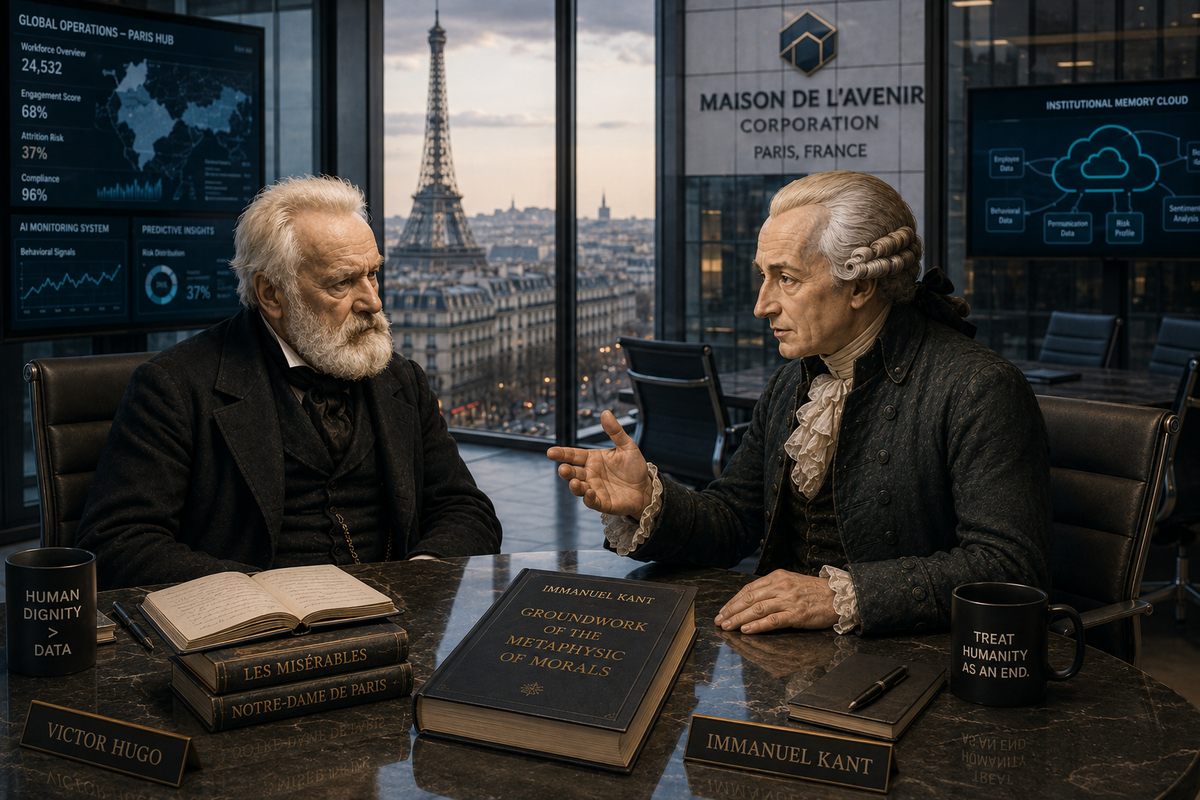
Author’s Note: Few novels contain so much of civilization within them as Les Misérables: theology, revolution, bureaucracy, poverty, law, mercy, memory, and the strange persistence of human dignity beneath the machinery of history. It is not merely a story but a city of consciousness through which generations continue to wander and discover themselves anew. I commend it especially to those interested in institutions, leadership, moral judgment, and the fate of the human person in administrative ages such as our own.
The modern corporation increasingly resembles one of Victor Hugo’s vast and haunted cityscapes: illuminated, labyrinthine, morally anxious, and crowded with systems that know how to classify human beings long before they know how to understand them. It is as though the gaslight of nineteenth-century Paris has merely changed its temperature and become the cold fluorescence of the compliance floor.
One suspects that if Hugo were to walk through the headquarters of a global technology company in 2026, he would recognize the spiritual architecture immediately. The uniforms would be gone; the bureaucracy would remain. The ledgers of the Paris police prefecture would have become cloud infrastructure. Informants would become telemetry. Dossiers would become behavioral data. Yet the central drama of Les Misérables—the struggle between administrative identity and human dignity—would persist unchanged beneath the polished surfaces of managerial civilization.
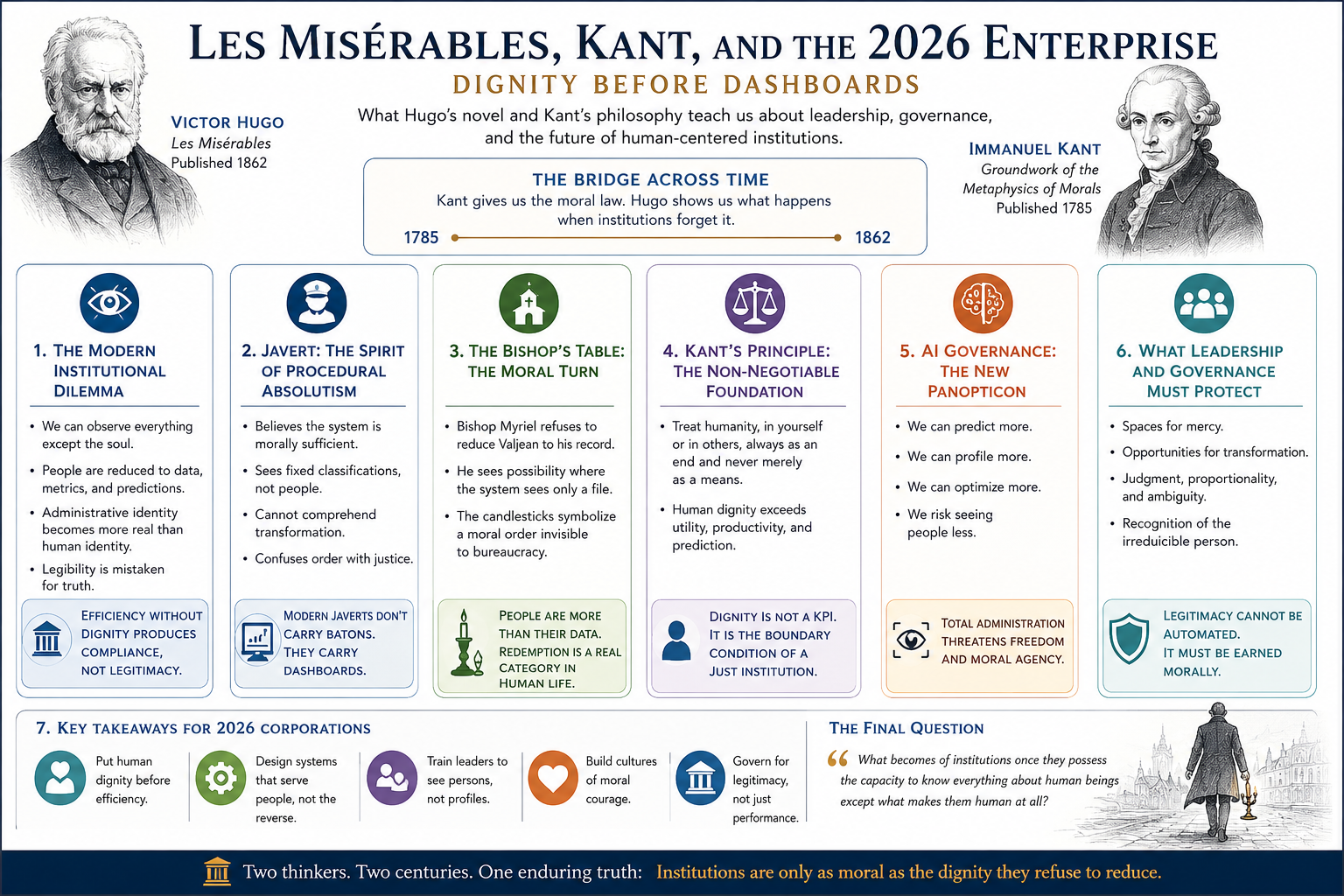
There is a deeper historical symmetry concealed beneath this resemblance. Immanuel Kant published Groundwork of the Metaphysics of Morals in 1785, at the high tide of the Enlightenment, when Europe still believed reason might furnish the architecture of moral civilization itself. Victor Hugo published Les Misérables in 1862, after revolution, empire, restoration, industrialization, and the administrative expansion of the modern state had already transformed the moral landscape of Europe. Kant formulates the principle of human dignity in philosophical abstraction; Hugo examines what becomes of that dignity once it enters the machinery of history. One writes before modern bureaucracy achieves full power. The other writes after its arrival has become impossible to ignore.
As I draft these lines listening to Franz Schubert’s Piano Trio No. 2 in E-flat major, D. 929 — particularly the second movement, Andante con moto — I am reminded that Schubert belonged to almost precisely the same Europe from which Hugo emerged: a continent of ministries, cafés, police files, salons, cholera, censors, revolutions, and exhausted grandeur. One feels, listening to the trio, that the old moral and religious languages of Europe are still faintly audible, though already receding behind the advancing machinery of administration and modernity. The movement advances with an almost procedural inevitability, grave and processional, as though some vast institution were quietly continuing its work long after everyone inside it had forgotten why it was built. Yet above this movement rise melodic lines of extraordinary tenderness and humanity. The music continually stages a conflict between system and soul, structure and personhood. One hears process below and dignity above.
The tragedy of modern organizational life is that institutions increasingly possess the technical capacity to observe everything except the soul. The corporation can now measure responsiveness, map communication flows, score engagement, predict attrition, analyze tone, evaluate influence, monitor productivity, and generate probabilistic judgments about future performance. The modern office, with its invisible streams of information and ceaseless murmur of electronic reporting, has become a species of secular clairvoyance.
What it struggles to perceive is the irreducible mystery of the person standing within the system. This was precisely Hugo’s fear. Beneath the emotional vastness of Les Misérables lies a profound anxiety about institutions that mistake legibility for truth. Hugo understood that once systems begin believing that the administrative category exhausts the human being, moral catastrophe follows naturally.
This is why Javert remains one of the most modern characters in literature. Javert is not merely a cruel policeman. Cruelty alone would make him too simple. Rather, he is the incarnation of procedural absolutism. He believes completely in the moral sufficiency of the system. A convict must remain a convict because institutional coherence depends upon fixed classifications. To Javert, ambiguity is intolerable because ambiguity threatens the metaphysical stability of order itself. He cannot comprehend transformation because transformation implies that the administrative record may not contain the truth of the person. Like many great bureaucrats, he suffers from a theological attachment to paperwork.
Modern corporations quietly produce and reward precisely this mentality. The contemporary Javert rarely carries a baton. More often he carries a dashboard, a governance framework, a performance calibration model, or an AI-enhanced management tool. He speaks in the language of alignment, optimization, accountability, efficiency, and consistency. He is often conscientious, intelligent, disciplined, and professionally admired. Indeed, the truly unsettling feature of the modern institution is that its most spiritually dangerous figures frequently arrive clothed in impeccable professionalism and accompanied by PowerPoint slides. Hugo understood that institutional brutality is rarely enacted by obvious villains. More often it emerges through morally sincere functionaries who confuse procedural order with justice itself.
The contemporary enterprise therefore faces a crisis that is not merely operational but philosophical. Increasingly, organizations treat human beings as administratively processable objects. Employees become “human capital.” Customers become “engagement surfaces.” Managers become vectors of performance transmission. Even executives begin to experience themselves as instruments of shareholder expectations and market narratives rather than moral agents exercising judgment. The corporation begins speaking a dialect of abstraction within which actual persons become increasingly difficult to perceive. The language of optimization quietly colonizes every dimension of institutional life until the organization no longer knows how to speak about persons except in instrumental terms.
At precisely this point, Immanuel Kant re-enters the discussion with startling relevance. Kant’s moral philosophy appears, at first glance, remote from modern corporate life. Yet his central claim cuts directly against the metaphysics underlying contemporary managerial civilization. Human beings, Kant insists, must always be treated as ends in themselves and never merely as means. It is among the most unfashionable ideas in the modern economy precisely because it places a limit upon efficiency. This is not simply a recommendation for kindness. It is a civilizational boundary condition. Kant is arguing that there exists something within the person that exceeds utility entirely. Human dignity cannot be reduced to productive value, economic contribution, behavioral predictability, or institutional usefulness.
The modern corporation struggles profoundly with this idea because corporations are, by design, systems of organized utility. They exist to coordinate labor, capital, information, and strategy toward measurable outcomes. Efficiency is not incidental to the enterprise; it is constitutive of it. Yet when efficiency ceases to be a tool and becomes a metaphysic, institutions begin dissolving the moral foundations of their own legitimacy. They become incapable of answering the oldest ethical question in political philosophy: what is a human being for? Or, to put the matter in the darker and more revealing language of the age: is there any aspect of human life that should remain unmonetized, unmeasured, and beyond managerial reach?
This is where Hugo’s novel becomes less a nineteenth-century masterpiece than a prophetic warning about the future of governance itself. The pivotal moment in Les Misérables is not the barricade, nor the chase through Paris, nor even the sewers beneath the city. It is the scene at the bishop’s table. Bishop Myriel performs an act that modern systems increasingly find unintelligible: he refuses to collapse a person into their record. When Valjean steals the silver and is returned by the police, the bishop does not deny the theft. Rather, he rejects the assumption that the theft contains the total truth of the man before him. In administrative terms, this decision is irrational. In moral terms, it is transformative. The candlesticks gleam in that scene not merely as church silver but as emblems of another order of value entirely — one invisible to bureaucracy.
What the bishop recognizes is possibility. He perceives that human beings are not exhausted by their historical data. This may, in fact, be the novel’s deepest pedagogical lesson for modern leadership. The bishop is not merely compassionate; he is perceptive. He understands that governance begins with forms of attention. Institutions become moral or inhuman according to what they are trained to notice. Javert notices infractions. The bishop notices persons. The distinction determines the fate of an entire civilization.
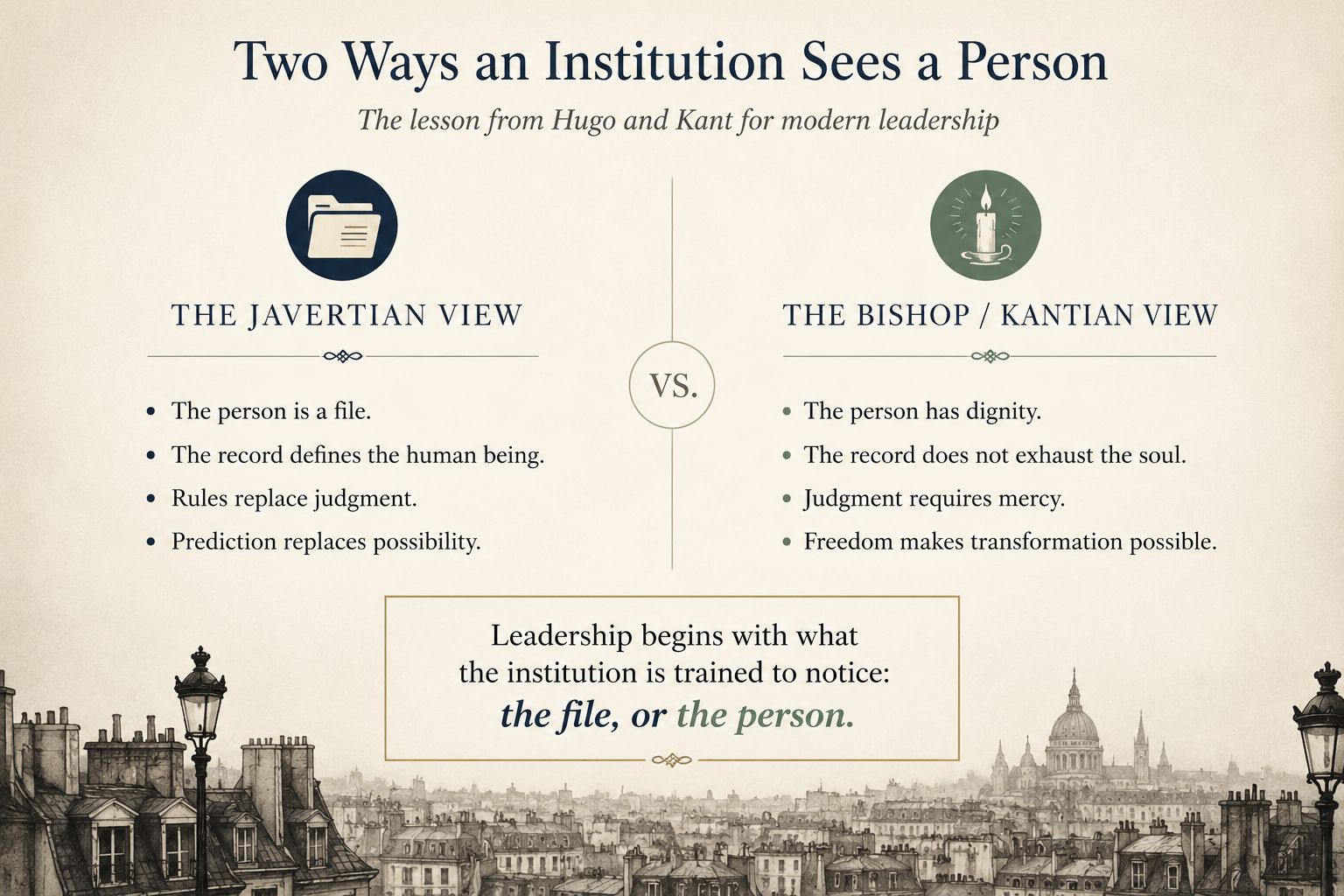
Modern corporations invest enormous resources teaching managers how to measure performance, identify risk, optimize systems, and enforce consistency. Far less attention is devoted to educating moral perception itself. Yet leadership, at its highest level, is not fundamentally administrative. It is interpretive. The executive, like the judge, teacher, priest, or statesman before him, must learn to distinguish between data and destiny.
This is why the scene at the bishop’s table functions as a practical pedagogy rather than a sentimental interruption. It teaches that humane institutions depend not merely upon better rules but upon better habits of seeing. A civilization capable only of classification eventually loses the ability to recognize transformation when it appears before it.
This distinction has become extraordinarily important in 2026 because contemporary institutions increasingly operate with permanent memory. Every mistake leaves sediment. Internal communications are archived indefinitely. Professional reputations become searchable histories. Social media preserves failures with near-liturgical permanence. AI systems ingest behavioral traces continuously, generating increasingly stable identity models from accumulated patterns. Modernity has constructed what the medieval Church once only imagined: an earthly apparatus approaching omniscience. The result is an emerging civilization of reputational determinism in which individuals struggle to escape earlier versions of themselves.
Hugo would have regarded this as spiritually disastrous. The moral architecture of Les Misérables depends entirely upon the possibility that a person may become more than their institutional designation. Jean Valjean is meaningful precisely because he cannot be adequately explained by his file. Once organizations lose the ability to recognize this truth, they become incapable of genuine moral judgment. They can still enforce compliance. They can still maintain efficiency. They can still produce quarterly growth. What they cannot produce is legitimacy. And legitimacy, as every empire eventually discovers beneath its marble corridors and ceremonial language, cannot be manufactured indefinitely through procedure alone.
This crisis becomes even more acute in the age of AI governance. The emerging enterprise now possesses tools capable of predicting employee behavior with increasing sophistication. Organizations can identify “flight risks,” infer emotional states from communication patterns, analyze collaboration dynamics, and algorithmically rank promotability. The temptation is obvious: if human beings become sufficiently measurable, then management itself may eventually become an engineering problem rather than a moral practice. The fantasy of total administration, which once haunted the dreams of emperors and police ministries, now reappears disguised as software procurement.
Yet this is precisely the world Kant warns against. The reduction of persons into predictable objects within systems of causality threatens the very concept of freedom upon which morality depends. If institutions come to regard individuals primarily as behaviorally knowable entities, then moral agency itself begins to erode conceptually. The person becomes not a subject worthy of dignity but an optimization surface requiring management. The soul is translated into analytics and quietly ceases to be a soul at all.
In such a world, Javert no longer appears as a policeman wandering through nineteenth-century Paris. He becomes infrastructure. And beneath it all lies the modern conviction that everything essential may eventually be rendered calculable.
The essential question facing the corporation of 2026 is therefore not whether AI will improve productivity or whether governance systems can scale efficiently. Those are secondary questions. The deeper question is whether institutions can preserve a conception of the human being that survives optimization itself. Can organizations maintain spaces for mercy, transformation, judgment, proportionality, and moral ambiguity once systems become capable of total administrative recall? Can there remain any darkened corner of humanity untouched by the glow of the dashboard?
Hugo’s answer is neither sentimental nor naïve. Les Misérables is not an argument against institutions. Hugo was not hostile to institutions themselves; indeed, Les Misérables depends upon the possibility of lawful order. His warning concerns institutions that forget the distinction between administration and judgment. Hugo understood that societies require order, law, and governance. His warning is subtler and more difficult: institutions become morally unstable when they cease distinguishing between the person and the category. Once administrative coherence becomes supreme, legitimacy slowly decays from within. Systems grow colder. Surveillance intensifies. Language becomes managerial and euphemistic. Trust must increasingly be manufactured synthetically because authentic solidarity has disappeared. The institution continues functioning perfectly at the exact moment it begins spiritually collapsing.
Listening to Schubert while thinking about the modern corporation produces the peculiar sensation that the underlying drama has scarcely changed across two centuries. The technologies differ; the metaphysical anxieties remain intact. The ledgers have become databases. The prefecture has become the enterprise dashboard. Surveillance has shed its boots and acquired an interface. Yet the essential question persists unchanged beneath the polished surfaces of managerial civilization: can institutions preserve any conception of the human being that exceeds classification?
Kant offers the only philosophical principle capable of resisting this trajectory. Human dignity must remain prior to institutional utility. Persons cannot be exhaustively translated into metrics, records, rankings, or predictive models. The organization must remember that there exists something within the individual that exceeds managerial comprehension. For Kant, this excess is reason and moral freedom; for Hugo, it is something closer to grace. Yet both arrive at the same forbidden conclusion: the human being possesses a value the system cannot price correctly.
This is why the candlesticks remain the central symbol of Hugo’s novel. They represent the persistence of moral recognition inside systems increasingly organized around classification. The bishop sees in Valjean something the bureaucracy cannot see because bureaucracy, by its nature, struggles to perceive transcendence. It can process behavior. It cannot fully recognize freedom. And freedom, inconveniently for every age of administration, always retains the power to surprise the ledger.
That, finally, may be the central crisis of the modern corporation. Our institutions have become extraordinarily intelligent about systems while becoming progressively less capable of recognizing persons. We measure everything except meaning. We optimize everything except moral legitimacy. We produce unprecedented organizational visibility while losing sight of the human soul standing beneath the fluorescent light of managerial civilization.
The question confronting the 2026 enterprise is therefore not merely economic or technological. It is civilizational. What becomes of institutions once they possess the capacity to know everything about human beings except what makes them human at all? One suspects Hugo already knew the answer. The city grows brighter. The hearts within it grow dimmer. And somewhere, still, Jean Valjean walks through the night carrying the candlesticks.