Scripture as Divine Speech: Authority, Inspiration, and Canon as Self-Witness (Part 1 of a six-part series)


Series Introduction
This six-part series represents the culmination of four decades of sustained study of the biblical text, with particular attention to the Greek Scriptures—both the Septuagint and the Nestle-Aland Greek New Testament. It is written from the conviction that careful, long-term engagement with the text itself remains indispensable for theological clarity, especially on questions of authority, inspiration, and canon.
Rather than approaching these doctrines primarily through later theological formulations or abstract models, this study proceeds inductively, attending closely to the language, grammar, and patterns of Scripture as it presents itself.
The argument is grounded in the textual forms that functioned most directly within early Jewish and Christian communities—the Greek Scriptures through which the New Testament authors read, cited, and interpreted the Old Testament, and through which the early church articulated its theology.
At the center of this investigation is a single question:
Across its diverse writings, Scripture consistently presents itself not merely as a record of religious experience, but as the product of divine speech—words originating in God, mediated through human agents, and preserved in written form without surrendering their authority. This series traces that claim across the canon.
This series advances a cumulative argument: Scripture presents itself not merely as testimony about God, but as the enduring means by which God speaks authoritatively to his people.
Old Testament foundations for revelation as spoken and written word.
The explicit claim that prophetic words originate in God himself.
How Scripture is received, guarded, and recognized as binding authority.
The New Testament’s use of Israel’s Scriptures as divine address.
The canon as recognized through Scripture’s own theological claims.
Authority, inspiration, and canon drawn together in a coherent doctrine.
Beginning with the Old Testament’s portrayal of divine speech and inscription, it proceeds through prophetic claims, canonical reception, and New Testament appropriation, before turning to the theological implications of Scripture’s self-witness.
The argument is cumulative and text-driven. Taken together, the biblical writings present a coherent theological vision:
that Scripture is not simply about God, but is itself the enduring, authoritative means by which God speaks.
Part 1 Introduction
Part 1 opens the series by examining the Old Testament’s foundational presentation of divine speech and written revelation, drawing primarily on the Septuagint as the textual form most directly received and employed within early Christian interpretation.
Focusing on key passages in the Pentateuch and early narrative traditions, this section argues that Scripture consistently locates authority at the level of divinely given words. From Moses’ commissioning to the inscription of the law, and from prophetic speech to covenantal restrictions on alteration, the text presents revelation as prior, determinate, and verbally mediated.
By attending closely to the Greek textual tradition, this study highlights how Scripture portrays its own origin:
not as evolving religious reflection, but as divine speech entrusted to human agents and preserved in written form.
The result is a theological framework in which the authority of Scripture is inseparable from its character as the very words of God—spoken, written, and enduring.
Textual Base and Canonical Reception
The exegetical analyses that follow work primarily with the Greek Scriptures, namely Septuaginta: Editio altera (Rahlfs–Hanhart, 2006) and Novum Testamentum Graece (Nestle-Aland, 27th ed.), rather than proceeding consistently from the Hebrew Masoretic Text. Unless otherwise noted, Old Testament citations follow Rahlfs–Hanhart, with English translations drawn from A New English Translation of the Septuagint (NETS). Citations of the Hebrew text and the New Testament follow Biblia Hebraica Stuttgartensia and NA27, respectively.
| Text / Edition | Role in the Study | Function |
|---|---|---|
| Septuaginta: Editio altera (Rahlfs–Hanhart) | Primary Old Testament Greek base | Main exegetical frame for Old Testament analysis |
| A New English Translation of the Septuagint (NETS) | Primary English translation reference | Translation support for Greek Old Testament citations |
| Biblia Hebraica Stuttgartensia | Hebrew control text | Consulted where Hebrew lexical or syntactic features matter directly |
| Novum Testamentum Graece (NA27) | Primary New Testament Greek base | Textual basis for New Testament citations and analysis |
This study privileges the Greek textual forms most directly received, cited, and interpreted in early Christian theological reflection.
This methodological decision reflects not a diminished regard for the Hebrew Bible but a deliberate focus on the canonical forms of Scripture as received, cited, and interpreted within the New Testament and the early Christian church, including Jewish-Christian communities. Because this study concerns Scripture’s self-witness to authority within the Christian canon, priority is given to the textual forms that functioned normatively in apostolic proclamation and early Christian theology.[1] Where Hebrew lexical or syntactic features bear directly on the argument, they are addressed explicitly; nevertheless, the primary exegetical frame remains the Greek texts through which Scripture’s authority was most directly mediated in early Christian interpretation and reception. This canonical focus is therefore not merely historical but theological, insofar as the argument concerns Scripture’s authority as it functioned within the life of the church.
Old Testament Witness to Divine Speech and Written Revelation
The argument of Part 1 moves along a clear theological line: divine speech is given, mediated, inscribed, preserved, and received as binding authority.
The Old Testament consistently presents divine revelation as articulated speech originating in God and mediated through human agents, with repeated emphasis on the words themselves as the vehicle of authority. From the earliest narratives of Israel’s formation, God is depicted not merely as inspiring religious insight but as supplying the very words to be spoken.
| Passage | Key Phrase | Theme | Theological Force |
|---|---|---|---|
| Exodus 4:10–12 | “I will open your mouth” | Divinely given speech | Prophetic authority originates in God, not in rhetorical capacity |
| Exodus 24:4 | “Moses wrote all the words of the Lord” | Inscription of revelation | Writing preserves divine utterance in textual form |
| Exodus 31:18; 32:16 | “Written by the finger of God” | Divine authorship | The written law participates in the authority of its divine source |
| Numbers 22:38 | “That word I will speak” | Prophetic constraint | The prophet is bound to prior divine speech |
| Deuteronomy 4:2 | “You shall not add … nor take away” | Bounded revelation | The revealed word is delimited and not subject to alteration |
| Deuteronomy 18:18 | “I will put my words in his mouth” | Divine origin of prophecy | Prophetic speech derives from God’s own words |
| Deuteronomy 29:29 | “The secret things … the things revealed” | Boundary of revelation | Revelation defines the sphere of covenantal responsibility |
| Deuteronomy 31:24–26 | “As a witness” | Book of the law as covenant witness | Written Scripture stands as a public, enduring standard over the community |
In Exodus 4:10–12, Moses’s protest concerning his inability to speak is met by God’s assurance that he will open Moses’s mouth and instruct him what to say (ἐγὼ ἀνοίξω τὸ στόμα σου καὶ συμβιβάσω σε ὃ μέλλεις λαλῆσαι, Exod. 4:12). The narrative thereby establishes a theological paradigm in which prophetic authority derives not from innate capacity, rhetorical skill, or personal charisma, but from divinely supplied speech. The prophet’s words are presented as determined by prior divine instruction, grounding their authority in God’s own communicative initiative.[2] The aorist verb ἔγραψεν presents inscription as a definite historical act, marking the preservation of divine utterance in written form. Framed in language that anticipates later prophetic and New Testament formulae, the passage presents writing as a divinely authorized mode of revelation rather than a secondary record.[3]
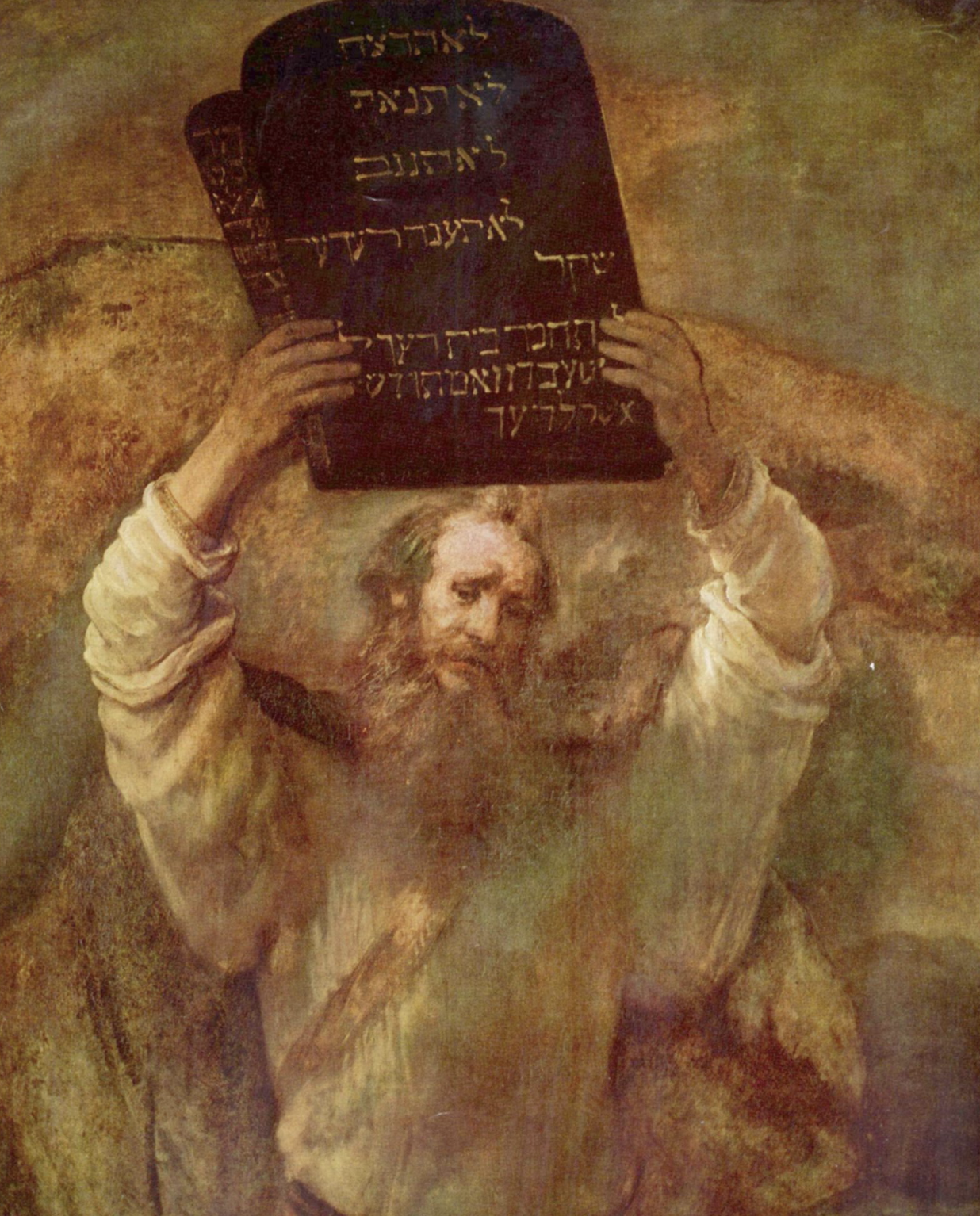
The materiality of divine authorship is further intensified in Exodus 31:18 and 32:16, where the tablets of the covenant are described as written “by the finger of God” (γεγραμμένα τῷ δακτύλῳ τοῦ θεοῦ, Exod. 31:18).[4] They are further identified as the very “work of God,” bearing writing engraved by God himself (ἔργον θεοῦ … γραφὴ θεοῦ κεχαραγμένη, Exod. 32:16).[5] These descriptions are not incidental metaphors but function theologically to anchor Israel’s law in divine agency rather than human legislation. The text insists that the written form of the law participates in the authority of its divine source, thereby resisting any sharp separation between revelation and inscription.[6] The text insists that the written form of the law participates in the authority of its divine source, thereby resisting any sharp separation between revelation and inscription.
A similar emphasis appears in the Balaam narratives (Num. 22:38; 23:5, 12, 16, 26), where a reluctant prophet is repeatedly constrained to speak only the words that God places in his mouth (τὸν λόγον ὃν ἂν ἐμβάλῃ ὁ θεὸς εἰς τὸ στόμα μου, τοῦτον λαλήσω, Num. 22:38).[7] These texts collectively insist that divine authority is not diminished but stabilized by inscription. Here, prophetic fidelity is measured not by intention or sincerity but by conformity[8] to a prior and delimited utterance, reinforcing the claim that God’s word precedes and governs human proclamation.[9] The text insists that the written form of the law participates in the authority of its divine source, thereby resisting any sharp separation between revelation and inscription.
Deuteronomy gathers these themes into a sustained theological reflection on revelation, authority, and obedience. Deuteronomy 4:2 explicitly prohibits adding to or subtracting from the commanded word, thereby treating the revealed text as a bounded and sufficient disclosure whose authority is compromised by alteration (οὐ προσθήσετε … οὐδὲ ἀφελεῖτε, Deut 4:2).[10] Moses’ mediating role is carefully delimited: he stands between God and the people to declare “the word of the LORD” (τὸν λόγον κυρίου, Deut 5:5),[11] yet the words themselves remain God’s possession rather than Moses’ interpretive extension. This logic reaches a climactic formulation in Deuteronomy 18:18–19, where God promises to raise up a prophet like Moses and to put His own words into that prophet’s mouth (δώσω τὰ ῥήματά μου ἐν τῷ στόματι αὐτοῦ, Deut 18:18),[12] holding the people morally accountable for their response to those words. Revelation is thus construed as divine speech entrusted to human agents without being surrendered to human control or modification.[13]
Finally, Deuteronomy 29:29 articulates the epistemic and covenantal boundary[14] of revelation: “the secret things belong to the LORD our God, but the things revealed belong to us and to our children forever” (τὰ κρυπτὰ κυρίῳ τῷ θεῷ ἡμῶν, τὰ δὲ φανερὰ ἡμῖν καὶ τοῖς τέκνοις ἡμῶν εἰς τὸν αἰῶνα, Deut. 29:29).[15] What is revealed is given not for speculation but for obedience, and its permanence is secured through written preservation.
“The secret things belong to the LORD our God, but the things revealed belong to us and to our children forever.”
What God has reserved to himself. These are not the measure of covenant obligation, nor the proper ground of speculative authority.
What God has disclosed for the life of his people. These are given publicly, preserved enduringly, and bound to obedience across generations.
The text marks a theological boundary: authority rests not in what remains hidden, but in what God has actually revealed.
This concern for the bounded preservation of revealed divine speech is enacted concretely in Deuteronomy 31:24–26, where, once Moses had finished writing the words of the law in a book, the book is placed beside the ark of the covenant as a witness against Israel (ἐν τῷ τελέσαι Μωυσῆς γράφων πάντας τοὺς λόγους τοῦ νόμου … λήμψεσθε τὸ βιβλίον τοῦ νόμου τούτου … εἰς μαρτύριον, Deut. 31:24–26).[16] Scripture is thereby located at the heart of Israel’s communal life as an enduring, external standard that judges leaders and people alike. Read cumulatively, these passages present a robust Old Testament theology of inspiration in which divine authority is mediated through spoken words, stabilized through
References
[1] For discussion of the Septuagint as a primary scriptural medium of early Christian exegesis and theological reasoning, see Martin Hengel, The Septuagint as Christian Scripture (Edinburgh: T&T Clark, 2002), 1–32; and Karen H. Jobes and Moisés Silva, Invitation to the Septuagint, 2nd ed. (Grand Rapids: Baker Academic, 2015), 17–41.
[2] καὶ ἔγραψεν Μωυσῆς πάντα τὰ ῥήματα κυρίου (Exod. 24:4), “And Moses wrote all the words of the Lord.” The aorist verb ἔγραψεν presents the act of writing as a definite narrative event. In context, this formulation underscores inscription as an integral mode through which divine revelation is preserved.
[3] On the relationship between divine speech and prophetic mediation in Exodus, see Brevard S. Childs, The Book of Exodus: A Critical, Theological Commentary (Philadelphia: Westminster Press, 1974), 86–89. Childs notes that Moses’ authority is grounded not in charisma but in divinely authorized speech.
[4] γεγραμμένα τῷ δακτύλῳ τοῦ θεοῦ, “written by the finger of God” (Exod. 31:18; trans. author). The perfect participle emphasizes the completed and authoritative character of the inscription as a divine act.
[5] ἔργον θεοῦ … γραφὴ θεοῦ κεχαραγμένη, “the work of God … the writing engraved by God” (Exod. 32:16; trans. author). The appositional phrasing reinforces divine authorship at both the level of content and material production.
[6] For the theological significance of divine inscription imagery, see Moshe Weinfeld, Deuteronomy and the Deuteronomic School (Oxford: Clarendon Press, 1972), 193–95. The “finger of God” motif functions to exclude human authorship at the level of authority, even while human mediation remains operative.
[7] τὸν λόγον ὃν ἂν ἐμβάλῃ ὁ θεὸς εἰς τὸ στόμα μου, τοῦτον λαλήσω, “The word that God puts into my mouth, that I will speak” (Num. 22:38; trans. author). The demonstrative τοῦτον (“this”) resumes and restricts the relative clause, underscoring the prophet’s obligation to utter only the divinely supplied word. See also Num. 23:5, 12, 16, 26.
[8] On the emphasis on divinely given words in prophetic commissioning narratives, see Moshe Weinfeld, Deuteronomy 1–11, AB 5 (New York: Doubleday, 1991), 180–85; and Christopher R. Seitz, Prophecy and Hermeneutics (Grand Rapids: Baker Academic, 2007), 31–45.
[9] On the Balaam narratives as a commentary on prophetic constraint and verbal fidelity, see Baruch A. Levine, Numbers 21–36, Anchor Bible 4A (New York: Doubleday, 2000), 166–72. Levine emphasizes that Balaam’s inability to deviate from God’s words underscores a theology of compelled speech.
[10] οὐ προσθήσετε πρὸς τὸν λόγον … οὐδὲ ἀφελεῖτε ἀπ’ αὐτοῦ, “You shall not add to the word … nor take away from it” (Deut 4:2; trans. author). The paired future prohibitions, governed by opposing prepositions (πρός / ἀπό), construe the revealed word as a closed and delimited entity whose integrity is violated by either expansion or reduction.
[11] τὸν λόγον κυρίου, “the word of the LORD” (Deut 5:5; trans. author). The singular formulation underscores that Moses’ role is declarative rather than generative: he mediates a word that already belongs to God and does not extend or modify its content.
[12] δώσω τὰ ῥήματά μου ἐν τῷ στόματι αὐτοῦ, “I will put my words in his mouth” (Deut 18:18; trans. author). The first-person divine subject and possessive pronoun (ῥήματά μου) emphasize that prophetic speech originates in God’s initiative and authority, not in the prophet’s interpretive discretion.
[13] For Deuteronomy’s theology of revelation and prophetic succession, see Patrick D. Miller, Deuteronomy, Interpretation (Louisville: Westminster John Knox, 1990), 64–69, and J. G. McConville, Deuteronomy, Apollos Old Testament Commentary (Downers Grove, IL: IVP Academic, 2002), 321–26.
[14] By "boundary" Deuteronomy 29:29 marks a divinely instituted distinction between what God has chosen to disclose and what God has reserved to himself—a boundary that regulates not the scope of obedience but the locus of human responsibility and authority.
[15] τὰ κρυπτὰ κυρίῳ τῷ θεῷ ἡμῶν, τὰ δὲ φανερὰ ἡμῖν καὶ τοῖς τέκνοις ἡμῶν εἰς τὸν αἰῶνα, “The secret things belong to the LORD our God, but the things revealed belong to us and to our children forever” (Deut. 29:29; trans. author). The contrast between τὰ κρυπτὰ and τὰ φανερὰ marks a divinely instituted boundary between undisclosed divine knowledge and covenantally binding revelation.
[16] ἐν τῷ τελέσαι Μωυσῆς γράφων πάντας τοὺς λόγους τοῦ νόμου τούτου εἰς βιβλίον, “When Moses finished writing all the words of this law in a book” (v. 24); λήμψεσθε τὸ βιβλίον τοῦ νόμου τούτου … καὶ ἔσται ἐκεῖ εἰς μαρτύριον, “You shall take this book of the law … and it shall be there as a witness” (vv. 25–26) (Deut. 31:24–26; trans. author). The placement of the written law beside the ark formalizes its role as an enduring covenantal witness rather than a merely archival record.