Hermeneutics Before Theory: How the Greeks Invented Interpretation


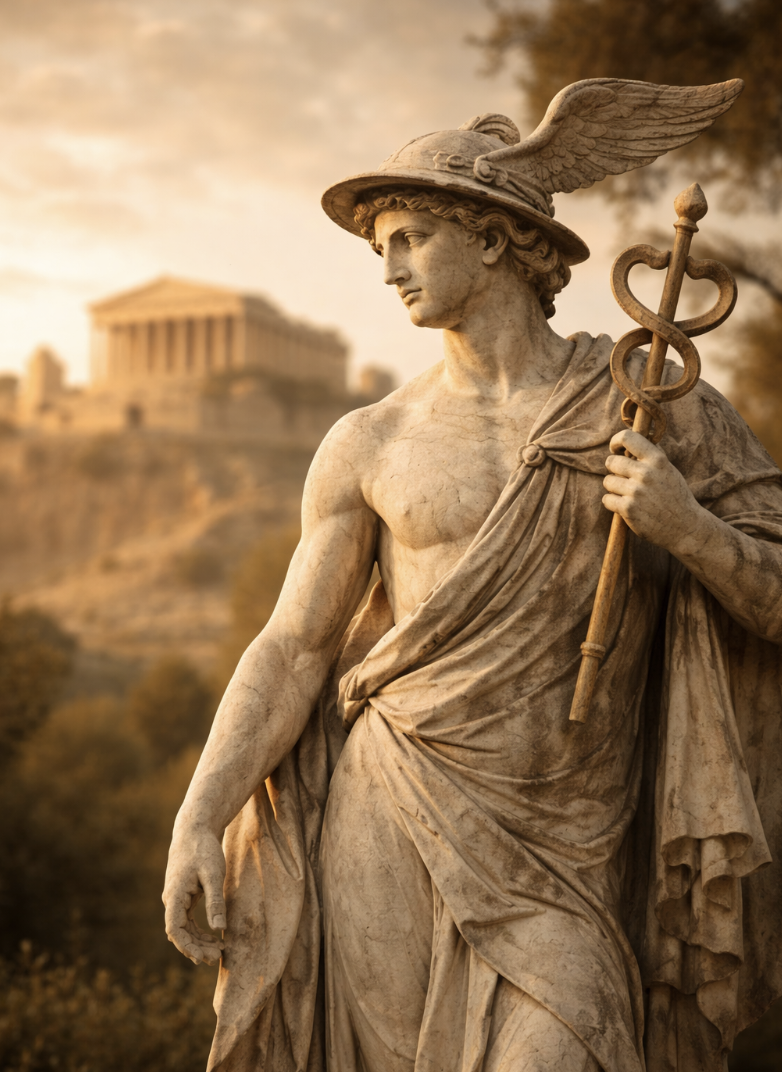
Hermeneutics is often treated as a philosophical discipline—a theory about how we understand texts, meaning, and experience. But this is not where it begins.
Long before it became a theory, hermeneutics was something people did.
It emerged wherever meaning was not immediately clear—where language failed, where cultures met, where divine messages needed explanation, and where human beings struggled to make sense of the world.
At its core, hermeneutics begins not in philosophy, but in mediation.
Hermeneutics begins as the act of making meaning intelligible across distance.
In the ancient Greek world, interpretation first appears in a practical form: translation.
When Greeks encountered foreign peoples, communication depended on interpreters—figures who stood between languages and cultures. These interpreters were not simply translators of words. They were mediators of meaning.
They made exchange possible where it would otherwise break down.
But their role was not neutral. They occupied an ambiguous position, necessary to both sides, yet belonging fully to neither. From the beginning, interpretation carried with it tension, uncertainty, and the problem of trust.
Greek tragedy expands this idea in a striking way.
Here, the interpreter is no longer just a translator between people, but a mediator between gods and mortals. Figures like Prometheus or the prophet Teiresias reveal what would otherwise remain hidden—the will of the gods, the meaning of an oracle, the truth behind appearances.
Interpretation becomes something more than communication. It becomes disclosure.
And yet, the everyday meaning remains. Messengers, too, are interpreters. The same word applies to both the bearer of divine truth and the carrier of ordinary speech.
Interpretation moves fluidly between the sacred and the ordinary.
This structure becomes especially clear in the transmission of Homeric poetry.
Homer’s epics were not simply read. They were performed—brought to life by rhapsodes, “stitchers of song,” who recited and interpreted them before audiences.
These performers did not create the poetry. They carried it.
In Plato’s Ion, the rhapsode stands between poet and audience, forming part of a chain through which meaning flows. The poet inspires the performer, the performer delivers the poem, and the audience receives it.
Interpretation, here, is not optional. It is the condition under which meaning reaches anyone at all.
Meaning does not travel directly—it moves through interpreters.
With Plato, interpretation becomes something to think about.
He asks: what is the interpreter actually doing?
The surprising answer is that interpretation may not be grounded in knowledge at all. The interpreter does not necessarily understand in a technical sense. Instead, he participates in a process—receiving and transmitting meaning.
Aristotle takes a different path. For him, interpretation becomes tied to language itself. It is the act of expressing thought in words, of making meaning explicit.
But even here, something of the earlier sense remains. Interpretation still involves movement—carrying meaning from one form to another.
Interpretation is not confined to literature or philosophy.
In medicine, the physician reads symptoms as signs of hidden conditions. The body becomes something to interpret—a field of meaning that must be deciphered.
In rhetoric, the speaker acts as a mediator, translating complex or elevated ideas into forms that others can grasp.
Across these domains, interpretation appears again and again—not as theory, but as practice
Wherever meaning is not immediate, interpretation begins.
When we step back, a pattern emerges.
Across different areas of ancient life, hermeneutics consistently refers to one thing:
the work of mediation.
In every case, interpretation exists because meaning does not simply present itself. It must be carried, translated, or revealed.
Hermeneutics did not begin as a philosophy of understanding.
It began as a response to a problem:
meaning is never fully immediate.
There is always distance—between speaker and listener, sign and significance, origin and reception. And wherever that distance appears, interpretation becomes necessary.
Only later does hermeneutics become a theory.
At the beginning, it is something far more fundamental:
Hermeneutics is the human effort to make meaning intelligible across boundaries.
Before it was ever a discipline, hermeneutics was a condition of life.
It arose wherever communication faltered, wherever meaning was unclear, and wherever someone had to step in between—to interpret, to translate, to make sense.
In that sense, hermeneutics is not simply about texts.
It is about the very possibility of understanding.