Hermeneutics, Authority, and the Enduring Contribution of D. R. Dungan


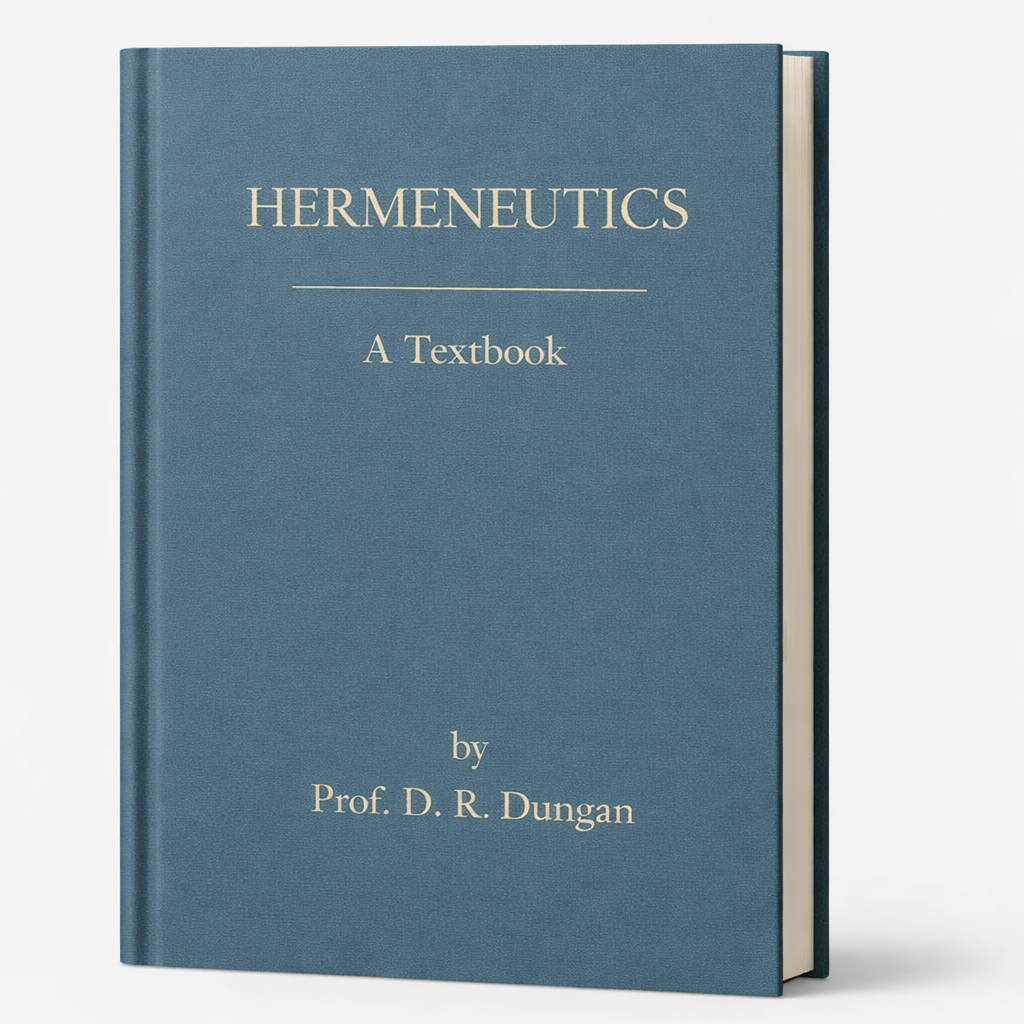
The question of hermeneutics—how Scripture is interpreted and applied—stands at the center of ecclesial identity in the Churches of Christ. Few figures have shaped this conversation more decisively than D. R. Dungan. His articulation of a disciplined, pattern-oriented approach to Scripture provided a framework that has guided generations of believers in their pursuit of biblical faithfulness. Far from being a relic of the past, Dungan’s work—Hermeneutics: A Text-Book (1888)—remains a vital resource for the present—especially as the church seeks to navigate contemporary challenges in leadership, authority, and governance.
Dungan’s hermeneutical method as the foundation for a richer and more mature ecclesial practice
At the same time, the current moment invites not a rejection of Dungan’s method, but a constructive retrieval and expansion of it. The hermeneutical tradition he helped establish contains within it the seeds of a richer, more integrated approach—one capable of sustaining both doctrinal fidelity and institutional wisdom.
Dungan’s contribution emerged within the intellectual and ecclesial context of the nineteenth-century Restoration Movement. His central method—later summarized as Command, Example, and Necessary Inference (CENI)—sought to provide a clear and rational means of discerning biblical authority.
By identifying how Scripture communicates normatively, Dungan offered the church a way to move beyond subjective interpretation and ground its practices in the text itself.
This approach reflected a deep commitment to the authority of Scripture and the unity of the church. In a fragmented religious landscape, Dungan’s hermeneutic functioned as a stabilizing force, enabling congregations to pursue a shared vision of faithfulness without reliance on creeds or centralized authority structures.
Importantly, Dungan did not intend his method to flatten Scripture but to honor its integrity. His emphasis on commands, examples, and inferences was an attempt to take seriously the various ways in which the biblical text instructs its readers.
As such, his work should be understood not as reductionistic but as an effort toward clarity, coherence, and accountability.
Over time, Dungan’s approach became deeply embedded in the life of the Churches of Christ. It shaped preaching, teaching, and congregational decision-making, forming what might be called an interpretive culture. This culture emphasized careful reasoning, attentiveness to biblical detail, and a shared commitment to doing only what Scripture authorizes.
Such formation yielded significant strengths. It cultivated a people deeply committed to Scripture, wary of innovation for its own sake, and dedicated to preserving the integrity of apostolic teaching. It also reinforced the principle of congregational autonomy, ensuring that authority remained rooted in the text rather than in external institutions.
Hermeneutical practices do more than interpret Scripture—they shape the very life of the community. In this respect, Dungan’s influence has been profound, contributing to a distinctive ecclesial identity marked by both conviction and continuity.
The contemporary challenges facing the church—particularly in the area of eldership and governance—do not diminish Dungan’s contribution. Rather, they highlight the need to extend and mature the interpretive framework he helped establish.
The current situation in the Churches of Christ is a hermeneutical crisis—this language should be understood constructively. It signals a moment of transition in which the church is called to deepen its engagement with Scripture.
Further,
The issue is not that Dungan’s method is flawed, but that it has sometimes been asked to function in isolation from other interpretive disciplines that can enrich and support it. Thus, the resulting contemporary milieu is one of confusion rooted in hermeneutical decisions.
Dungan’s approach provides a strong foundation, but like any foundation, it is meant to support further construction. The task before the church is to build upon that foundation in ways that remain faithful to its original intent while addressing the complexities of contemporary life.
One way forward lies in the integration of three complementary disciplines: classical philology, canonical interpretation, and moral formation.
First, classical philology enables interpreters to attend more closely to the linguistic and historical dimensions of Scripture. By engaging the original languages and contexts of the biblical text, the church can deepen its understanding of the very commands, examples, and inferences that Dungan emphasized.
Second, canonical interpretation encourages readers to see Scripture as a unified whole. Rather than approaching texts in isolation, this perspective situates individual passages within the broader narrative of God’s work. This does not replace pattern-based reasoning but enriches it, ensuring that patterns are understood within the full scope of biblical theology.
Third, moral formation highlights the formative purpose of Scripture. Dungan’s method rightly seeks to identify what Scripture authorizes, but Scripture also aims to shape who believers become. By attending to this dimension, the church can recover a more holistic vision of leadership—one that integrates character, wisdom, and responsibility.
Together, these disciplines do not compete with Dungan’s hermeneutic; they complete it. They provide the depth and texture necessary for his approach to function as part of a broader, more comprehensive engagement with Scripture.
The article’s central claim: CENI remains central, but not isolated
Nowhere is this integration more needed than in the formation of elders. The challenges facing the contemporary eldership are rooted, at least in part, in the way Scripture has been interpreted and applied. When leadership is understood primarily in terms of identifiable patterns, there is a risk of overlooking the broader theological vision that undergirds those patterns.
A constructive retrieval of Dungan’s work can help address this issue. By reaffirming the authority of Scripture while expanding the interpretive framework through which it is read, the church can develop a richer understanding of the eldership—one that includes not only qualifications and functions but also formation, accountability, and institutional wisdom.
In this sense, the path forward is not innovation but restoration in the deepest sense: a return to Scripture that is both faithful and fully attentive to its complexity.
Such a return honors Dungan’s original intent while equipping the church to meet present challenges.
It is important to emphasize that development is not the same as departure. The history of Christian interpretation demonstrates that faithful communities continually revisit and refine their hermeneutical practices. This process is not a sign of instability but of vitality.
Dungan himself worked from a deep desire to recover the “ancient order of things.” That project was never static; it involved ongoing reflection, correction, and renewal. To extend his work today is to participate in that same movement.
The goal, therefore, is not to move beyond Dungan but to move more deeply into the interpretive vision he helped inaugurate. By situating his method within a richer theological and hermeneutical context, the church can preserve its core commitments while gaining the resources needed for faithful leadership in a complex world.
D. R. Dungan’s contribution to hermeneutics in the Churches of Christ remains indispensable. His commitment to biblical authority, rational clarity, and ecclesial unity continues to shape the life of the church.
The present moment does not call Dungan's work into question but invites its renewal.
By building upon Dungan’s foundation—integrating philology, canonical reasoning, and moral formation—the church can recover a more comprehensive approach to Scripture. Such an approach will not only strengthen interpretation but also sustain the practices of leadership and governance that depend upon it.
In this way, the legacy of Dungan is not merely preserved; it is fulfilled. The hermeneutic he helped articulate becomes, once again, a living instrument for guiding the church—faithful to its origins, yet fully engaged with the demands of the present.