Alexander Campbell: Reason, Scripture, and the Intellectual Integrity of New Testament Christianity


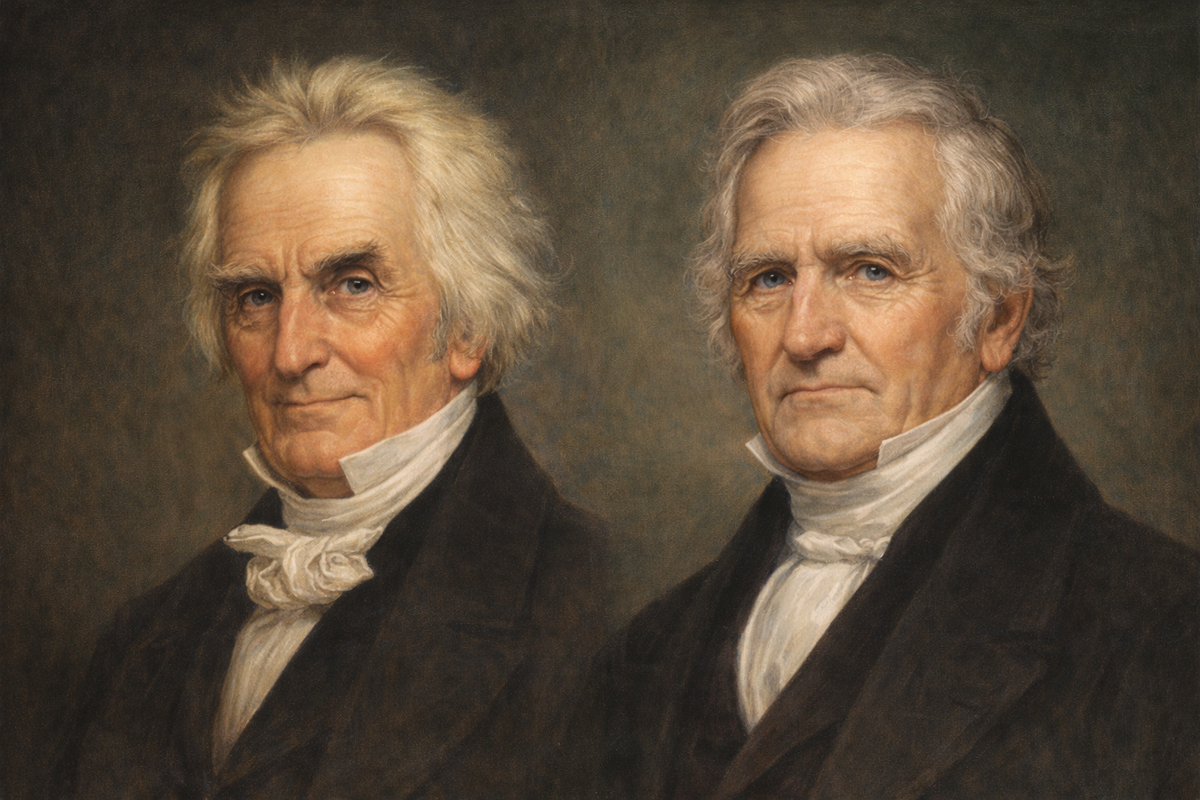
Alexander Campbell is often remembered as a religious reformer, a restorer of primitive Christianity, or a controversial frontier voice in the American religious experiment. Yet to leave him there is to miss something essential.
Campbell was, at his core, an intellectual of unusual discipline and reach—a man whose theological vision was shaped not by impulse, novelty, or mere reaction against ecclesiastical disorder, but by a serious engagement with the governing intellectual currents of his age. He stands not only as a reformer of church practice but as one of the most formidable minds in the history of the American Restoration Movement.
He belonged to a world in which reason had acquired renewed dignity, method had become a governing ideal, and human understanding was increasingly trusted as capable of discerning truth. The Enlightenment had recast reason as a legitimate authority in questions of knowledge and interpretation. Baconian thought had insisted that inquiry must proceed through a disciplined method rather than an inherited assumption. Scottish Common Sense philosophy had defended the basic reliability of ordinary human cognition against corrosive skepticism, arguing that men and women are not imprisoned in doubt, but are capable of knowing the world as it is. These were not isolated strands of thought loosely hovering about the nineteenth century.
They formed, rather, a converging intellectual inheritance—a coherent framework for approaching truth, authority, and interpretation. It was within this atmosphere that Campbell’s mind was formed, and from it that his reforming vision drew both confidence and structure.
Reason as a legitimate instrument for knowledge, judgment, and interpretation.
Truth pursued through disciplined inquiry rather than inherited assumption or premature system.
Confidence that ordinary readers, rightly disciplined, can genuinely know and understand.
What distinguishes Campbell, however, is not merely that he inherited these habits of thought, but that he brought them to bear upon the church with rare consistency. At a time when theological discourse was often bound to inherited creeds, sectarian loyalties, and speculative systems, Campbell insisted that Christianity ought to be approached with intellectual seriousness and moral candor. Scripture, he believed, was not the guarded property of clerical specialists, nor the raw material for endless abstraction. It was the proper object of disciplined inquiry, accessible to rational readers willing to attend patiently to its language, its order, and its claims.
This confidence must not be mistaken for naïve rationalism. Campbell was not proposing that reason displace revelation, nor that faith bow before the tribunal of human cleverness. His was a deeper and more chastened conviction: that truth, because it is one, cannot finally contradict itself. The God who gave Scripture is the same God who made the human mind. Therefore, the right use of reason is not hostile to faith, but serviceable to it.
Campbell’s appeal to Scripture was inseparable from his appeal to reason, and his reliance upon reason was inseparable from his submission to Scripture. He refused the false choice between the two. If God had spoken, then His Word must be intelligible; if Scripture was indeed divine communication, then it could be understood through careful reading, comparison, and disciplined reflection.
Here, the influence of the Baconian method becomes especially clear. Campbell approached Scripture not as a field for speculative invention, but as a body of material to be observed, compared, and responsibly ordered. In this respect, he sought to do in theology what Bacon had sought to do in natural philosophy:
to restrain premature system-building, to resist dogmatic overreach, and to let disciplined inquiry correct inherited error.
Campbell distrusted theological constructs that stood over the text and dictated its meaning in advance. Instead, he called for a return to the text itself—to Scripture examined patiently, interpreted contextually, and permitted to speak in its own voice. The objective was not innovation for its own sake, but recovery:
the restoration of New Testament Christianity through the careful study of the New Testament itself.
This methodological posture was reinforced by the assumptions of Scottish Common Sense realism, which underwrote Campbell’s remarkable confidence in the ordinary reader.
If human cognition is fundamentally reliable—if perception, memory, language, and judgment are not radically deceptive—then the meaning of Scripture is not hidden behind priestly mediation or reserved for academic elites.
It is accessible, at least in its essential claims, to those who approach the text with humility, discipline, and good sense. This democratizing confidence was central to the Restoration vision. The authority of Scripture did not require the sanction of a hierarchy in order to be known. It could be encountered directly by Christians willing to read with seriousness and integrity.
The implications were enormous. If Scripture is intelligible and sufficient, then religious authority cannot rest securely upon tradition alone. Creeds, confessions, and inherited systems may be useful in limited ways, but they are never beyond examination. They stand under Scripture, not beside it. Campbell’s critique of sectarianism was therefore not merely practical or emotional; it was epistemological and theological at once. The divisions of Christendom persisted, in his judgment, not because Scripture was hopelessly obscure, but because human systems had been permitted to obscure what Scripture plainly revealed.
And yet Campbell’s rigor did not collapse into reductionism.
—He did not treat the Bible as a mere compendium of detached propositions, nor Christianity as a mechanical arrangement of proof texts.
—He understood Scripture as a coherent body of divine communication, and he regarded the New Testament in particular as the normative pattern of Christian faith and practice.
—His emphasis upon New Testament Christianity was not arbitrary, still less nostalgic. It was theological.
The apostolic witness furnished the church with its authoritative form, its doctrinal center, and its practical shape. To return to the New Testament was, for Campbell, to return to the decisive revelation of Christ’s will for His people.
What emerges, then, is a portrait of Campbell as an intellectual reformer whose work was grounded in deep respect for both reason and revelation. He did not reject the intellectual gains of his age; he harnessed them. He did not fear method; he employed it. He did not distrust the capacities of human understanding; he sought to discipline them under the authority of divine speech.
At every point, however, his aim was not the enthronement of reason, but the recovery of truth. His project was not anthropocentric, but ecclesial and theological: to bring the church under the plain, sufficient, and authoritative witness of the New Testament.
This balance may well be Campbell’s most enduring contribution. In an age tempted either to dissolve faith into sentiment or to sever it from reason altogether, he insisted that Christian conviction must be at once intellectually responsible and scripturally obedient. He believed that truth is unified because its source is unified. The God who made the mind is the God who speaks in Scripture. Properly used, reason does not rival revelation; it receives, orders, and serves it.
To read Campbell in this light is to recover the seriousness of the original Restoration project. He was not merely calling for a devotional return to the Bible, nor merely advocating ecclesiastical simplification.
He was calling for a return to Scripture as the authoritative, intelligible, and sufficient norm of Christian life. His plea was at once theological and epistemological, grounded in the conviction that God has spoken clearly and that His people are capable of hearing.
It is precisely here that the present condition of many sectors of the Churches of Christ must be considered with honesty.
What is needed now is not restless innovation, nor the anxious pursuit of novelty, but recollection—an intentional return to the intellectual and theological foundations from which the movement first arose. The American Restoration Movement was not born from anti-intellectual impulse or mere sectarian protest.
At its best, it was a disciplined engagement with Scripture, reason, and the nature of Christian unity. At its center stood figures such as Alexander Campbell, his father Thomas Campbell, and others of that era whose labor combined theological conviction, methodological clarity, and unwavering submission to the authority of the New Testament.
It must be admitted that this inheritance has not always been preserved with the care it deserves. The drift has taken different forms. In some quarters, the principled rigor of early Restoration thought has hardened into a functional traditionalism—confident in inherited patterns, but detached from the reasoning that once gave those patterns coherence. In others, there has been a quiet surrender to broader theological fashions, where distinctly Restoration commitments are softened in the name of relevance, accessibility, or ecumenical ease. In both cases, the loss is more than doctrinal precision. What has been forfeited is a disciplined posture toward Scripture itself.
The original Campbell vision was not narrow, reactionary, or anti-historical. It was intellectually ambitious and spiritually serious. Thomas Campbell’s plea for unity upon the expressly revealed will of God was not minimalism, but clarity. Alexander Campbell’s insistence upon the New Testament as the church’s sufficient and normative guide was not biblicist simplification, but a carefully reasoned theological judgment. The framework that sustained this vision—reason disciplined by method, method subordinated to Scripture, and Scripture received as the church’s final authority—remains not only relevant, but urgently necessary.
To recover this inheritance is not to indulge in antiquarian sentiment. It is to remember that the church is always vulnerable to drift, whether into rigid traditionalism that has forgotten its own foundations, or into an untethered progressivism that abandons them altogether. The Campbells offer another way. They summon the church,
—to patient exegesis,
—to careful comparison of texts,
— to resistance against speculative system-building,
—and to the conviction that truth is discovered under Scripture rather than manufactured beyond it.
Above all, such recovery requires a fresh return to the New Testament itself. For the aim of the Restoration Movement was never the preservation of a party, but the restoration of a people—a community ordered by the apostolic witness to Christ. To seek New Testament Christianity afresh is not to mimic the past in superficial detail, but to recover the substance of apostolic faith: the life, teaching, authority, and pattern of Jesus Christ as mediated through the inspired Scriptures.
If the Churches of Christ are to move forward with integrity, they must first look back with seriousness. The intellectual and theological vision of Alexander Campbell and his contemporaries remains a resource of unusual depth. It calls the church to think clearly, read carefully, and live faithfully under the authority of Scripture.
The task before us, then, is neither to discard this vision nor merely to admire it, but to take it up again—deliberately, rigorously, and without embarrassment. For in doing so, we do not return merely to a man or a movement, but to the enduring claim at the heart of both: that in the New Testament, rightly understood, the church may once more hear the voice of Christ and be ordered accordingly.